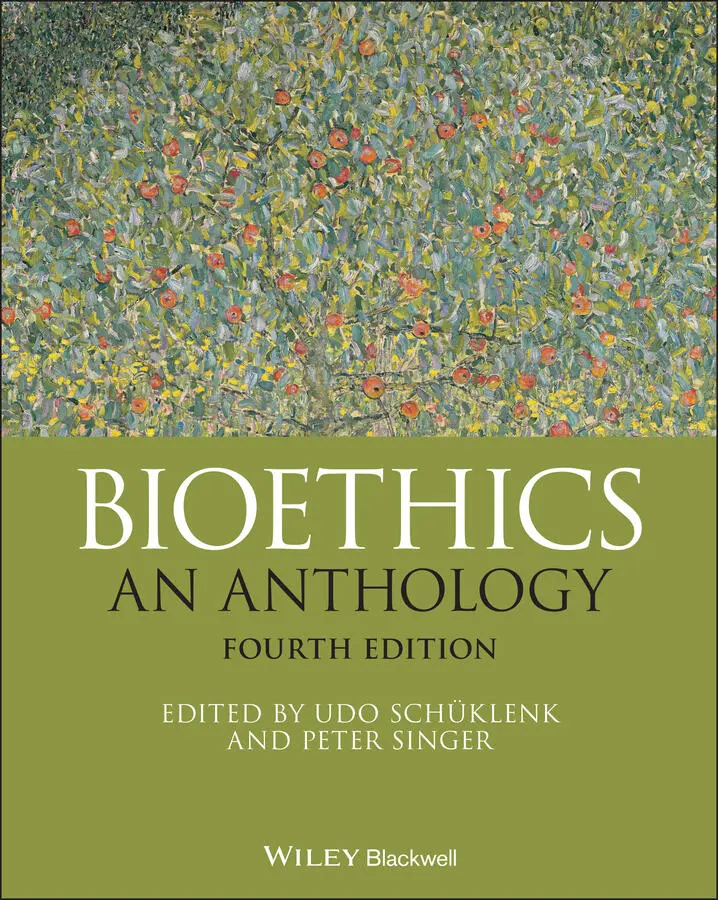
Bioethics
Здесь есть возможность читать онлайн «Bioethics» — ознакомительный отрывок электронной книги совершенно бесплатно, а после прочтения отрывка купить полную версию. В некоторых случаях можно слушать аудио, скачать через торрент в формате fb2 и присутствует краткое содержание. Жанр: unrecognised, на английском языке. Описание произведения, (предисловие) а так же отзывы посетителей доступны на портале библиотеки ЛибКат.
- Название:Bioethics
- Автор:
- Жанр:
- Год:неизвестен
- ISBN:нет данных
- Рейтинг книги:4 / 5. Голосов: 1
-
Избранное:Добавить в избранное
- Отзывы:
-
Ваша оценка:
Bioethics: краткое содержание, описание и аннотация
Предлагаем к чтению аннотацию, описание, краткое содержание или предисловие (зависит от того, что написал сам автор книги «Bioethics»). Если вы не нашли необходимую информацию о книге — напишите в комментариях, мы постараемся отыскать её.
For more than two decades,
has been widely regarded as the definitive single-volume compendium of seminal readings on both traditional and cutting-edge ethical issues in biology and medicine. Acclaimed for its scope and depth of coverage, this landmark work brings together compelling writings by internationally-renowned bioethicist to help readers develop a thorough understanding of the central ideas, critical issues, and current debate in the field.
Now fully revised and updated, the fourth edition contains a wealth of new content on ethical questions and controversies related to the COVID-19 pandemic, advances in CRISPR gene editing technology, physician-assisted death, public health and vaccinations, transgender children, medical aid in dying, the morality of ending the lives of newborns, and much more. Throughout the new edition, carefully selected essays explore a wide range of topics and offer diverse perspectives that underscore the interdisciplinary nature of bioethical study. Edited by two of the field’s most respected scholars, Covers an unparalleled range of thematically-organized topics in a single volume Discusses recent high-profile cases, debates, and ethical issues Features three brand-new sections: Conscientious Objection, Academic Freedom and Research, and Disability Contains new essays on topics such as brain death, life and death decisions for the critically ill, experiments on humans and animals, neuroethics, and the use of drugs to ease the pain of unrequited love Includes a detailed index that allows the reader to easily find terms and topics of interest
remains a must-have resource for all students, lecturers, and researchers studying the ethical implications of the health-related life sciences, and an invaluable reference for doctors, nurses, and other professionals working in health care and the biomedical sciences.
Bioethics — читать онлайн ознакомительный отрывок
Ниже представлен текст книги, разбитый по страницам. Система сохранения места последней прочитанной страницы, позволяет с удобством читать онлайн бесплатно книгу «Bioethics», без необходимости каждый раз заново искать на чём Вы остановились. Поставьте закладку, и сможете в любой момент перейти на страницу, на которой закончили чтение.
Интервал:
Закладка:
But if the second woman does deliberately have a disabled child, has she harmed him – affected him for the worse? We must first ask: “Could he truly claim, when he grows up, ‘If my mother had waited, I would have been born three months later, as a normal child’?” The answer is, “No.” If his mother had waited, he would not have been born at all; she would have had a different child. When I claim this, I need not assume that the time of one’s conception, or the particular cells from which one grew, are essential to one’s identity. Perhaps we can suppose that I might have been conceived a year later, if we are supposing that my parents had no child when they in fact had me, but a year later had a child who was exactly or very much like me. But in our case the child the woman would have if she waits would be as unlike the child she would have now as any two of her actual children would be likely to be. Given this, we cannot claim that they would have been the same child. (To argue this in another way. Suppose that I am in fact my mother’s first child and eldest son. And suppose that things had gone like this: she had no child when I was in fact born, then had a girl, then a boy. Can I claim that I, her first child, would have been that girl? Why not claim that I, her eldest son, would have been that boy? Both claims are equally good, and so, since they cannot both be true, equally bad. So, if she had waited before having children, I would not have been born at all.) 6
The second woman’s disabled child is, then, not worse off than he would otherwise have been, for he wouldn’t otherwise have been. Might we still claim that in deliberately conceiving a disabled child, the woman harms this child? We might perhaps claim this if the child’s life would be not worth living – would be worse than nothing; but we have assumed that it would be worth living. And in this case being disabled is the only way in which this child can receive life. So the case is like that in which a doctor removes a person’s limb to save his life. It would not be true, at least in a morally relevant sense, that the doctor harmed this person, or affected him for the worse. We seem bound to say the same about my second woman.
I conclude, then, that if the second woman deliberately conceives a disabled rather than a normal child, she would not be harming this child. The first woman, if she deliberately neglects the treatment, would be harming her child. Notice next that in every other way the two acts are exactly similar. The side‐effects on other people should be much the same. These side‐effects would provide some person‐affecting grounds for the claim that the second woman’s act would be wrong. But it is obvious that if we judge the two acts on person‐affecting principles, the first woman’s act must be considerably more wrong. In her case, there are not just side‐effects – her child is seriously harmed. The second woman’s child is not harmed. Since this is the only difference between the two acts, the case provides a test for person‐affecting principles. The impersonal principle tells us to reduce misery and increase happiness, whether or not people are affected for better or worse. If there is any plausibility in the restriction to acts which affect people, it must be worse to harm someone than to cause equivalent unhappiness in a way which harms no‐one. The second woman’s act must, in other words, be less wrong than the first’s. It we think that it is not less wrong, we cannot accept the restriction to acts which affect people.
The acts which I have described are of course unusual. But this does not make them a worse test for the person‐affecting restriction. On the contrary, they are unusual because they are designed as a test. The two women’s acts are designed to be as similar as they could be, except in one respect. Each woman deliberately brings it about that she has a disabled rather than a normal child. The only difference is that in one case the disabled and the normal child are the same child, while in the other they are not. This is precisely the difference which, on the person‐affecting principle, matters. If we think that the two acts would be just as wrong, we cannot believe that it does matter.
Some of you may think that the person‐affecting principle survives this test. You may think: “Since the second woman doesn’t harm her child, what she does is less wrong.” But there are other cases where such implications seem harder to accept. Take genetic counseling. We could not advise the dominant carriers of diseases to accept genetic counseling for the sake of their children, for if they reject this counseling, and marry other dominant carriers, it will not be true that their children will have been harmed, or affected for the worse. Or again, Dr. Kass has argued that it would be wrong to use certain kinds of artificial fertilization, on the ground that if children are conceived in these ways, rather than in normal ways, they run greater risks of certain deformities. 7 But these particular children cannot be conceived in normal ways. For them, the alternatives are artificial fertilization, or nothing. So we can only claim that we would be harming them, or affecting them for the worse, if the risks of deformities were so great that their lives would probably be not worth living.
When we turn to population policy, the implications become much harder to accept….
[Editorial note: the rest of Parfit’s talk is not reprinted here. His more recent thoughts about the problems discussed in this talk, and the larger problems of population policy, will appear in a future issue of the journal, Philosophy & Public Affairs , under the title “Overpopulation.”]
Notes
1 1Cf. Michael Tooley, “Abortion and Infanticide,” Philosophy and Public Affairs, 2, No. 1 (Fall 1972) [see chapter 1in this Anthology].
2 2Quoted in G. Tedeschi, “On Tort Liability for ‘Wrongful Life,’ ” Israel Law Review, October 1966, p. 514, footnote 3.
3 3The logic he describes in his books, The Language of Morals, OUP, 1952, and Freedom and Reason, OUP, 1963.
4 4For a legal discussion of related issues, see “A Cause of Action for ‘Wrongful Life,’ ” Minnesota Law Review, 55, No. 1 (November 1970).
5 5This asymmetry is discussed in Jan Narveson’s two articles: “Utilitarianism and New Generations,” Mind, January 1967, and “Moral Problems of Population,” The Monist, January 1973. I have learned much from both of these.
6 6For a different view, take a remark in Gwen Raverat’s Period Piece, Faber and Faber, 1952, “It is always a fascinating problem to consider who we would have been if our mother (or our father) had married another person.”
7 7“Making babies – the new biology and the ‘old’ morality,” Leon Kass, The Public Interest, Winter, 1972.
8 Genetics and Reproductive Risk: Can Having Children Be Immoral?
Laura M. Purdy
Is it morally permissible for me to have children? A decision to procreate is surely one of the most significant decisions a person can make. So it would seem that it ought not be made without some moral soul‐searching.
There are many reasons why one might hesitate to bring children into this world if one is concerned about their welfare. Some are rather general, such as the deteriorating environment or the prospect of poverty. Others have a narrower focus, such as continuing civil war in one’s country or the lack of essential social support for child‐rearing in the United States. Still others may be relevant only to individuals at risk of passing harmful diseases to their offspring.
Читать дальшеИнтервал:
Закладка:
Похожие книги на «Bioethics»
Представляем Вашему вниманию похожие книги на «Bioethics» списком для выбора. Мы отобрали схожую по названию и смыслу литературу в надежде предоставить читателям больше вариантов отыскать новые, интересные, ещё непрочитанные произведения.

Обсуждение, отзывы о книге «Bioethics» и просто собственные мнения читателей. Оставьте ваши комментарии, напишите, что Вы думаете о произведении, его смысле или главных героях. Укажите что конкретно понравилось, а что нет, и почему Вы так считаете.