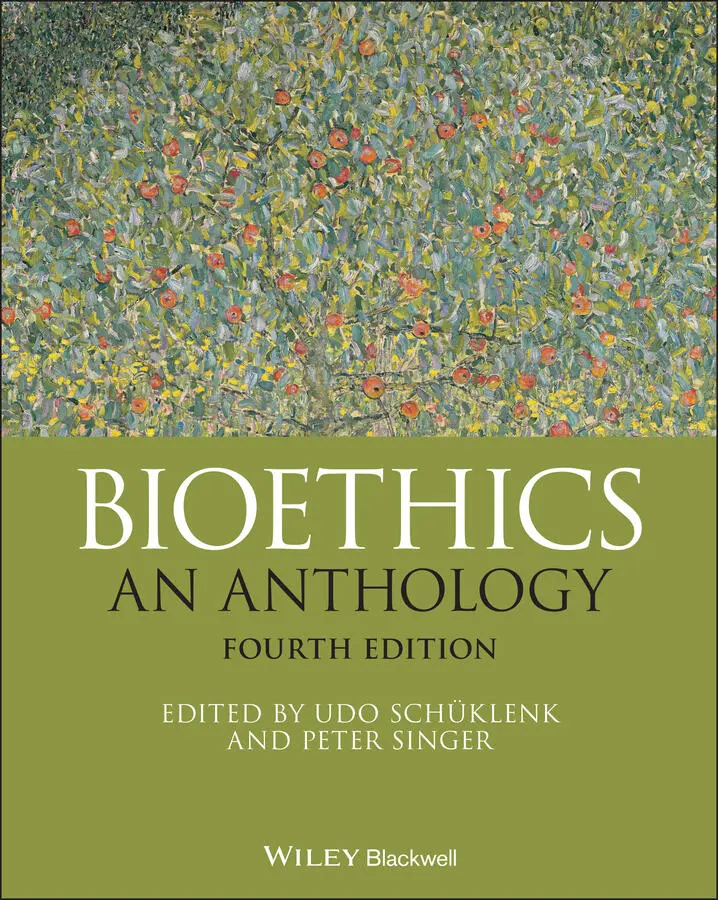
Bioethics
Здесь есть возможность читать онлайн «Bioethics» — ознакомительный отрывок электронной книги совершенно бесплатно, а после прочтения отрывка купить полную версию. В некоторых случаях можно слушать аудио, скачать через торрент в формате fb2 и присутствует краткое содержание. Жанр: unrecognised, на английском языке. Описание произведения, (предисловие) а так же отзывы посетителей доступны на портале библиотеки ЛибКат.
- Название:Bioethics
- Автор:
- Жанр:
- Год:неизвестен
- ISBN:нет данных
- Рейтинг книги:4 / 5. Голосов: 1
-
Избранное:Добавить в избранное
- Отзывы:
-
Ваша оценка:
Bioethics: краткое содержание, описание и аннотация
Предлагаем к чтению аннотацию, описание, краткое содержание или предисловие (зависит от того, что написал сам автор книги «Bioethics»). Если вы не нашли необходимую информацию о книге — напишите в комментариях, мы постараемся отыскать её.
For more than two decades,
has been widely regarded as the definitive single-volume compendium of seminal readings on both traditional and cutting-edge ethical issues in biology and medicine. Acclaimed for its scope and depth of coverage, this landmark work brings together compelling writings by internationally-renowned bioethicist to help readers develop a thorough understanding of the central ideas, critical issues, and current debate in the field.
Now fully revised and updated, the fourth edition contains a wealth of new content on ethical questions and controversies related to the COVID-19 pandemic, advances in CRISPR gene editing technology, physician-assisted death, public health and vaccinations, transgender children, medical aid in dying, the morality of ending the lives of newborns, and much more. Throughout the new edition, carefully selected essays explore a wide range of topics and offer diverse perspectives that underscore the interdisciplinary nature of bioethical study. Edited by two of the field’s most respected scholars, Covers an unparalleled range of thematically-organized topics in a single volume Discusses recent high-profile cases, debates, and ethical issues Features three brand-new sections: Conscientious Objection, Academic Freedom and Research, and Disability Contains new essays on topics such as brain death, life and death decisions for the critically ill, experiments on humans and animals, neuroethics, and the use of drugs to ease the pain of unrequited love Includes a detailed index that allows the reader to easily find terms and topics of interest
remains a must-have resource for all students, lecturers, and researchers studying the ethical implications of the health-related life sciences, and an invaluable reference for doctors, nurses, and other professionals working in health care and the biomedical sciences.
Bioethics — читать онлайн ознакомительный отрывок
Ниже представлен текст книги, разбитый по страницам. Система сохранения места последней прочитанной страницы, позволяет с удобством читать онлайн бесплатно книгу «Bioethics», без необходимости каждый раз заново искать на чём Вы остановились. Поставьте закладку, и сможете в любой момент перейти на страницу, на которой закончили чтение.
Интервал:
Закладка:
I will mention one last possible objection to the use of synthetic gametes by same‐sex couples: that the very desire to have children with shared genetics reflects a dubious understanding of parenthood, namely that one is only a parent if one is a genetic parent, that it is genetic relatedness that entitles anyone to the moral status of parenthood. By contrast, some commentators argue that moral commitment creates parenthood, not genetic relatedness, not ‘biologism.’ For example, Thomas Murray has said ‘Genetic parenthood is incidental to parent‐child mutuality’. (see page 32 from Murray 17). From a perspective like this, same‐sex couples lack for nothing as parents, and their children lack for nothing as children simply because they might be genetically unrelated in whole or in part. From this perspective, synthetic gametes would only open up same‐sex couples to a mistaken view that presently can only affect opposite‐sex couples: that full genetic relatedness is the morally relevant threshold of parent‐child relations. Even if we grant that prospective parents can be mistaken in about the importance of genetics, it is not clear why same‐sex couples should be singled out and possibly excluded from the use of synthetic gametes in the name of protecting them from that mistake. Closing off synthetic gametes to same‐sex couples would close off an important means by which families, in general, consolidate and express their identities. If the treatment of genetic relatedness as a desideratum in children is tolerated in opposite‐sex couples, it is unclear why it should not be tolerated across the spectrum of adults looking to have children in the context of their chosen relationships. In any case, same‐sex couples having children via synthetic gametes would represent only a miniscule fraction of the total number of parents looking to have children with their shared genetics. To the extent that ‘biologism’ is a moral problem, its solution will not be meaningfully advanced by closing off synthetic gametes to gay and lesbian couples. Treating the use of synthetic gametes by gay and lesbian couples as morally suspect would, moreover, leave those couples vulnerable to objections against their use of other ARTs, objections that synthetic gametes silence. In this sense, invoking worries about biologism against gay and lesbian couples seems entirely out of proportion to the nature of the supposed problem, which is hardly remediable by focus on those couples alone.
Conclusions
In some quarters of bioethics, homosexual men and women do not enjoy a strong presumption of equality in regard to social goods and relationships. Some commentators presuppose this inequality in the questions they raise about the prospect of synthetic gametes and the children of same‐sex couples, questions that imply burdens of proof that do not apply to others. Other commentators express this view directly in claims that gay and lesbian parenthood compromises the rights and welfare of children, so much so that gay men and lesbians should refrain from having children altogether (according to the more stringent arguments) or should avoid using certain methods to have children (according to the less stringent arguments).
To be fair, some commentators have expressed strong support for the use of synthetic gametes as a way for same‐sex couples to have children with shared genetics. Testa and Harris have defended this use on four main fronts: (1) that the idea of ‘nature’ cannot sustain an argument against it because the ‘whole practice of medicine is a comprehensive attempt to frustrate the course of nature’, (2) that claims that children are harmed by coming into existence this way cannot be sustained because existence is preferable to non‐existence in terms of the value of children’s lives to themselves, (3) that ARTs are currently available to homosexual men and women in a way that would make it idiosyncratic to forbid synthetic gametes and (4) that, in any case, the evidence is lacking that children of gay and lesbian parents fare worse than the children of others. 18Not only do they criticise objections to the use of synthetic gametes as unfounded, but Testa and Harris offer positive arguments in favour of synthetic gametes for gay and lesbian people, for example, by arguing that synthetic gametes would help ‘democratise reproduction’. Yet, even here, the defence of gay men and lesbians as parents comes as the conclusion to a long and involved argument, which Testa and Harris concede could have gone on to even greater lengths!
In the early days of bioethics, some commentators analysed homosexuality relative to various theories of disease and health. 19–21Ironically, many of those early discussions occurred after the interpretation of homosexuality as pathological had already faded in credibility and significance. The UK Wolfenden Report repudiated the view of homosexuality as pathological in 1957, and the American Psychiatric Association followed suit in 1973. 22,23Bioethics busied itself with this question for some time afterward. Since those discussions, however, most analysts have moved on from questions about the ‘pathology’ of homosexuality, and focused on questions of healthcare access and equity for gay men and lesbians. Yet some commentators have used synthetic gametes to throw the integrity of homosexual men and women into question again, at least as far as parenthood is concerned. In different ways, Somerville, Velleman and Callahan treat the legitimacy of gay and lesbian parenthood as objectionable. As I have tried to show, however, their very objections can sometimes work in favour of synthetic gametes for same‐sex couples, especially by rendering moot worries about the relationships between parents and children.
At this stage of bioethics, though, why should we not assume in an axiomatic way that gay men and lesbians should be respected in their sexual identities, in their relationships in general, and in relationships with their children in particular? How many times must bioethics relitigate parenthood for gay men and lesbians? Questions of ethics do arise in the use of synthetic gametes by same‐sex couples, but the most important questions are not about the suitability of same‐sex couples as parents or even the welfare of their children. The most important questions involve access and equity. Are prevailing clinical standards – with their framing of infertility in terms of anatomical or physiological deficits involving opposite‐sex partners – a hindrance in any way to fertility medicine for same‐sex partners? If insurance companies in the USA cover infertility treatments for straight couples, is there any morally compelling reason they should not extend the same benefits to opposite‐sex couples, some of whom will be in lawful marriages? Given the historical arc of homosexuality in bioethics, the field may eventually move to embrace these kinds of questions fully, after the novelty of synthetic gametes wears off, and bioethics may yet embrace homosexual men and women as the presumptive equals of everyone else in regard to fitness as parents. The sooner, the better.
References
1 1 West, F. D., Shirazi R., Mardanpour P., et al. In vitro‐derived gametes from stem cells. Semin Repro Med 2013; 31:33–8.
2 2 Den, J. M., Satoh, K., Wang, H., et al. Generation of viable male and female mice from two fathers. Biol Reprod 2011; 84:613–18.
3 3 Gates, G. LGBT parenting in the United States. The Williams Institute of UCLA, 2013. https://williamsinstitute.law.ucla.edu/wp‐content/uploads/LGBT‐Parenting‐US‐Feb‐2013.pdf
4 4 Ethics Committee of the American Society of Reproductive Medicine. Access to fertility treatments by gay, lesbian, and unmarried people. Fertil Steril 2009; 92:1190–3.
Читать дальшеИнтервал:
Закладка:
Похожие книги на «Bioethics»
Представляем Вашему вниманию похожие книги на «Bioethics» списком для выбора. Мы отобрали схожую по названию и смыслу литературу в надежде предоставить читателям больше вариантов отыскать новые, интересные, ещё непрочитанные произведения.

Обсуждение, отзывы о книге «Bioethics» и просто собственные мнения читателей. Оставьте ваши комментарии, напишите, что Вы думаете о произведении, его смысле или главных героях. Укажите что конкретно понравилось, а что нет, и почему Вы так считаете.