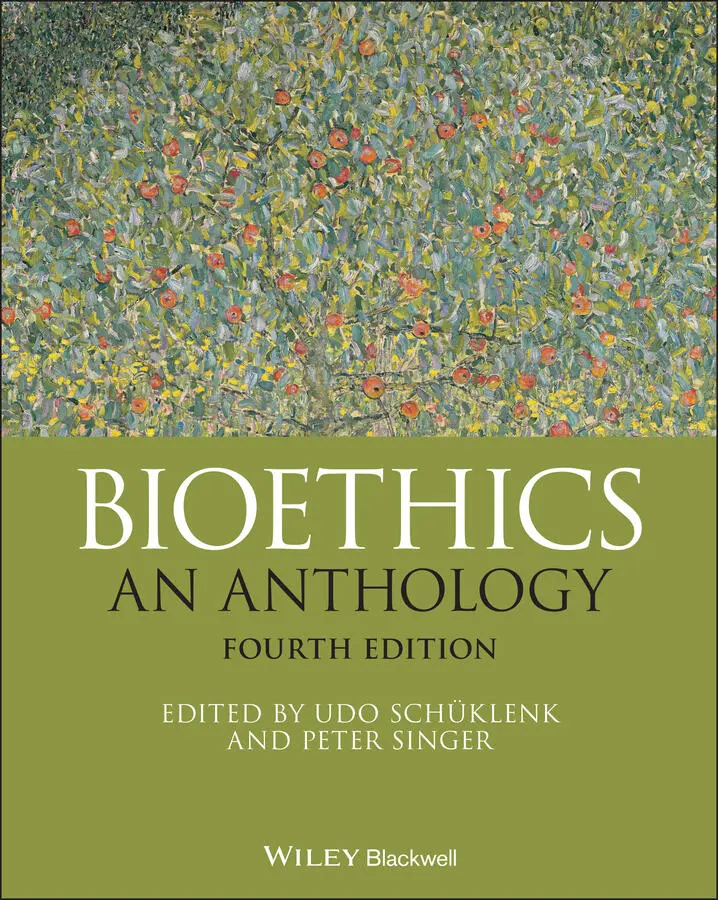
Bioethics
Здесь есть возможность читать онлайн «Bioethics» — ознакомительный отрывок электронной книги совершенно бесплатно, а после прочтения отрывка купить полную версию. В некоторых случаях можно слушать аудио, скачать через торрент в формате fb2 и присутствует краткое содержание. Жанр: unrecognised, на английском языке. Описание произведения, (предисловие) а так же отзывы посетителей доступны на портале библиотеки ЛибКат.
- Название:Bioethics
- Автор:
- Жанр:
- Год:неизвестен
- ISBN:нет данных
- Рейтинг книги:4 / 5. Голосов: 1
-
Избранное:Добавить в избранное
- Отзывы:
-
Ваша оценка:
Bioethics: краткое содержание, описание и аннотация
Предлагаем к чтению аннотацию, описание, краткое содержание или предисловие (зависит от того, что написал сам автор книги «Bioethics»). Если вы не нашли необходимую информацию о книге — напишите в комментариях, мы постараемся отыскать её.
For more than two decades,
has been widely regarded as the definitive single-volume compendium of seminal readings on both traditional and cutting-edge ethical issues in biology and medicine. Acclaimed for its scope and depth of coverage, this landmark work brings together compelling writings by internationally-renowned bioethicist to help readers develop a thorough understanding of the central ideas, critical issues, and current debate in the field.
Now fully revised and updated, the fourth edition contains a wealth of new content on ethical questions and controversies related to the COVID-19 pandemic, advances in CRISPR gene editing technology, physician-assisted death, public health and vaccinations, transgender children, medical aid in dying, the morality of ending the lives of newborns, and much more. Throughout the new edition, carefully selected essays explore a wide range of topics and offer diverse perspectives that underscore the interdisciplinary nature of bioethical study. Edited by two of the field’s most respected scholars, Covers an unparalleled range of thematically-organized topics in a single volume Discusses recent high-profile cases, debates, and ethical issues Features three brand-new sections: Conscientious Objection, Academic Freedom and Research, and Disability Contains new essays on topics such as brain death, life and death decisions for the critically ill, experiments on humans and animals, neuroethics, and the use of drugs to ease the pain of unrequited love Includes a detailed index that allows the reader to easily find terms and topics of interest
remains a must-have resource for all students, lecturers, and researchers studying the ethical implications of the health-related life sciences, and an invaluable reference for doctors, nurses, and other professionals working in health care and the biomedical sciences.
Bioethics — читать онлайн ознакомительный отрывок
Ниже представлен текст книги, разбитый по страницам. Система сохранения места последней прочитанной страницы, позволяет с удобством читать онлайн бесплатно книгу «Bioethics», без необходимости каждый раз заново искать на чём Вы остановились. Поставьте закладку, и сможете в любой момент перейти на страницу, на которой закончили чтение.
Интервал:
Закладка:
Notes
1 1This essay originally appeared in the Birmingham News 1 December 1997 and was revised by the author for the 4th edition of this anthology.
2 2Ann Curry, “After 10 Years, New Adventures for Septuplets,” Dateline, December 12, 2007. http://www.nbcnews.com/id/22223331/#.USAS0hzB‐AE
6 The Meaning of Synthetic Gametes for Gay and Lesbian People and Bioethics Too
Timothy F. Murphy
Researchers have had success in using synthetic gametes – sperm derived from female stem cells and ova derived from male stem cells – to produce live offspring in laboratory animals. 1The prospects for same‐sex couples to have children using only their gametes has been predicted in some of the earliest reports of success in the development of synthetic gametes, and some researchers have mapped this outcome as meaningfully within the range of possibility. 2Even so, considerable work remains to be done before human beings conceived with synthetic gametes could materialise this way,
Gay and lesbian people do already have children, of course, from opposite‐sex relationships, by adoption, through surrogacy arrangements, and – more recently – through various assisted reproductive treatments (ART). As many as six million people in the USA have a gay or lesbian parent. 3Because of shifting social views, it is likely that many more children of gay and lesbian parents are on the way. For example, the American Society of Reproductive Medicine now counsels its members to offer their services without regard to sexual orientation or marital status. 4Even so, two men or two women hoping to have children together cannot expect to share genetic parenthood, although certain symbolic gestures toward shared parenthood are available. For example, one woman might offer ova for fertilisation while her partner gestates the children. 5Two gay men may blend their sperm prior to insemination when relying on surrogate gestation for a child so that the child’s genetics are a matter of chance rather than choice. By contrast with these practices, the use of synthetic gametes – ova derived from males and sperm derived from females – stands poised to offer same‐sex couples ways to share full genetic parenthood of their children.
Despite the increasing social acceptance of gay men and lesbians around the world, the prospect of parenthood by homosexual men and women raises suspicion and even outright rejection in some quarters, and these objections carry over to bioethics as well. I want to show examples of these objections in a range of bioethics analysis, and show how synthetic gametes would – paradoxically – disarm key elements of these objections. In doing so, I hope to make the case that it is past time to move past the burdens of proof that are reflexively invoked in regard to parenthood by gay men and lesbians whenever a novel method of assisted conception surfaces.
Controversial Parenthood
When it comes to same‐sex couples turning to synthetic gametes, A. J. Newson and Anna Smajdor say ‘new ethical questions’ arise, ‘such as whether same‐sex couples should be able to access this technology to have children who are genetically related to them both’. 6I fully concede that the prospect of same‐sex couples as the genetic parents of children is a novel question, but the question of cross‐sex gamete production is not any more novel for them than for anyone else. If synthetic gametes become possible, any man or woman can be the source of sperm or ova no matter what kind of relationship they are in. Yet Newson and Smajdor do not treat the use of synthetic gametes for infertile opposite‐sex couples as a specifically ethical concern; they certainly do not frame the question of synthetic gametes for opposite‐sex couples as a question of access, presumably because they assume these couples to be fit as parents in all the ways that matter. In regard to same‐sex couples, Newson and Smajdor go on to ask ‘Will a man whose DNA is contained in the egg (used to produce a child) be recognised as a “biological” mother?’ (see page 186 from Newson et al. 6). By contrast, they ask no parallel question of ethics and access for their own example of single men or women who might rely on their own sperm and synthetic ova to produce a child. In any case, why assume that a man whose synthesised ovum is used to produce a child cannot be recognised as the child’s mother in a biological sense even as he retains a male identity? After all, one transgender man who gestated his own children expresses no doubts about being the children’s father. 7Techniques of fertility preservation for transgender men and women – preserving gametes prior to body modifications that would otherwise leave people infertile – are likely to increase the ranks of transgender men who are the genetic mothers of their children, and the ranks of transgender women who are the genetic fathers of their children. 8Rather than trying to retrofit all parents into mutually exclusive categories of mother and father, why not ask a more searching question, namely whether these categories offer an adequate vocabulary for expressing the relationships progenitors can have with their progeny?
Other discussions also represent the parenthood of gay men and lesbians as ethically controversial. In 2009, a study group of scientists, ethicists, journal editors and lawyers reviewed the science of synthetic gametes and suggested likely uses, some of which they said might require legal and policy oversight. This group indicated that the possibility of using synthetic gametes for reproduction in same‐sex couples is unlikely in the future, for genetic reasons related to conception and embryogenesis. 9Even so, their analysis does not rule out same‐sex reproduction as impossible. Perhaps for that reason, the group went on to say ‘same‐sex reproduction is inarguably a controversial, if highly unlikely, potential end result of this research’ (see page 13 from Mathews et al. 9). The study group, therefore, identifies this kind of reproduction as ‘requiring deliberation and possible policy options’ (see table 1from Mathews et al.).
This interpretation of same‐sex reproduction as ‘inarguably controversial’ comes without any supporting rationale. By contrast, the study group did feel obliged to offer a rationale after describing other novel uses of synthetic gametes, such as the in vitro creation of human embryos for research that involves their destruction. The group noted that those practices offend people ‘who imbue such embryos with full moral status’ (see page 12 from Mathews et al.). By contrast, the idea that two men or two women conceive and raise a child together is represented as self‐evidently controversial, requiring no supporting explanation at all.
Interpretations like these treat same‐sex couples as a novelty act in bioethics, primarily by suggesting that their moral standing as parents requires levels of moral scrutiny not required of other parents. At the very least, discussions like these still suppose that someone – moral and social authorities – have to function as gatekeepers for homosexual men and women wanting to be parents, as against assuming in advance that any safe and effective treatment for infertility should be presumptively available to any adult, which is the entitlement these commentators confer without qualification on opposite‐sex couples, subject only to the constraints of safety and efficacy of the intervention in question.
Protecting Children from Some Possible Parents
As against commentators whose background assumptions throw gay and lesbian parenthood into question, some commentators explicitly reject the idea that same‐sex couples should be parents, at least not in any planned or socially approved way. Sometimes these objections focus on the nature of same‐sex couples as parents; other times the objections focus on the way in which same‐sex couples are able to have children.
Читать дальшеИнтервал:
Закладка:
Похожие книги на «Bioethics»
Представляем Вашему вниманию похожие книги на «Bioethics» списком для выбора. Мы отобрали схожую по названию и смыслу литературу в надежде предоставить читателям больше вариантов отыскать новые, интересные, ещё непрочитанные произведения.

Обсуждение, отзывы о книге «Bioethics» и просто собственные мнения читателей. Оставьте ваши комментарии, напишите, что Вы думаете о произведении, его смысле или главных героях. Укажите что конкретно понравилось, а что нет, и почему Вы так считаете.