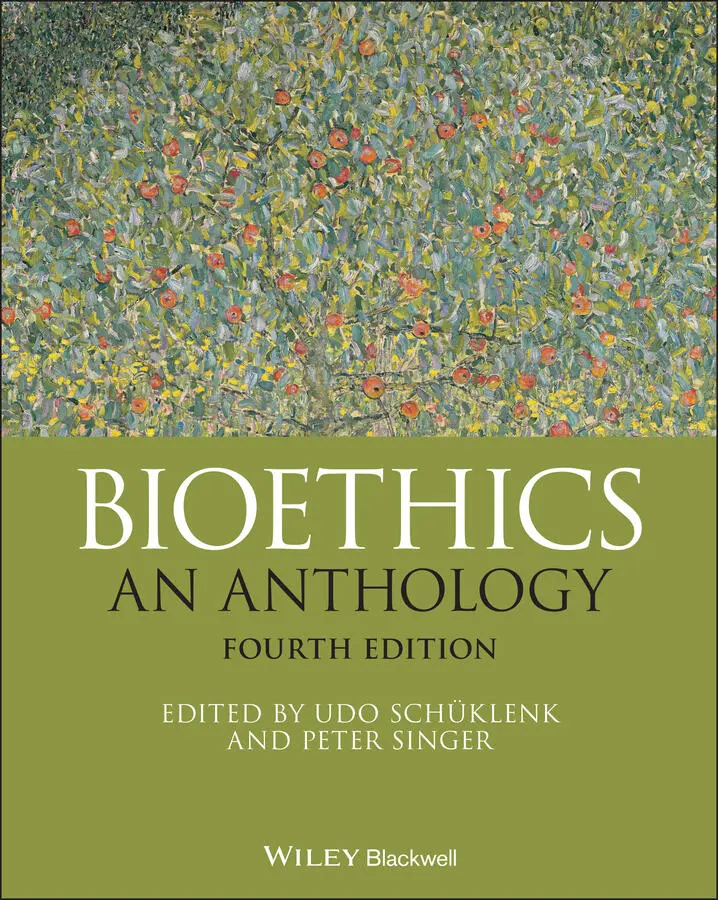
Bioethics
Здесь есть возможность читать онлайн «Bioethics» — ознакомительный отрывок электронной книги совершенно бесплатно, а после прочтения отрывка купить полную версию. В некоторых случаях можно слушать аудио, скачать через торрент в формате fb2 и присутствует краткое содержание. Жанр: unrecognised, на английском языке. Описание произведения, (предисловие) а так же отзывы посетителей доступны на портале библиотеки ЛибКат.
- Название:Bioethics
- Автор:
- Жанр:
- Год:неизвестен
- ISBN:нет данных
- Рейтинг книги:4 / 5. Голосов: 1
-
Избранное:Добавить в избранное
- Отзывы:
-
Ваша оценка:
Bioethics: краткое содержание, описание и аннотация
Предлагаем к чтению аннотацию, описание, краткое содержание или предисловие (зависит от того, что написал сам автор книги «Bioethics»). Если вы не нашли необходимую информацию о книге — напишите в комментариях, мы постараемся отыскать её.
For more than two decades,
has been widely regarded as the definitive single-volume compendium of seminal readings on both traditional and cutting-edge ethical issues in biology and medicine. Acclaimed for its scope and depth of coverage, this landmark work brings together compelling writings by internationally-renowned bioethicist to help readers develop a thorough understanding of the central ideas, critical issues, and current debate in the field.
Now fully revised and updated, the fourth edition contains a wealth of new content on ethical questions and controversies related to the COVID-19 pandemic, advances in CRISPR gene editing technology, physician-assisted death, public health and vaccinations, transgender children, medical aid in dying, the morality of ending the lives of newborns, and much more. Throughout the new edition, carefully selected essays explore a wide range of topics and offer diverse perspectives that underscore the interdisciplinary nature of bioethical study. Edited by two of the field’s most respected scholars, Covers an unparalleled range of thematically-organized topics in a single volume Discusses recent high-profile cases, debates, and ethical issues Features three brand-new sections: Conscientious Objection, Academic Freedom and Research, and Disability Contains new essays on topics such as brain death, life and death decisions for the critically ill, experiments on humans and animals, neuroethics, and the use of drugs to ease the pain of unrequited love Includes a detailed index that allows the reader to easily find terms and topics of interest
remains a must-have resource for all students, lecturers, and researchers studying the ethical implications of the health-related life sciences, and an invaluable reference for doctors, nurses, and other professionals working in health care and the biomedical sciences.
Bioethics — читать онлайн ознакомительный отрывок
Ниже представлен текст книги, разбитый по страницам. Система сохранения места последней прочитанной страницы, позволяет с удобством читать онлайн бесплатно книгу «Bioethics», без необходимости каждый раз заново искать на чём Вы остановились. Поставьте закладку, и сможете в любой момент перейти на страницу, на которой закончили чтение.
Интервал:
Закладка:
Prenatal Screening, Sex Selection, and Cloning
As our knowledge of genetics expands, prospective parents are increasingly given the opportunity to make use of this knowledge, to prevent the birth of genetically compromised children. Here it is important to note that prevention need not involve abortion or the destruction of preimplantation embryos. At‐risk parents can avoid having a disabled child by deciding not to have children, by adopting children, or by using donor gametes or embryos.
Is it wrong to bring severely disabled children into the world, if one could avoid doing so? Laura M. Purdy in “Genetics and Reproductive Risk: Can Having Children be Immoral?” gives an affirmative answer. Rejecting the view “that it is morally permissible to conceive individuals so long as we do not expect them to be so miserable that they wish they were dead,” she argues that parents ought to ensure that any children they are going to have, possess “normal health.” While she acknowledges that the notion is vague, she takes it to be sufficient to mark out as wrong the bringing into the world of children who are at risk of having serious genetic afflictions, such as Huntington’s disease.
The notion that there ought to be a sphere of liberty within which prospective parents are free to make reproductive choices is widely accepted. There is, however, disagreement as to whether reproductive liberty has limits, and if it does, where these limits ought to be drawn. Take sex selection. Many jurisdictions allow parents to prevent the birth of children affected by certain genetic diseases, but do not allow them to do this for non‐medical reasons, such as wanting to balance the sex ratio of their children. In a statement entitled “Sex Selection and Preimplantation Genetic Diagnosis,” the Ethics Committee of the American Society of Reproductive Medicine indicates the extent to which it shares the concerns behind such laws. The Committee itself does not believe that non‐medical sex selection is so clearly and seriously wrong that it favors the use of the law to prohibit it. Instead, the Committee would stop at discouraging sex selection for non‐medical reasons.
Julian Savulescu and Edgar Dahl respond to the Committee’s statement in their essay “Sex Selection and Preimplantation Diagnosis.” They find its arguments unpersuasive, particularly given that, in Western societies, most people seeking to use sex selection do so not because they value one sex more than the other, but to balance the number of boys and girls in their family.
Those opposing preimplantation genetic diagnosis for the above purpose may, however, have concerns that go beyond the welfare interests of the future child. David King explains “Why We Should Not Permit Embryos to be Selected as Tissue Donors.” He believes that the practice objectifies the child and turns it into a mere tool. This contradicts, he says, the basic Kantian ethical principle that human beings must always be treated as ends, and never merely as a means to an end. Even if the future child will be a much‐loved member of the family, we ought to resist the temptation to allow the selection of embryos as tissue donors because it is yet another step in the objectification of humans and “and the consequences of doing so are … disastrous.”
But is the maxim that we must never regard others solely as a means to an end infringed if the tissue‐matched child is loved and cherished in its own right, as an end? Kant’s maxim provides, as King correctly notes, a plausible account of what is wrong with slavery, but its implication in the present context is far less clear. People generally have children for a variety of reasons: they want a sister for “Ann,” a companion for their old age, a son to continue the blood line, and so on. If tissue‐matching of embryos to save another child were ruled out by the Kantian maxim, would this not also perhaps rule out many other widely accepted reasons for having children as well?
In allowing tissue‐matching of embryos, we are, King holds, proceeding down a slippery slope toward some very bad societal consequences. Critics of this kind of argument might question, however, whether the bad consequences at the bottom of the slope are truly bad, or as bad as they are made out to be. They may also ask whether the slope is really so slippery and if sound laws and public policies would not arrest any possible slide.
For many people reproductive human cloning is one of the bad consequences that lie at the bottom of the slippery slope. When the existence of the sheep “Dolly” (the first mammal to owe its existence to somatic cell nuclear transfer, or cloning) was announced in 1997, there was swift world‐wide reaction. People feared that the cloning of humans would not be far away. Only 24 hours after the world knew of Dolly’s existence, a bill outlawing human cloning was announced in New York State, and a few days later, then US President Clinton banned federal funding for research into it.
Michael Tooley examines this issue in “The Moral Status of Human Cloning: Neo‐Lockean Persons versus Human Embryos.” In earlier editions of this Anthology , we included an article by the same author, first published in 1998. In that earlier article, Tooly distinguished between the questions of whether reproductive human cloning is in principle morally acceptable and whether it is acceptable at the present time , given current scientific knowledge and understanding. He then reached the conclusion that the practice was acceptable in principle, but morally problematic, given the state of knowledge at the time. In this new article, specially written for this volume, Tooley notes more recent research that makes it less likely that cloning from an adult would produce a person with reduced life expectancy. In this and other ways, his conclusion is now more open to the acceptability of human reproductive cloning, both in principle and in practice, than it was in his earlier article.
5 The McCaughey Septuplets God's Will or Human Choice? 1
Gregory Pence
In 1997, American media rejoiced that all seven of the McCaugheys' fetuses made it to birth and seemed healthy. Yet for all the coverage of that story, rarely did the darkerv truth emerge. Call me a curmudgeon, but something is wrong here.
We often over‐generalize from well‐publicized cases (e.g., after the 1986 Baby M case, some states banned commercial surrogacy). In France since 1982 – where couples sometimes pursue pregnancy with religious zeal because each new baby garners a bonus from the government – use of fertility drugs has increased tenfold the number of triplets and the number of quadruplets, thirtyfold.
Some complain about the costs to society of so many babies in one birth, and true, the gestation, birth, and special care of the septuplets probably cost a cool million dollars. Others complain that the human uterus did not evolve to bear litters and that large multiple births are unnatural. Still others wonder what toll this extraordinary gestation had on mother McCaughey's body and health.
These are important matters, but they strike me as morally secondary. Costs can be absorbed by being spread over millions of payers, and what is unnatural in one era becomes normal in the next (witness anesthesia). And if Mrs McCaughey made an informed choice, she was free to risk injuring her body in childbirth as she saw fit.
Still others wonder if these two parents could really nurture each of the septuplets. Would you want to grow up with one‐seventh of the attention you got from your dad? Did the McCaugheys have the time, energy, and money to nourish each child’s full potential?
My real concern is about what is best for the children. This couple took the fertility drug Pergonal, conceived seven embryos, refused to reduce any (abort), and then said that any results were “God's will.” In doing so, they risked the lives and health of their babies. They took bad odds and hoped that all seven would be healthy. In so doing, they took the risk of having seven disabled, or even seven dead, babies.
Читать дальшеИнтервал:
Закладка:
Похожие книги на «Bioethics»
Представляем Вашему вниманию похожие книги на «Bioethics» списком для выбора. Мы отобрали схожую по названию и смыслу литературу в надежде предоставить читателям больше вариантов отыскать новые, интересные, ещё непрочитанные произведения.

Обсуждение, отзывы о книге «Bioethics» и просто собственные мнения читателей. Оставьте ваши комментарии, напишите, что Вы думаете о произведении, его смысле или главных героях. Укажите что конкретно понравилось, а что нет, и почему Вы так считаете.