Bioethics
Здесь есть возможность читать онлайн «Bioethics» — ознакомительный отрывок электронной книги совершенно бесплатно, а после прочтения отрывка купить полную версию. В некоторых случаях можно слушать аудио, скачать через торрент в формате fb2 и присутствует краткое содержание. Жанр: unrecognised, на английском языке. Описание произведения, (предисловие) а так же отзывы посетителей доступны на портале библиотеки ЛибКат.
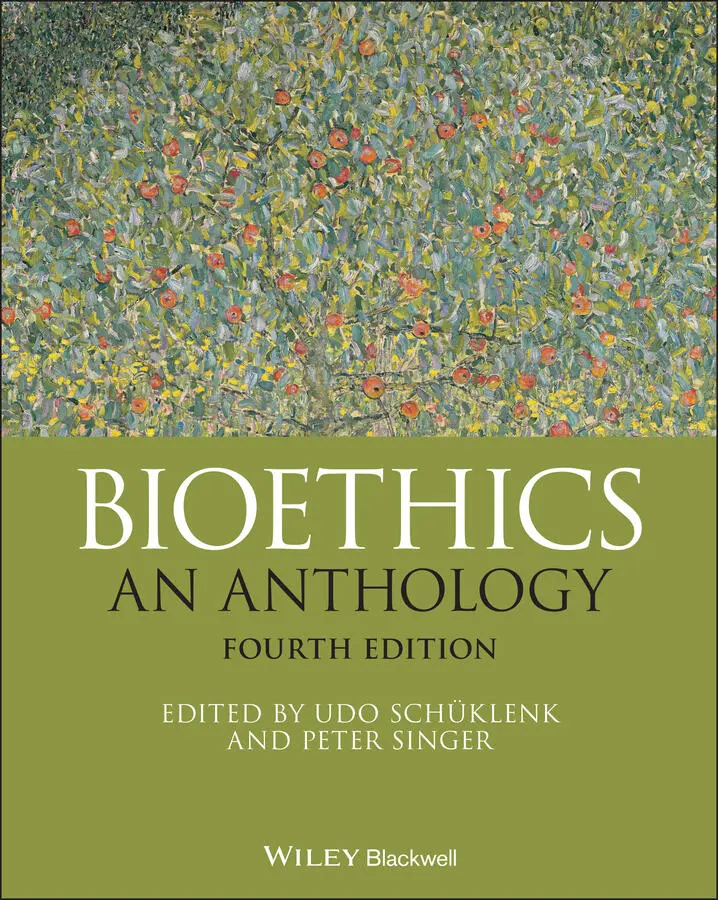
- Название:Bioethics
- Автор:
- Жанр:
- Год:неизвестен
- ISBN:нет данных
- Рейтинг книги:4 / 5. Голосов: 1
-
Избранное:Добавить в избранное
- Отзывы:
-
Ваша оценка:
Bioethics: краткое содержание, описание и аннотация
Предлагаем к чтению аннотацию, описание, краткое содержание или предисловие (зависит от того, что написал сам автор книги «Bioethics»). Если вы не нашли необходимую информацию о книге — напишите в комментариях, мы постараемся отыскать её.
For more than two decades,
has been widely regarded as the definitive single-volume compendium of seminal readings on both traditional and cutting-edge ethical issues in biology and medicine. Acclaimed for its scope and depth of coverage, this landmark work brings together compelling writings by internationally-renowned bioethicist to help readers develop a thorough understanding of the central ideas, critical issues, and current debate in the field.
Now fully revised and updated, the fourth edition contains a wealth of new content on ethical questions and controversies related to the COVID-19 pandemic, advances in CRISPR gene editing technology, physician-assisted death, public health and vaccinations, transgender children, medical aid in dying, the morality of ending the lives of newborns, and much more. Throughout the new edition, carefully selected essays explore a wide range of topics and offer diverse perspectives that underscore the interdisciplinary nature of bioethical study. Edited by two of the field’s most respected scholars, Covers an unparalleled range of thematically-organized topics in a single volume Discusses recent high-profile cases, debates, and ethical issues Features three brand-new sections: Conscientious Objection, Academic Freedom and Research, and Disability Contains new essays on topics such as brain death, life and death decisions for the critically ill, experiments on humans and animals, neuroethics, and the use of drugs to ease the pain of unrequited love Includes a detailed index that allows the reader to easily find terms and topics of interest
remains a must-have resource for all students, lecturers, and researchers studying the ethical implications of the health-related life sciences, and an invaluable reference for doctors, nurses, and other professionals working in health care and the biomedical sciences.
Bioethics — читать онлайн ознакомительный отрывок
Ниже представлен текст книги, разбитый по страницам. Система сохранения места последней прочитанной страницы, позволяет с удобством читать онлайн бесплатно книгу «Bioethics», без необходимости каждый раз заново искать на чём Вы остановились. Поставьте закладку, и сможете в любой момент перейти на страницу, на которой закончили чтение.
Интервал:
Закладка:
Of course, Bassen does not make the possibility of empathy a necessary condition of victimizability; he requires only mentation. Hence, on Bassen’s actual view, this author, as I have described him, can be a victim. The problem is that the basic intuition that renders Bassen’s view plausible is missing in the author’s case. In order to attempt to avoid counterexamples, Bassen has made his thesis too weak to be supported by the intuitions that suggested it.
Even so, the mentation requirement on victimizability is still subject to counterexamples. Suppose a severe accident renders me totally unconscious for a month, after which I recover. Surely killing me while I am unconscious victimizes me, even though I am incapable of mentation during that time. It follows that Bassen’s thesis fails. Apparently, attempts to restrict the value of a future‐like‐ours argument so that fetuses do not fall within its scope do not succeed.
V
In this essay, it has been argued that the correct ethic of the wrongness of killing can be extended to fetal life and used to show that there is a strong presumption that any abortion is morally impermissible. If the ethic of killing adopted here entails, however, that contraception is also seriously immoral, then there would appear to be a difficulty with the analysis of this essay.
But this analysis does not entail that contraception is wrong. Of course, contraception prevents the actualization of a possible future of value. Hence, it follows from the claim that if futures of value should be maximized that contraception is prima facie immoral. This obligation to maximize does not exist, however; furthermore, nothing in the ethics of killing in this paper entails that it does. The ethics of killing in this essay would entail that contraception is wrong only if something were denied a human future of value by contraception. Nothing at all is denied such a future by contraception, however.
Candidates for a subject of harm by contraception fall into four categories: (1) some sperm or other, (2) some ovum or other, (3) a sperm and an ovum separately, and (4) a sperm and an ovum together. Assigning the harm to some sperm is utterly arbitrary, for no reason can be given for making a sperm the subject of harm rather than an ovum. Assigning the harm to some ovum is utterly arbitrary, for no reason can be given for making an ovum the subject of harm rather than a sperm. One might attempt to avoid these problems by insisting that contraception deprives both the sperm and the ovum separately of a valuable future like ours. On this alternative, too many futures are lost. Contraception was supposed to be wrong, because it deprived us of one future of value, not two. One might attempt to avoid this problem by holding that contraception deprives the combination of sperm and ovum of a valuable future like ours. But here the definite article misleads. At the time of contraception, there are hundreds of millions of sperm, one (released) ovum and millions of possible combinations of all of these. There is no actual combination at all. Is the subject of the loss to be a merely possible combination? Which one? This alternative does not yield an actual subject of harm either. Accordingly, the immorality of contraception is not entailed by the loss of a future‐like‐ours argument simply because there is no nonarbitrarily identifiable subject of the loss in the case of contraception.
VI
The purpose of this essay has been to set out an argument for the serious presumptive wrongness of abortion subject to the assumption that the moral permissibility of abortion stands or falls on the moral status of the fetus. Since a fetus possesses a property, the possession of which in adult human beings is sufficient to make killing an adult human being wrong, abortion is wrong. This way of dealing with the problem of abortion seems superior to other approaches to the ethics of abortion, because it rests on an ethics of killing which is close to self‐evident, because the crucial morally relevant property clearly applies to fetuses, and because the argument avoids the usual equivocations on “human life,” “human being,” or “person.” The argument rests neither on religious claims nor on Papal dogma. It is not subject to the objection of “speciesism.” Its soundness is compatible with the moral permissibility of euthanasia and contraception. It deals with our intuitions concerning young children.
Finally, this analysis can be viewed as resolving a standard problem – indeed, the standard problem – concerning the ethics of abortion. Clearly, it is wrong to kill adult human beings. Clearly, it is not wrong to end the life of some arbitrarily chosen single human cell. Fetuses seem to be like arbitrarily chosen human cells in some respects and like adult humans in other respects. The problem of the ethics of abortion is the problem of determining the fetal property that settles this moral controversy. The thesis of this essay is that the problem of the ethics of abortion, so understood, is solvable.
Notes
1 1Feinberg, “Abortion,” in Matters of Life and Death: New Introductory Essays in Moral Philosophy, Tom Regan, ed. (New York: Random House, 1986), pp. 256–93; Tooley, “Abortion and Infanticide,” Philosophy and Public Affairs, II, 1 (1972): 37–65 [see chapter 1in this volume], Tooley, Abortion and Infanticide (New York: Oxford, 1984); Warren, “On the Moral and Legal Status of Abortion,” The Monist, 1. VII, 1 (1973): 43–61; Engelhardt, “The Ontology of Abortion,” Ethics, I. XXXIV, 3 (1974): 217–34; Sumner, Abortion and Moral Theory (Princeton: University Press, 1981); Noonan, “An Almost Absolute Value in History,” in The Morality of Abortion: Legal and Historical Perspectives, Noonan, ed. (Cambridge: Harvard, 1970); and Devine, The Ethics of Homicide (Ithaca: Cornell, 1978).
2 2For interesting discussions of this issue, see Warren Quinn, “Abortion: Identity and Loss,” Philosophy and Public Affairs, XIII, 1 (1984): 24–54; and Lawrence C. Becker, “Human Being: The Boundaries of the Concept,” Philosophy and Public Affairs, IV, 4 (1975): 334–59.
3 3For example, see my “Ethics and the Elderly: Some Problems,” in Stuart Spicker, Kathleen Woodward, and David Van Tassel, eds., Aging and the Elderly: Humanistic Perspectives in Gerontology (Atlantic Highlands, NJ: Humanities, 1978), pp. 341–55.
4 4See Warren, “On the Moral and Legal Status of Abortion,” and Tooley, “Abortion and Infanticide.”
5 5This seems to be the fatal flaw in Warren’s treatment of this issue.
6 6I have been most influenced on this matter by Jonathan Glover, Causing Death and Saving Lives (New York: Penguin, 1977), ch. 3; and Robert Young, “What Is So Wrong with Killing People?” Philosophy, LIV, 210 (1979): 515–28.
7 7Feinberg, Tooley, Warren, and Engelhardt have all dealt with this problem.
8 8Kant, “Duties to Animals and Spirits,” in Lectures on Ethics, trans. Louis Infeld (New York: Harper, 1963), p. 239.
9 9I am indebted to Jack Bricke for raising this objection.
10 10Presumably a preference utilitarian would press such an objection. Tooley once suggested that his account has such a theoretical underpinning. See his “Abortion and Infanticide,” pp. 44–5.
11 11Donald VanDeVeer seems to think this is self‐evident. See his “Whither Baby Doe?” in Matters of Life and Death, p. 233.
12 12“Must the Bearer of a Right Have the Concept of That to Which He Has a Right?” Ethics, XCV, 1 (1984): 68–74.
13 13See Tooley again in “Abortion and Infanticide,” pp. 47–9.
14 14“Present Sakes and Future Prospects: The Status of Early Abortion,” Philosophy and Public Affairs, XI, 4 (1982): 322–6.
Читать дальшеИнтервал:
Закладка:
Похожие книги на «Bioethics»
Представляем Вашему вниманию похожие книги на «Bioethics» списком для выбора. Мы отобрали схожую по названию и смыслу литературу в надежде предоставить читателям больше вариантов отыскать новые, интересные, ещё непрочитанные произведения.

Обсуждение, отзывы о книге «Bioethics» и просто собственные мнения читателей. Оставьте ваши комментарии, напишите, что Вы думаете о произведении, его смысле или главных героях. Укажите что конкретно понравилось, а что нет, и почему Вы так считаете.