Bioethics
Здесь есть возможность читать онлайн «Bioethics» — ознакомительный отрывок электронной книги совершенно бесплатно, а после прочтения отрывка купить полную версию. В некоторых случаях можно слушать аудио, скачать через торрент в формате fb2 и присутствует краткое содержание. Жанр: unrecognised, на английском языке. Описание произведения, (предисловие) а так же отзывы посетителей доступны на портале библиотеки ЛибКат.
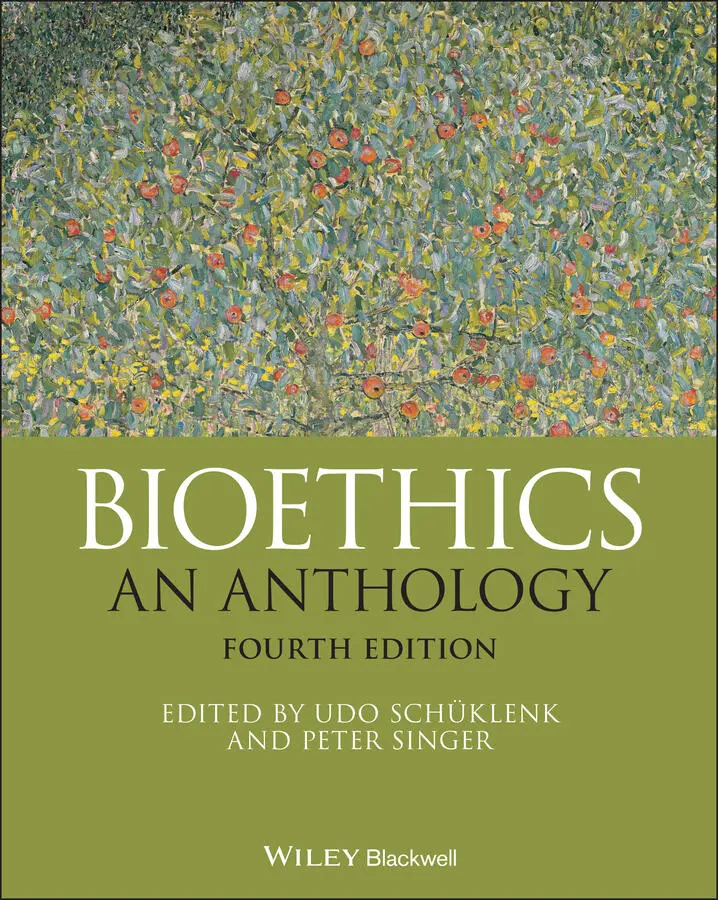
- Название:Bioethics
- Автор:
- Жанр:
- Год:неизвестен
- ISBN:нет данных
- Рейтинг книги:4 / 5. Голосов: 1
-
Избранное:Добавить в избранное
- Отзывы:
-
Ваша оценка:
Bioethics: краткое содержание, описание и аннотация
Предлагаем к чтению аннотацию, описание, краткое содержание или предисловие (зависит от того, что написал сам автор книги «Bioethics»). Если вы не нашли необходимую информацию о книге — напишите в комментариях, мы постараемся отыскать её.
For more than two decades,
has been widely regarded as the definitive single-volume compendium of seminal readings on both traditional and cutting-edge ethical issues in biology and medicine. Acclaimed for its scope and depth of coverage, this landmark work brings together compelling writings by internationally-renowned bioethicist to help readers develop a thorough understanding of the central ideas, critical issues, and current debate in the field.
Now fully revised and updated, the fourth edition contains a wealth of new content on ethical questions and controversies related to the COVID-19 pandemic, advances in CRISPR gene editing technology, physician-assisted death, public health and vaccinations, transgender children, medical aid in dying, the morality of ending the lives of newborns, and much more. Throughout the new edition, carefully selected essays explore a wide range of topics and offer diverse perspectives that underscore the interdisciplinary nature of bioethical study. Edited by two of the field’s most respected scholars, Covers an unparalleled range of thematically-organized topics in a single volume Discusses recent high-profile cases, debates, and ethical issues Features three brand-new sections: Conscientious Objection, Academic Freedom and Research, and Disability Contains new essays on topics such as brain death, life and death decisions for the critically ill, experiments on humans and animals, neuroethics, and the use of drugs to ease the pain of unrequited love Includes a detailed index that allows the reader to easily find terms and topics of interest
remains a must-have resource for all students, lecturers, and researchers studying the ethical implications of the health-related life sciences, and an invaluable reference for doctors, nurses, and other professionals working in health care and the biomedical sciences.
Bioethics — читать онлайн ознакомительный отрывок
Ниже представлен текст книги, разбитый по страницам. Система сохранения места последней прочитанной страницы, позволяет с удобством читать онлайн бесплатно книгу «Bioethics», без необходимости каждый раз заново искать на чём Вы остановились. Поставьте закладку, и сможете в любой момент перейти на страницу, на которой закончили чтение.
Интервал:
Закладка:
The view that what makes killing wrong is the loss to the victim of the value of the victim’s future gains additional support when some of its implications are examined. In the first place, it is incompatible with the view that it is wrong to kill only beings who are biologically human. It is possible that there exists a different species from another planet whose members have a future like ours. Since having a future like that is what makes killing someone wrong, this theory entails that it would be wrong to kill members of such a species. Hence, this theory is opposed to the claim that only life that is biologically human has great moral worth, a claim which many anti‐abortionists have seemed to adopt. This opposition, which this theory has in common with personhood theories, seems to be a merit of the theory.
In the second place, the claim that the loss of one’s future is the wrong‐making feature of one’s being killed entails the possibility that the futures of some actual nonhuman mammals on our own planet are sufficiently like ours that it is seriously wrong to kill them also. Whether some animals do have the same right to life as human beings depends on adding to the account of the wrongness of killing some additional account of just what it is about my future or the futures of other adult human beings which makes it wrong to kill us. No such additional account will be offered in this essay. Undoubtedly, the provision of such an account would be a very difficult matter. Undoubtedly, any such account would be quite controversial. Hence, it surely should not reflect badly on this sketch of an elementary theory of the wrongness of killing that it is indeterminate with respect to some very difficult issues regarding animal rights.
In the third place, the claim that the loss of one’s future is the wrong‐making feature of one’s being killed does not entail, as sanctity of human life theories do, that active euthanasia is wrong. Persons who are severely and incurably ill, who face a future of pain and despair, and who wish to die will not have suffered a loss if they are killed. It is, strictly speaking, the value of a human’s future which makes killing wrong in this theory. This being so, killing does not necessarily wrong some persons who are sick and dying. Of course, there may be other reasons for a prohibition of active euthanasia, but that is another matter. Sanctity‐of‐human‐life theories seem to hold that active euthanasia is seriously wrong even in an individual case where there seems to be good reason for it independently of public policy considerations. This consequence is most implausible, and it is a plus for the claim that the loss of a future of value is what makes killing wrong that it does not share this consequence.
In the fourth place, the account of the wrongness of killing defended in this essay does straight‐forwardly entail that it is prima facie seriously wrong to kill children and infants, for we do presume that they have futures of value. Since we do believe that it is wrong to kill defenseless little babies, it is important that a theory of the wrongness of killing easily account for this. Personhood theories of the wrongness of killing, on the other hand, cannot straightforwardly account for the wrongness of killing infants and young children. 7 Hence, such theories must add special ad hoc accounts of the wrongness of killing the young. The plausibility of such ad hoc theories seems to be a function of how desperately one wants such theories to work. The claim that the primary wrong‐making feature of a killing is the loss to the victim of the value of its future accounts for the wrongness of killing young children and infants directly; it makes the wrongness of such acts as obvious as we actually think it is. This is a further merit of this theory. Accordingly, it seems that this value of a future‐like‐ours theory of the wrongness of killing shares strengths of both sanctity‐of‐life and personhood accounts while avoiding weaknesses of both. In addition, it meshes with a central intuition concerning what makes killing wrong.
The claim that the primary wrong‐making feature of a killing is the loss to the victim of the value of its future has obvious consequences for the ethics of abortion. The future of a standard fetus includes a set of experiences, projects, activities, and such which are identical with the futures of adult human beings and are identical with the futures of young children. Since the reason that is sufficient to explain why it is wrong to kill human beings after the time of birth is a reason that also applies to fetuses, it follows that abortion is prima facie seriously morally wrong.
This argument does not rely on the invalid inference that, since it is wrong to kill persons, it is wrong to kill potential persons also. The category that is morally central to this analysis is the category of having a valuable future like ours; it is not the category of personhood. The argument to the conclusion that abortion is prima facie seriously morally wrong proceeded independently of the notion of person or potential person or any equivalent. Someone may wish to start with this analysis in terms of the value of a human future, conclude that abortion is, except perhaps in rare circumstances, seriously morally wrong, infer that fetuses have the right to life, and then call fetuses “persons” as a result of their having the right to life. Clearly, in this case, the category of person is being used to state the conclusion of the analysis rather than to generate the argument of the analysis.
The structure of this anti‐abortion argument can be both illuminated and defended by comparing it to what appears to be the best argument for the wrongness of the wanton infliction of pain on animals. This latter argument is based on the assumption that it is prima facie wrong to inflict pain on me (or you, reader). What is the natural property associated with the infliction of pain which makes such infliction wrong? The obvious answer seems to be that the infliction of pain causes suffering and that suffering is a misfortune. The suffering caused by the infliction of pain is what makes the wanton infliction of pain on me wrong. The wanton infliction of pain on other adult humans causes suffering. The wanton infliction of pain on animals causes suffering. Since causing suffering is what makes the wanton infliction of pain wrong and since the wanton infliction of pain on animals causes suffering, it follows that the wanton infliction of pain on animals is wrong.
This argument for the wrongness of the wanton infliction of pain on animals shares a number of structural features with the argument for the serious prima facie wrongness of abortion. Both arguments start with an obvious assumption concerning what it is wrong to do to me (or you, reader). Both then look for the characteristic or the consequence of the wrong action which makes the action wrong. Both recognize that the wrong‐making feature of these immoral actions is a property of actions sometimes directed at individuals other than postnatal human beings. If the structure of the argument for the wrongness of the wanton infliction of pain on animals is sound, then the structure of the argument for the prima facie serious wrongness of abortion is also sound, for the structure of the two arguments is the same. The structure common to both is the key to the explanation of how the wrongness of abortion can be demonstrated without recourse to the category of person. In neither argument is that category crucial.
This defense of an argument for the wrongness of abortion in terms of a structurally similar argument for the wrongness of the wanton infliction of pain on animals succeeds only if the account regarding animals is the correct account. Is it? In the first place, it seems plausible. In the second place, its major competition is Kant’s account. Kant believed that we do not have direct duties to animals at all, because they are not persons. Hence, Kant had to explain and justify the wrongness of inflicting pain on animals on the grounds that “he who is hard in his dealings with animals becomes hard also in his dealing with men.” 8 The problem with Kant’s account is that there seems to be no reason for accepting this latter claim unless Kant’s account is rejected. If the alternative to Kant’s account is accepted, then it is easy to understand why someone who is indifferent to inflicting pain on animals is also indifferent to inflicting pain on humans, for one is indifferent to what makes inflicting pain wrong in both cases. But, if Kant’s account is accepted, there is no intelligible reason why one who is hard in his dealings with animals (or crabgrass or stones) should also be hard in his dealings with men. After all, men are persons: animals are no more persons than crabgrass or stones. Persons are Kant’s crucial moral category. Why, in short, should a Kantian accept the basic claim in Kant’s argument?
Читать дальшеИнтервал:
Закладка:
Похожие книги на «Bioethics»
Представляем Вашему вниманию похожие книги на «Bioethics» списком для выбора. Мы отобрали схожую по названию и смыслу литературу в надежде предоставить читателям больше вариантов отыскать новые, интересные, ещё непрочитанные произведения.

Обсуждение, отзывы о книге «Bioethics» и просто собственные мнения читателей. Оставьте ваши комментарии, напишите, что Вы думаете о произведении, его смысле или главных героях. Укажите что конкретно понравилось, а что нет, и почему Вы так считаете.