Bioethics
Здесь есть возможность читать онлайн «Bioethics» — ознакомительный отрывок электронной книги совершенно бесплатно, а после прочтения отрывка купить полную версию. В некоторых случаях можно слушать аудио, скачать через торрент в формате fb2 и присутствует краткое содержание. Жанр: unrecognised, на английском языке. Описание произведения, (предисловие) а так же отзывы посетителей доступны на портале библиотеки ЛибКат.
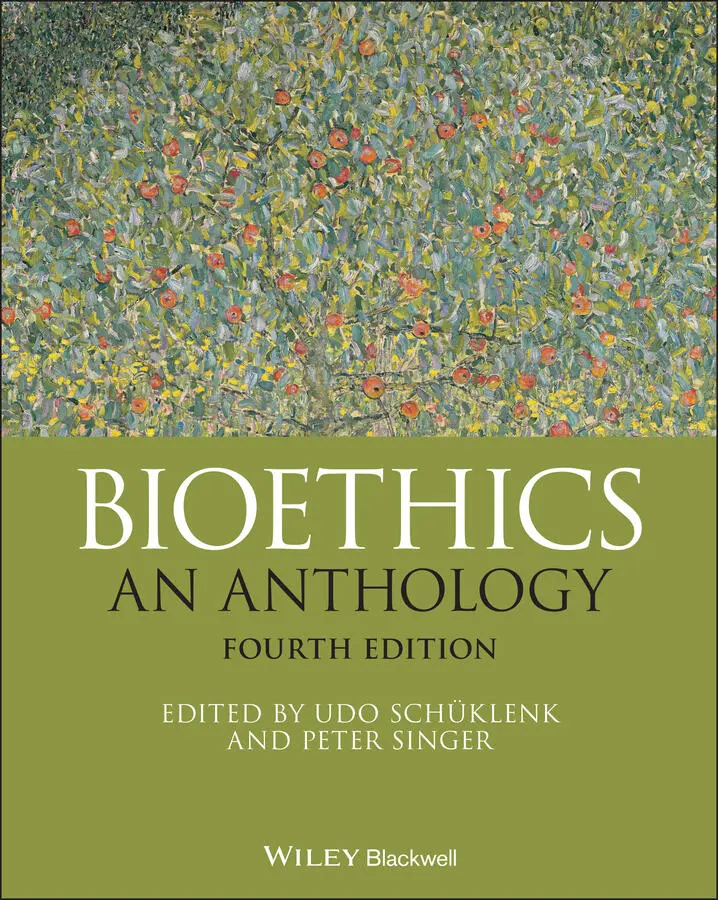
- Название:Bioethics
- Автор:
- Жанр:
- Год:неизвестен
- ISBN:нет данных
- Рейтинг книги:4 / 5. Голосов: 1
-
Избранное:Добавить в избранное
- Отзывы:
-
Ваша оценка:
Bioethics: краткое содержание, описание и аннотация
Предлагаем к чтению аннотацию, описание, краткое содержание или предисловие (зависит от того, что написал сам автор книги «Bioethics»). Если вы не нашли необходимую информацию о книге — напишите в комментариях, мы постараемся отыскать её.
For more than two decades,
has been widely regarded as the definitive single-volume compendium of seminal readings on both traditional and cutting-edge ethical issues in biology and medicine. Acclaimed for its scope and depth of coverage, this landmark work brings together compelling writings by internationally-renowned bioethicist to help readers develop a thorough understanding of the central ideas, critical issues, and current debate in the field.
Now fully revised and updated, the fourth edition contains a wealth of new content on ethical questions and controversies related to the COVID-19 pandemic, advances in CRISPR gene editing technology, physician-assisted death, public health and vaccinations, transgender children, medical aid in dying, the morality of ending the lives of newborns, and much more. Throughout the new edition, carefully selected essays explore a wide range of topics and offer diverse perspectives that underscore the interdisciplinary nature of bioethical study. Edited by two of the field’s most respected scholars, Covers an unparalleled range of thematically-organized topics in a single volume Discusses recent high-profile cases, debates, and ethical issues Features three brand-new sections: Conscientious Objection, Academic Freedom and Research, and Disability Contains new essays on topics such as brain death, life and death decisions for the critically ill, experiments on humans and animals, neuroethics, and the use of drugs to ease the pain of unrequited love Includes a detailed index that allows the reader to easily find terms and topics of interest
remains a must-have resource for all students, lecturers, and researchers studying the ethical implications of the health-related life sciences, and an invaluable reference for doctors, nurses, and other professionals working in health care and the biomedical sciences.
Bioethics — читать онлайн ознакомительный отрывок
Ниже представлен текст книги, разбитый по страницам. Система сохранения места последней прочитанной страницы, позволяет с удобством читать онлайн бесплатно книгу «Bioethics», без необходимости каждый раз заново искать на чём Вы остановились. Поставьте закладку, и сможете в любой момент перейти на страницу, на которой закончили чтение.
Интервал:
Закладка:
Note what each partisan will say. The anti‐abortionist will claim that her position is supported by such generally accepted moral principles as “It is always prima facie seriously wrong to take a human life” or “It is always prima facie seriously wrong to end the life of a baby.” Since these are generally accepted moral principles, her position is certainly not obviously wrong. The pro‐choicer will claim that her position is supported by such plausible moral principles as “Being a person is what gives an individual intrinsic moral worth” or “It is only seriously prima facie wrong to take the life of a member of the human community.” Since these are generally accepted moral principles, the pro‐choice position is certainly not obviously wrong. Unfortunately, we have again arrived at a standoff.
Now, how might one deal with this standoff? The standard approach is to try to show how the moral principles of one’s opponent lose their plausibility under analysis. It is easy to see how this is possible. On the one hand, the anti‐abortionist will defend a moral principle concerning the wrongness of killing which tends to be broad in scope in order that even fetuses at an early stage of pregnancy will fall under it. The problem with broad principles is that they often embrace too much. In this particular instance, the principle “It is always prima facie wrong to take a human life” seems to entail that it is wrong to end the existence of a living human cancer‐cell culture, on the grounds that the culture is both living and human. Therefore, it seems that the anti‐abortionist’s favored principle is too broad.
On the other hand, the pro‐choicer wants to find a moral principle concerning the wrongness of killing which tends to be narrow in scope in order that fetuses will not fall under it. The problem with narrow principles is that they often do not embrace enough. Hence, the needed principles such as “It is prima facie seriously wrong to kill only persons” or “It is prima facie wrong to kill only rational agents” do not explain why it is wrong to kill infants or young children or the severely retarded or even perhaps the severely mentally ill. Therefore, we seem again to have a standoff. The anti‐abortionist charges, not unreasonably, that pro‐choice principles concerning killing are too narrow to be acceptable; the pro‐choicer charges, not unreasonably, that anti‐abortionist principles concerning killing are too broad to be acceptable.
Attempts by both sides to patch up the difficulties in their positions run into further difficulties. The anti‐abortionist will try to remove the problem in her position by reformulating her principle concerning killing in terms of human beings. Now we end up with: “It is always prima facie seriously wrong to end the life of a human being.” This principle has the advantage of avoiding the problem of the human cancer‐cell culture counterexample. But this advantage is purchased at a high price. For although it is clear that a fetus is both human and alive, it is not at all clear that a fetus is a human being . There is at least something to be said for the view that something becomes a human being only after a process of development, and that therefore first trimester fetuses and perhaps all fetuses are not yet human beings. Hence, the anti‐abortionist, by this move, has merely exchanged one problem for another. 2
The pro‐choicer fares no better. She may attempt to find reasons why killing infants, young children, and the severely retarded is wrong which are independent of her major principle that is supposed to explain the wrongness of taking human life, but which will not also make abortion immoral. This is no easy task. Appeals to social utility will seem satisfactory only to those who resolve not to think of the enormous difficulties with a utilitarian account of the wrongness of killing and the significant social costs of preserving the lives of the unproductive. 3 A pro‐choice strategy that extends the definition of “person” to infants or even to young children seems just as arbitrary as an anti‐abortion strategy that extends the definition of “human being” to fetuses. Again, we find symmetries in the two positions and we arrive at a standoff.
There are even further problems that reflect symmetries in the two positions. In addition to counterexample problems, or the arbitrary application problems that can be exchanged for them, the standard anti‐abortionist principle “It is prima facie seriously wrong to kill a human being,” or one of its variants, can be objected to on the grounds of ambiguity. If “human being” is taken to be a biological category, then the anti‐abortionist is left with the problem of explaining why a merely biological category should make a moral difference. Why, it is asked, is it any more reasonable to base a moral conclusion on the number of chromosomes in one’s cells than on the color of one’s skin? 4 If “human being,” on the other hand, is taken to be a moral category, then the claim that a fetus is a human being cannot be taken to be a premise in the anti‐abortion argument, for it is precisely what needs to be established. Hence, either the anti‐abortionist’s main category is a morally irrelevant, merely biological category, or it is of no use to the anti‐abortionist in establishing (noncircularly, of course) that abortion is wrong.
Although this problem with the anti‐abortionist position is often noticed, it is less often noticed that the pro‐choice position suffers from an analogous problem. The principle “Only persons have the right to life” also suffers from an ambiguity. The term “person” is typically defined in terms of psychological characteristics, although there will certainly be disagreement concerning which characteristics are most important. Supposing that this matter can be settled, the pro‐choicer is left with the problem of explaining why psychological characteristics should make a moral difference. If the pro‐choicer should attempt to deal with this problem by claiming that an explanation is not necessary, that in fact we do treat such a cluster of psychological properties as having moral significance, the sharp‐witted anti‐abortionist should have a ready response. We do treat being both living and human as having moral significance. If it is legitimate for the pro‐choicer to demand that the anti‐abortionist provide an explanation of the connection between the biological character of being a human being and the wrongness of being killed (even though people accept this connection), then it is legitimate for the anti‐abortionist to demand that the pro‐choicer provide an explanation of the connection between psychological criteria for being a person and the wrongness of being killed (even though that connection is accepted). 5
Feinberg has attempted to meet this objection (he calls psychological personhood “commonsense personhood”):
The characteristics that confer commonsense personhood are not arbitrary bases for rights and duties, such as race, sex or species membership; rather they are traits that make sense out of rights and duties and without which those moral attributes would have no point or function. It is because people are conscious; have a sense of their personal identities; have plans, goals, and projects; experience emotions; are liable to pains, anxieties, and frustrations; can reason and bargain, and so on – it is because of these attributes that people have values and interests, desires and expectations of their own, including a stake in their own futures, and a personal well‐being of a sort we cannot ascribe to unconscious or nonrational beings. Because of their developed capacities they can assume duties and responsibilities and can have and make claims on one another. Only because of their sense of self, their life plans, their value hierarchies, and their stakes in their own futures can they be ascribed fundamental rights. There is nothing arbitrary about these linkages.
Читать дальшеИнтервал:
Закладка:
Похожие книги на «Bioethics»
Представляем Вашему вниманию похожие книги на «Bioethics» списком для выбора. Мы отобрали схожую по названию и смыслу литературу в надежде предоставить читателям больше вариантов отыскать новые, интересные, ещё непрочитанные произведения.

Обсуждение, отзывы о книге «Bioethics» и просто собственные мнения читателей. Оставьте ваши комментарии, напишите, что Вы думаете о произведении, его смысле или главных героях. Укажите что конкретно понравилось, а что нет, и почему Вы так считаете.