Bioethics
Здесь есть возможность читать онлайн «Bioethics» — ознакомительный отрывок электронной книги совершенно бесплатно, а после прочтения отрывка купить полную версию. В некоторых случаях можно слушать аудио, скачать через торрент в формате fb2 и присутствует краткое содержание. Жанр: unrecognised, на английском языке. Описание произведения, (предисловие) а так же отзывы посетителей доступны на портале библиотеки ЛибКат.
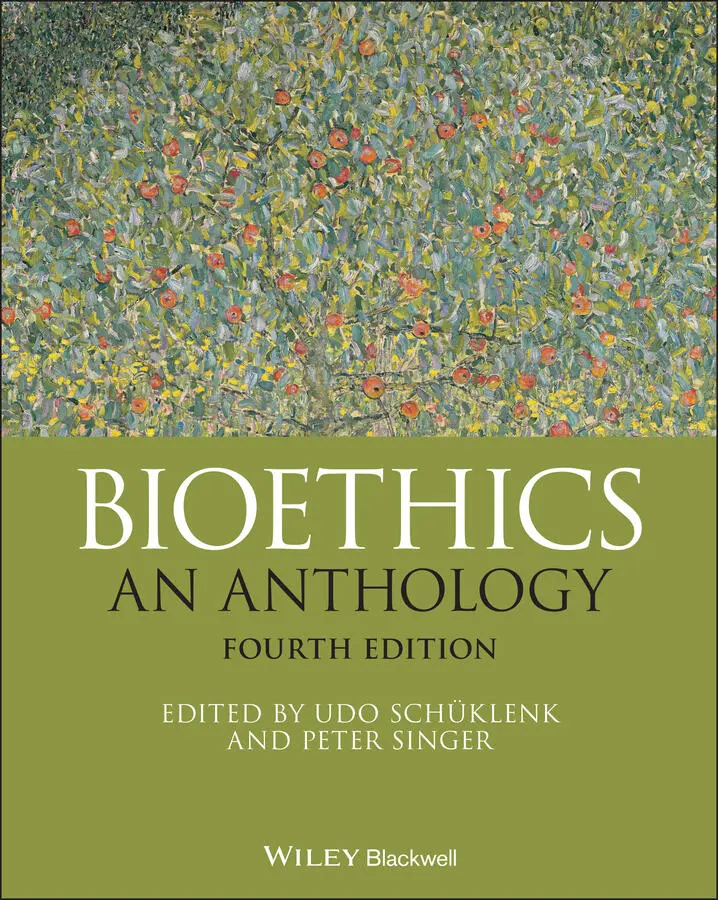
- Название:Bioethics
- Автор:
- Жанр:
- Год:неизвестен
- ISBN:нет данных
- Рейтинг книги:4 / 5. Голосов: 1
-
Избранное:Добавить в избранное
- Отзывы:
-
Ваша оценка:
Bioethics: краткое содержание, описание и аннотация
Предлагаем к чтению аннотацию, описание, краткое содержание или предисловие (зависит от того, что написал сам автор книги «Bioethics»). Если вы не нашли необходимую информацию о книге — напишите в комментариях, мы постараемся отыскать её.
For more than two decades,
has been widely regarded as the definitive single-volume compendium of seminal readings on both traditional and cutting-edge ethical issues in biology and medicine. Acclaimed for its scope and depth of coverage, this landmark work brings together compelling writings by internationally-renowned bioethicist to help readers develop a thorough understanding of the central ideas, critical issues, and current debate in the field.
Now fully revised and updated, the fourth edition contains a wealth of new content on ethical questions and controversies related to the COVID-19 pandemic, advances in CRISPR gene editing technology, physician-assisted death, public health and vaccinations, transgender children, medical aid in dying, the morality of ending the lives of newborns, and much more. Throughout the new edition, carefully selected essays explore a wide range of topics and offer diverse perspectives that underscore the interdisciplinary nature of bioethical study. Edited by two of the field’s most respected scholars, Covers an unparalleled range of thematically-organized topics in a single volume Discusses recent high-profile cases, debates, and ethical issues Features three brand-new sections: Conscientious Objection, Academic Freedom and Research, and Disability Contains new essays on topics such as brain death, life and death decisions for the critically ill, experiments on humans and animals, neuroethics, and the use of drugs to ease the pain of unrequited love Includes a detailed index that allows the reader to easily find terms and topics of interest
remains a must-have resource for all students, lecturers, and researchers studying the ethical implications of the health-related life sciences, and an invaluable reference for doctors, nurses, and other professionals working in health care and the biomedical sciences.
Bioethics — читать онлайн ознакомительный отрывок
Ниже представлен текст книги, разбитый по страницам. Система сохранения места последней прочитанной страницы, позволяет с удобством читать онлайн бесплатно книгу «Bioethics», без необходимости каждый раз заново искать на чём Вы остановились. Поставьте закладку, и сможете в любой момент перейти на страницу, на которой закончили чтение.
Интервал:
Закладка:
11 Oderberg, David (2000) Applied Ethics: A Non‐Consequentialist Approach. New York: Oxford University Press.
12 Pavlischek, Keith (1993). “Abortion logic and paternal responsibilities: One more look at Judith Thomson’s ‘Defense of abortion’.” Public Affairs Quarterly, 7: 341–61.
13 Schwarz, Stephen (1990). The Moral Question of Abortion. Chicago: Loyola University Press.
14 Stone, Jim (1987). “Why potentiality matters.” Journal of Social Philosophy, 26: 815–30.
15 Stretton, Dean (2000). “The argument from intrinsic value: A critique.” Bioethics, 14: 228–39.
Notes
1 1See, for example: Carlson (1994: chs. 2–4); Gilbert (2003: 183–220, 363–90); Larson (2001: chs. 1–2); Moore and Persaud (2003: chs. 1–6); Muller (1997: chs. 1–2); O’Rahilly and Mueller (2000: chs. 3–4).
2 2For a discussion of the issues raised by twinning and cloning, see George and Lobo (2002).
3 3Some defenders of abortion have seen the damaging implications of this point for their position (Stretton, 2004), and have struggled to find a way around it. There are two leading proposals. The first is to suggest a mean between a capacity and an actual behavior, such as a disposition. But a disposition is just the development or specification of a capacity and so raises the unanswerable question of why just that much development, and not more or less should be required. The second proposal is to assert that the historical fact of someone having exercised a capacity (say, for conceptual thought) confers on her a right to life even if she does not now have the immediately exercisable capacity. But suppose we have baby Susan who has developed a brain and gained sufficient experience to the point that just now she has the immediately exercisable capacity for conceptual thought, but she has not yet exercised it. Why should she be in a wholly different category than say, baby Mary, who is just like Susan except she did actually have a conceptual thought? Neither proposal can bear the moral weight assigned to it. Both offer criteria that are wholly arbitrary.
4 4In arguing against an article by Lee, Dean Stretton claims that the basic natural capacity of rationality also comes in degrees, and that therefore the argument we are presenting against the position that moral worth is based on having some accidental characteristic would apply to our position also (Stretton, 2004). But this is to miss the important distinction between having a basic natural capacity (of which there are no degrees, since one either has it or one doesn’t), and the development of that capacity (of which there are infinite degrees).
5 5David Boonin claims, in reply to this argument – in an earlier and less developed form, presented by Lee (1996: 122) – that it is not clear that it is impermissible for a woman to destroy what is a part of, or a continuation of, herself. He then says that to the extent the unborn human being is united to her in that way, “it would if anything seem that her act is easier to justify than if this claim were not true” (2003: 230). But Boonin fails to grasp the point of the argument (perhaps understandably since it was not expressed very clearly in the earlier work he is discussing). The unity of the child to the mother is the basis for this child being related to the woman in a different way from how other children are. We ought to pursue our own good and the good of others with whom we are united in various ways. If that is so, then the closer someone is united to us, the deeper and more extensive our responsibility to the person will be.
6 6In some sense being bodily “occupied” when one does not wish to be is a harm; however, just as the child does not (as explained in the text), neither does the state inflict this harm on the woman, in circumstances in which the state prohibits abortion. By prohibiting abortion the state would only prevent the woman from performing an act (forcibly detaching the child from her) that would unjustly kill this developing child, who is an innocent party.
4 Why Abortion is Immoral
Don Marquis
The view that abortion is, with rare exceptions, seriously immoral has received little support in the recent philosophical literature. No doubt most philosophers affiliated with secular institutions of higher education believe that the anti‐abortion position is either a symptom of irrational religious dogma or a conclusion generated by seriously confused philosophical argument. The purpose of this essay is to undermine this general belief. This essay sets out an argument that purports to show, as well as any argument in ethics can show, that abortion is, except possibly in rare cases, seriously immoral, that it is in the same moral category as killing an innocent adult human being.
The argument is based on a major assumption. Many of the most insightful and careful writers on the ethics of abortion – such as Joel Feinberg, Michael Tooley, Mary Anne Warren, H. Tristram Engelhardt, Jr, L. W. Sumner, John T. Noonan, Jr, and Philip Devine 1 – believe that whether or not abortion is morally permissible stands or falls on whether or not a fetus is the sort of being whose life it is seriously wrong to end. The argument of this essay will assume, but not argue, that they are correct.
Also, this essay will neglect issues of great importance to a complete ethics of abortion. Some anti‐abortionists will allow that certain abortions, such as abortion before implantation or abortion when the life of a woman is threatened by a pregnancy or abortion after rape, may be morally permissible. This essay will not explore the casuistry of these hard cases. The purpose of this essay is to develop a general argument for the claim that the overwhelming majority of deliberate abortions are seriously immoral.
I
A sketch of standard anti‐abortion and pro‐choice arguments exhibits how those arguments possess certain symmetries that explain why partisans of those positions are so convinced of the correctness of their own positions, why they are not successful in convincing their opponents, and why, to others, this issue seems to be unresolvable. An analysis of the nature of this standoff suggests a strategy for surmounting it.
Consider the way a typical anti‐abortionist argues. She will argue or assert that life is present from the moment of conception or that fetuses look like babies or that fetuses possess a characteristic such as a genetic code that is both necessary and sufficient for being human. Anti‐abortionists seem to believe that (1) the truth of all of these claims is quite obvious, and (2) establishing any of these claims is sufficient to show that abortion is morally akin to murder.
A standard pro‐choice strategy exhibits similarities. The pro‐choicer will argue or assert that fetuses are not persons or that fetuses are not rational agents or that fetuses are not social beings. Pro‐choicers seem to believe that (1) the truth of any of these claims is quite obvious, and (2) establishing any of these claims is sufficient to show that an abortion is not a wrongful killing.
In fact, both the pro‐choice and the anti‐abortion claims do seem to be true, although the “it looks like a baby” claim is more difficult to establish the earlier the pregnancy. We seem to have a standoff. How can it be resolved?
As everyone who has taken a bit of logic knows, if any of these arguments concerning abortion is a good argument, it requires not only some claim characterizing fetuses, but also some general moral principle that ties a characteristic of fetuses to having or not having the right to life or to some other moral characteristic that will generate the obligation or the lack of obligation not to end the life of a fetus. Accordingly, the arguments of the anti‐abortionist and the pro‐choicer need a bit of filling in to be regarded as adequate.
Читать дальшеИнтервал:
Закладка:
Похожие книги на «Bioethics»
Представляем Вашему вниманию похожие книги на «Bioethics» списком для выбора. Мы отобрали схожую по названию и смыслу литературу в надежде предоставить читателям больше вариантов отыскать новые, интересные, ещё непрочитанные произведения.

Обсуждение, отзывы о книге «Bioethics» и просто собственные мнения читателей. Оставьте ваши комментарии, напишите, что Вы думаете о произведении, его смысле или главных героях. Укажите что конкретно понравилось, а что нет, и почему Вы так считаете.