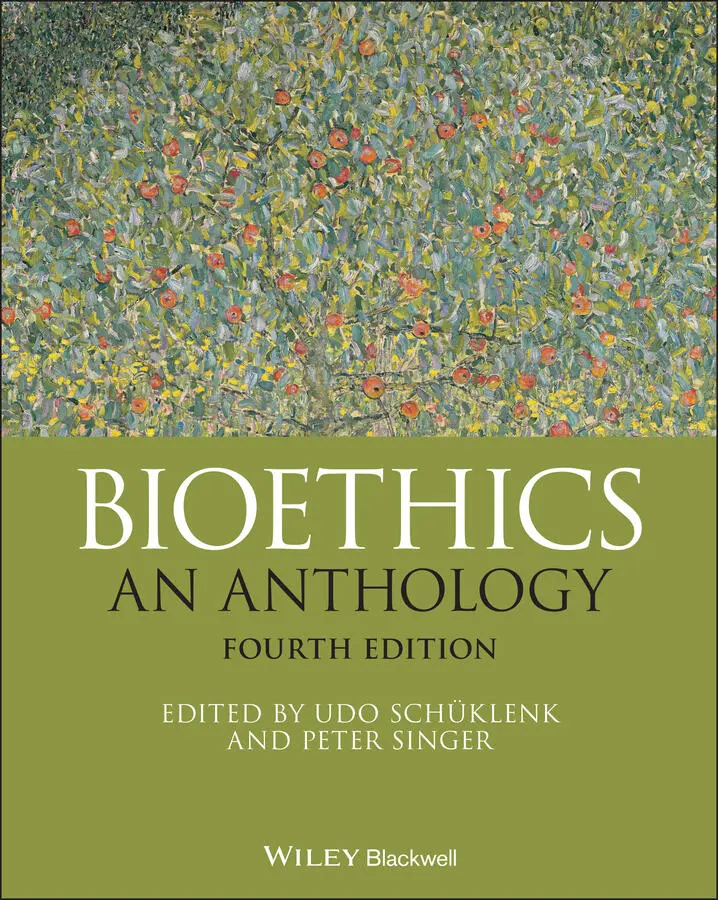
Bioethics
Здесь есть возможность читать онлайн «Bioethics» — ознакомительный отрывок электронной книги совершенно бесплатно, а после прочтения отрывка купить полную версию. В некоторых случаях можно слушать аудио, скачать через торрент в формате fb2 и присутствует краткое содержание. Жанр: unrecognised, на английском языке. Описание произведения, (предисловие) а так же отзывы посетителей доступны на портале библиотеки ЛибКат.
- Название:Bioethics
- Автор:
- Жанр:
- Год:неизвестен
- ISBN:нет данных
- Рейтинг книги:4 / 5. Голосов: 1
-
Избранное:Добавить в избранное
- Отзывы:
-
Ваша оценка:
Bioethics: краткое содержание, описание и аннотация
Предлагаем к чтению аннотацию, описание, краткое содержание или предисловие (зависит от того, что написал сам автор книги «Bioethics»). Если вы не нашли необходимую информацию о книге — напишите в комментариях, мы постараемся отыскать её.
For more than two decades,
has been widely regarded as the definitive single-volume compendium of seminal readings on both traditional and cutting-edge ethical issues in biology and medicine. Acclaimed for its scope and depth of coverage, this landmark work brings together compelling writings by internationally-renowned bioethicist to help readers develop a thorough understanding of the central ideas, critical issues, and current debate in the field.
Now fully revised and updated, the fourth edition contains a wealth of new content on ethical questions and controversies related to the COVID-19 pandemic, advances in CRISPR gene editing technology, physician-assisted death, public health and vaccinations, transgender children, medical aid in dying, the morality of ending the lives of newborns, and much more. Throughout the new edition, carefully selected essays explore a wide range of topics and offer diverse perspectives that underscore the interdisciplinary nature of bioethical study. Edited by two of the field’s most respected scholars, Covers an unparalleled range of thematically-organized topics in a single volume Discusses recent high-profile cases, debates, and ethical issues Features three brand-new sections: Conscientious Objection, Academic Freedom and Research, and Disability Contains new essays on topics such as brain death, life and death decisions for the critically ill, experiments on humans and animals, neuroethics, and the use of drugs to ease the pain of unrequited love Includes a detailed index that allows the reader to easily find terms and topics of interest
remains a must-have resource for all students, lecturers, and researchers studying the ethical implications of the health-related life sciences, and an invaluable reference for doctors, nurses, and other professionals working in health care and the biomedical sciences.
Bioethics — читать онлайн ознакомительный отрывок
Ниже представлен текст книги, разбитый по страницам. Система сохранения места последней прочитанной страницы, позволяет с удобством читать онлайн бесплатно книгу «Bioethics», без необходимости каждый раз заново искать на чём Вы остановились. Поставьте закладку, и сможете в любой момент перейти на страницу, на которой закончили чтение.
Интервал:
Закладка:
(“Abortion,” p. 270)
The plausible aspects of this attempt should not be taken to obscure its implausible features. There is a great deal to be said for the view that being a psychological person under some description is a necessary condition for having duties. One cannot have a duty unless one is capable of behaving morally, and a being’s capability of behaving morally will require having a certain psychology. It is far from obvious, however, that having rights entails consciousness or rationality, as Feinberg suggests. We speak of the rights of the severely retarded or the severely mentally ill, yet some of these persons are not rational. We speak of the rights of the temporarily unconscious. The New Jersey Supreme Court based their decision in the Quinlan case on Karen Ann Quinlan’s right to privacy, and she was known to be permanently unconscious at that time. Hence, Feinberg’s claim that having rights entails being conscious is, on its face, obviously false.
Of course, it might not make sense to attribute rights to a being that would never in its natural history have certain psychological traits. This modest connection between psychological personhood and moral personhood will create a place for Karen Ann Quinlan and the temporarily unconscious. But then it makes a place for fetuses also. Hence, it does not serve Feinberg’s pro‐choice purposes. Accordingly, it seems that the pro‐choicer will have as much difficulty bridging the gap between psychological personhood and personhood in the moral sense as the anti‐abortionist has bridging the gap between being a biological human being and being a human being in the moral sense.
Furthermore, the pro‐choicer cannot any more escape her problem by making person a purely moral category than the anti‐abortionist could escape by the analogous move. For if person is a moral category, then the pro‐choicer is left without the resources for establishing (noncircularly, of course) the claim that a fetus is not a person, which is an essential premise in her argument. Again, we have both a symmetry and a standoff between pro‐choice and anti‐abortion views.
Passions in the abortion debate run high. There are both plausibilities and difficulties with the standard positions. Accordingly, it is hardly surprising that partisans of either side embrace with fervor the moral generalizations that support the conclusions they preanalytically favor, and reject with disdain the moral generalizations of their opponents as being subject to inescapable difficulties. It is easy to believe that the counterexamples to one’s own moral principles are merely temporary difficulties that will dissolve in the wake of further philosophical research, and that the counterexamples to the principles of one’s opponents are as straightforward as the contradiction between A and O propositions in traditional logic. This might suggest to an impartial observer (if there are any) that the abortion issue is unresolvable.
There is a way out of this apparent dialectical quandary. The moral generalizations of both sides are not quite correct. The generalizations hold for the most part, for the usual cases. This suggests that they are all accidental generalizations, that the moral claims made by those on both sides of the dispute do not touch on the essence of the matter.
This use of the distinction between essence and accident is not meant to invoke obscure metaphysical categories. Rather, it is intended to reflect the rather atheoretical nature of the abortion discussion. If the generalization a partisan in the abortion dispute adopts were derived from the reason why ending the life of a human being is wrong, then there could not be exceptions to that generalization unless some special case obtains in which there are even more powerful countervailing reasons. Such generalizations would not be merely accidental generalizations; they would point to, or be based upon, the essence of the wrongness of killing, what it is that makes killing wrong. All this suggests that a necessary condition of resolving the abortion controversy is a more theoretical account of the wrongness of killing. After all, if we merely believe, but do not understand, why killing adult human beings such as ourselves is wrong, how could we conceivably show that abortion is either immoral or permissible?
II
In order to develop such an account, we can start from the following unproblematic assumption concerning our own case: it is wrong to kill us . Why is it wrong? Some answers can be easily eliminated. It might be said that what makes killing us wrong is that a killing brutalizes the one who kills. But the brutalization consists of being inured to the performance of an act that is hideously immoral; hence, the brutalization does not explain the immorality. It might be said that what makes killing us wrong is the great loss others would experience due to our absence. Although such hubris is understandable, such an explanation does not account for the wrongness of killing hermits, or those whose lives are relatively independent and whose friends find it easy to make new friends.
A more obvious answer is better. What primarily makes killing wrong is neither its effect on the murderer nor its effect on the victim’s friends and relatives, but its effect on the victim. The loss of one’s life is one of the greatest losses one can suffer. The loss of one’s life deprives one of all the experiences, activities, projects, and enjoyments that would otherwise have constituted one’s future. Therefore, killing someone is wrong, primarily because the killing inflicts (one of) the greatest possible losses on the victim. To describe this as the loss of life can be misleading, however. The change in my biological state does not by itself make killing me wrong. The effect of the loss of my biological life is the loss to me of all those activities, projects, experiences, and enjoyments which would otherwise have constituted my future personal life. These activities, projects, experiences, and enjoyments are either valuable for their own sakes or are means to something else that is valuable for its own sake. Some parts of my future are not valued by me now, but will come to be valued by me as I grow older and as my values and capacities change. When I am killed, I am deprived both of what I now value which would have been part of my future personal life, but also what I would come to value. Therefore, when I die, I am deprived of all of the value of my future. Inflicting this loss on me is ultimately what makes killing me wrong. This being the case, it would seem that what makes killing any adult human being prima facie seriously wrong is the loss of his or her future. 6
How should this rudimentary theory of the wrongness of killing be evaluated? It cannot be faulted for deriving an ‘ought’ from an ‘is’, for it does not. The analysis assumes that killing me (or you, reader) is prima facie seriously wrong. The point of the analysis is to establish which natural property ultimately explains the wrongness of the killing, given that it is wrong. A natural property will ultimately explain the wrongness of killing, only if (1) the explanation fits with our intuitions about the matter and (2) there is no other natural property that provides the basis for a better explanation of the wrongness of killing. This analysis rests on the intuition that what makes killing a particular human or animal wrong is what it does to that particular human or animal. What makes killing wrong is some natural effect or other of the killing. Some would deny this. For instance, a divine‐command theorist in ethics would deny it. Surely this denial is, however, one of those features of divine‐command theory which renders it so implausible.
The claim that what makes killing wrong is the loss of the victim’s future is directly supported by two considerations. In the first place, this theory explains why we regard killing as one of the worst of crimes. Killing is especially wrong, because it deprives the victim of more than perhaps any other crime. In the second place, people with AIDS or cancer who know they are dying believe, of course, that dying is a very bad thing for them. They believe that the loss of a future to them that they would otherwise have experienced is what makes their premature death a very bad thing for them. A better theory of the wrongness of killing would require a different natural property associated with killing which better fits with the attitudes of the dying. What could it be?
Читать дальшеИнтервал:
Закладка:
Похожие книги на «Bioethics»
Представляем Вашему вниманию похожие книги на «Bioethics» списком для выбора. Мы отобрали схожую по названию и смыслу литературу в надежде предоставить читателям больше вариантов отыскать новые, интересные, ещё непрочитанные произведения.

Обсуждение, отзывы о книге «Bioethics» и просто собственные мнения читателей. Оставьте ваши комментарии, напишите, что Вы думаете о произведении, его смысле или главных героях. Укажите что конкретно понравилось, а что нет, и почему Вы так считаете.