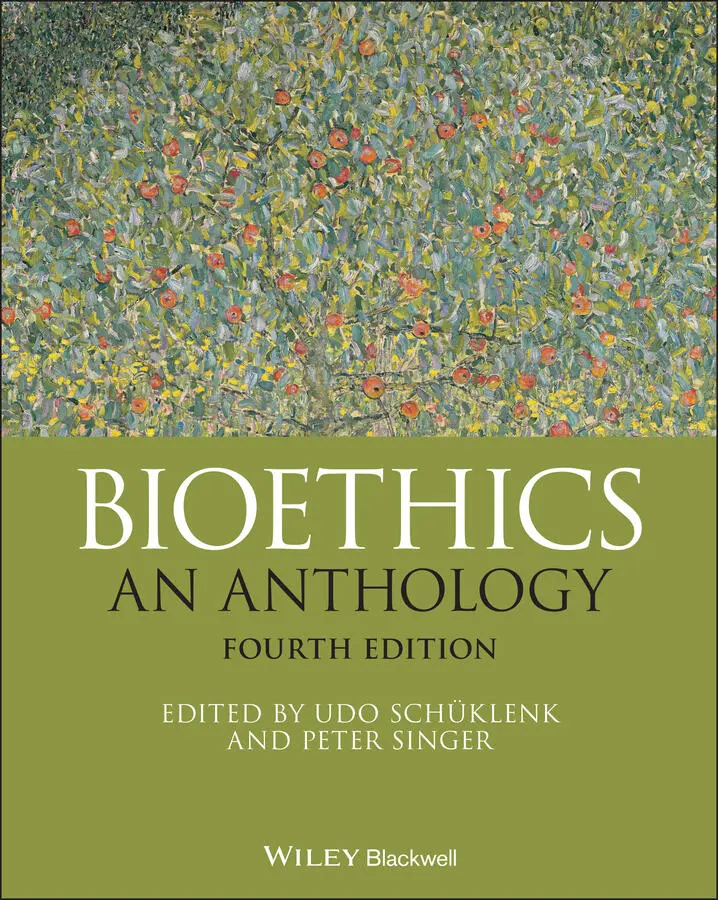
Bioethics
Здесь есть возможность читать онлайн «Bioethics» — ознакомительный отрывок электронной книги совершенно бесплатно, а после прочтения отрывка купить полную версию. В некоторых случаях можно слушать аудио, скачать через торрент в формате fb2 и присутствует краткое содержание. Жанр: unrecognised, на английском языке. Описание произведения, (предисловие) а так же отзывы посетителей доступны на портале библиотеки ЛибКат.
- Название:Bioethics
- Автор:
- Жанр:
- Год:неизвестен
- ISBN:нет данных
- Рейтинг книги:4 / 5. Голосов: 1
-
Избранное:Добавить в избранное
- Отзывы:
-
Ваша оценка:
Bioethics: краткое содержание, описание и аннотация
Предлагаем к чтению аннотацию, описание, краткое содержание или предисловие (зависит от того, что написал сам автор книги «Bioethics»). Если вы не нашли необходимую информацию о книге — напишите в комментариях, мы постараемся отыскать её.
For more than two decades,
has been widely regarded as the definitive single-volume compendium of seminal readings on both traditional and cutting-edge ethical issues in biology and medicine. Acclaimed for its scope and depth of coverage, this landmark work brings together compelling writings by internationally-renowned bioethicist to help readers develop a thorough understanding of the central ideas, critical issues, and current debate in the field.
Now fully revised and updated, the fourth edition contains a wealth of new content on ethical questions and controversies related to the COVID-19 pandemic, advances in CRISPR gene editing technology, physician-assisted death, public health and vaccinations, transgender children, medical aid in dying, the morality of ending the lives of newborns, and much more. Throughout the new edition, carefully selected essays explore a wide range of topics and offer diverse perspectives that underscore the interdisciplinary nature of bioethical study. Edited by two of the field’s most respected scholars, Covers an unparalleled range of thematically-organized topics in a single volume Discusses recent high-profile cases, debates, and ethical issues Features three brand-new sections: Conscientious Objection, Academic Freedom and Research, and Disability Contains new essays on topics such as brain death, life and death decisions for the critically ill, experiments on humans and animals, neuroethics, and the use of drugs to ease the pain of unrequited love Includes a detailed index that allows the reader to easily find terms and topics of interest
remains a must-have resource for all students, lecturers, and researchers studying the ethical implications of the health-related life sciences, and an invaluable reference for doctors, nurses, and other professionals working in health care and the biomedical sciences.
Bioethics — читать онлайн ознакомительный отрывок
Ниже представлен текст книги, разбитый по страницам. Система сохранения места последней прочитанной страницы, позволяет с удобством читать онлайн бесплатно книгу «Bioethics», без необходимости каждый раз заново искать на чём Вы остановились. Поставьте закладку, и сможете в любой момент перейти на страницу, на которой закончили чтение.
Интервал:
Закладка:
The second point is this: in the types of case we are considering, the harm caused (death) is much worse than the harms avoided (the difficulties in pregnancy). Pregnancy can involve severe impositions, but it is not nearly as bad as death – which is total and irreversible. One needn’t make light of the burdens of pregnancy to acknowledge that the harm that is death is in a different category altogether.
The burdens of pregnancy include physical difficulties and the pain of labor, and can include significant financial costs, psychological burdens, and interference with autonomy and the pursuit of other important goals (McDonagh, 1996: ch. 5). These costs are not inconsiderable. Partly for that reason, we owe our mothers gratitude for carrying and giving birth to us. However, where pregnancy does not place a woman’s life in jeopardy or threaten grave and lasting damage to her physical health, the harm done to other goods is not total. Moreover, most of the harms involved in pregnancy are not irreversible: pregnancy is a nine‐month task – if the woman and man are not in a good position to raise the child, adoption is a possibility. So the difficulties of pregnancy, considered together, are in a different and lesser category than death. Death is not just worse in degree than the difficulties involved in pregnancy; it is worse in kind.
It has been argued, however, that pregnancy can involve a unique type of burden. It has been argued that the intimacy involved in pregnancy is such that if the woman must remain pregnant without her consent then there is inflicted on her a unique and serious harm. Just as sex with consent can be a desired experience but sex without consent is a violation of bodily integrity, so (the argument continues) pregnancy involves such a close physical intertwinement with the fetus that not to allow abortion is analogous to rape – it involves an enforced intimacy (Boonin, 2003: 84; Little, 1999: 300–3).
However, this argument is based on a false analogy. Where the pregnancy is unwanted, the baby’s “occupying” the mother’s womb may involve a harm; but the child is committing no injustice against her. The baby is not forcing himself or herself on the woman, but is simply growing and developing in a way quite natural to him or her. The baby is not performing any action that could in any way be construed as aimed at violating the mother. 6
It is true that the fulfillment of the duty of a mother to her child (during gestation) is unique and in many cases does involve a great sacrifice. The argument we have presented, however, is that being a mother does generate a special responsibility, and that the sacrifice morally required of the mother is less burdensome than the harm that would be done to the child by expelling the child, causing his or her death, to escape that responsibility. Our argument equally entails responsibilities for the father of the child. His duty does not involve as direct a bodily relationship with the child as the mother’s, but it may be equally or even more burdensome. In certain circumstances, his obligation to care for the child (and the child’s mother), and especially his obligation to provide financial support, may severely limit his freedom and even require months or, indeed, years, of extremely burdensome physical labor. Historically, many men have rightly seen that their basic responsibility to their family (and country) has entailed risking, and in many cases, losing, their lives. Different people in different circumstances, with different talents, will have different responsibilities. It is no argument against any of these responsibilities to point out their distinctness.
So, the burden of carrying the baby, for all its distinctness, is significantly less than the harm the baby would suffer by being killed; the mother and father have a special responsibility to the child; it follows that intentional abortion (even in the few cases where the baby’s death is an unintended but foreseen side effect) is unjust and therefore objectively immoral.
References
1 Boonin, David (2003). A Defense of Abortion. New York: Cambridge University Press.
2 Carlson, Bruce (1994). Human Embryology and Developmental Biology. St. Louis, MO: Mosby.
3 Dworkin, Ronald (1993). Life’s Dominion: An Argument about Abortion, Euthanasia, and Individual Freedom. New York: Random House.
4 George, Robert and Lobo, Gòmez (2002). “Personal statement.” In The President’s Council on Bioethics, Human Cloning and Human Dignity: The Report of the President’s Council on Bioethics. (2002, pp. 294–306). New York: Public Affairs.
5 Gilbert, Scott (2003). Developmental Biology, 7th edn. Sunderland, MA: Sinnauer Associates.
6 Larson, William J. (2001). Human Embryology, 3rd edn. New York: Churchill Livingstone.
7 Lee, Patrick (1996). Abortion and Unborn Human Life. Washington, DC: Catholic University of America Press.
8 Little, Margaret Olivia (1999). “Abortion, intimacy, and the duty to gestate.” Ethical Theory and Moral Practice, 2: 295–312.
9 McDonagh, Eileen (1996). Breaking the Abortion Deadlock: From Choice to Consent. New York: Oxford University Press, 1996.
10 Moore, Keith, and Persaud, T. V. N. (2003). The Developing Human, Clinically Oriented Embryology, 7th edn. New York: W. B. Saunders.
11 Muller, Werner A. (1997). Developmental Biology. New York: Springer Verlag.
12 O’Rahilly, Ronan, and Mueller, Fabiola (2000). Human Embryology and Teratology, 3rd edn. New York: John Wiley & Sons.
13 Singer, Peter (1993). Practical Ethics, 2nd edn. Cambridge: Cambridge University Press.
14 Stretton, Dean (2004). “Essential properties and the right to life: a response to Lee.” Bioethics, 18/3: 264–82.
15 Thomson, Judith Jarvis (1971). “A defense of abortion.” Philosophy and Public Affairs, 1: 47–66; reprinted, among other places, in Joel Feinberg (ed.) The Problem of Abortion, 2nd edn. Belmont, CA: Wadsworth (1984, pp. 173–87).
16 Thomson, Judith Jarvis (1995). “Abortion.” Boston Review. Available at [ http://bostonreview.net/archives/BR20.3/thomson.php]
17 Tooley, Michael (1983). Abortion and Infanticide. New York: Oxford University Press.
18 Warren, Mary Ann (1984). “On the moral and legal status of abortion.” In Joel Feinberg (ed.) The Problem of Abortion, 2nd edn. Belmont, CA: Wadsworth (1984, pp. 102–19).
Further reading
1 Bailey, Ronald, Lee, Patrick, and George, Robert P. (2001). “Are stem cells babies?” Reason Online. Available at https://reason.com/2001/07/11/are‐stem‐cells‐babies/
2 Beckwith, Francis (1993). Politically Correct Death: Answering the Arguments for Abortion Rights. Grand Rapids, MI: Baker.
3 Beckwith, Francis (2000). Abortion and the Sanctity of Human Life. Joplin, MO: College Press.
4 Chappell, T. D. J. (1998). Understanding Human Goods: A Theory of Ethics. Edinburgh: Edinburgh University Press.
5 Finnis, John (1999). “Abortion and health care ethics.” In Helga Kuhse and Peter Singer (eds.), Bioethics: An Anthology (pp. 13–20). London: Blackwell.
6 Finnis, John (2001). “Abortion and cloning: some new evasions.” Available at http://lifeissues.net/writers/fin/fin_01aborcloneevasions.html
7 George, Robert (2001). “We should not kill human embryos – for any reason.” In The Clash of Orthodoxies: Law, Religion, and Morality in Crisis (pp. 317–23). Wilmington, DL: ISI Books.
8 Grisez, Germain (1990). “When do people begin?” Proceedings of the American Catholic Philosophical Quarterly, 63: 27–47.
9 Lee, Patrick (2004). “The pro‐life argument from substantial identity: A defense.” Bioethics, 18(3): 249–63.
10 Marquis, Don (1989). “Why abortion is immoral.” Journal of Philosophy, 86: 183–202.
Читать дальшеИнтервал:
Закладка:
Похожие книги на «Bioethics»
Представляем Вашему вниманию похожие книги на «Bioethics» списком для выбора. Мы отобрали схожую по названию и смыслу литературу в надежде предоставить читателям больше вариантов отыскать новые, интересные, ещё непрочитанные произведения.

Обсуждение, отзывы о книге «Bioethics» и просто собственные мнения читателей. Оставьте ваши комментарии, напишите, что Вы думаете о произведении, его смысле или главных героях. Укажите что конкретно понравилось, а что нет, и почему Вы так считаете.