Bioethics
Здесь есть возможность читать онлайн «Bioethics» — ознакомительный отрывок электронной книги совершенно бесплатно, а после прочтения отрывка купить полную версию. В некоторых случаях можно слушать аудио, скачать через торрент в формате fb2 и присутствует краткое содержание. Жанр: unrecognised, на английском языке. Описание произведения, (предисловие) а так же отзывы посетителей доступны на портале библиотеки ЛибКат.
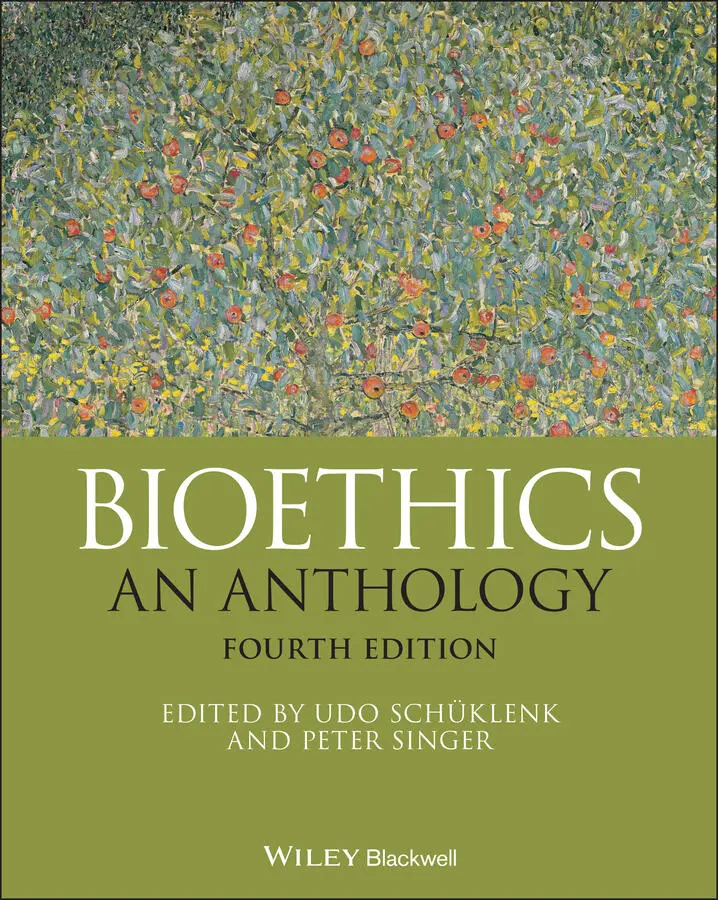
- Название:Bioethics
- Автор:
- Жанр:
- Год:неизвестен
- ISBN:нет данных
- Рейтинг книги:4 / 5. Голосов: 1
-
Избранное:Добавить в избранное
- Отзывы:
-
Ваша оценка:
Bioethics: краткое содержание, описание и аннотация
Предлагаем к чтению аннотацию, описание, краткое содержание или предисловие (зависит от того, что написал сам автор книги «Bioethics»). Если вы не нашли необходимую информацию о книге — напишите в комментариях, мы постараемся отыскать её.
For more than two decades,
has been widely regarded as the definitive single-volume compendium of seminal readings on both traditional and cutting-edge ethical issues in biology and medicine. Acclaimed for its scope and depth of coverage, this landmark work brings together compelling writings by internationally-renowned bioethicist to help readers develop a thorough understanding of the central ideas, critical issues, and current debate in the field.
Now fully revised and updated, the fourth edition contains a wealth of new content on ethical questions and controversies related to the COVID-19 pandemic, advances in CRISPR gene editing technology, physician-assisted death, public health and vaccinations, transgender children, medical aid in dying, the morality of ending the lives of newborns, and much more. Throughout the new edition, carefully selected essays explore a wide range of topics and offer diverse perspectives that underscore the interdisciplinary nature of bioethical study. Edited by two of the field’s most respected scholars, Covers an unparalleled range of thematically-organized topics in a single volume Discusses recent high-profile cases, debates, and ethical issues Features three brand-new sections: Conscientious Objection, Academic Freedom and Research, and Disability Contains new essays on topics such as brain death, life and death decisions for the critically ill, experiments on humans and animals, neuroethics, and the use of drugs to ease the pain of unrequited love Includes a detailed index that allows the reader to easily find terms and topics of interest
remains a must-have resource for all students, lecturers, and researchers studying the ethical implications of the health-related life sciences, and an invaluable reference for doctors, nurses, and other professionals working in health care and the biomedical sciences.
Bioethics — читать онлайн ознакомительный отрывок
Ниже представлен текст книги, разбитый по страницам. Система сохранения места последней прочитанной страницы, позволяет с удобством читать онлайн бесплатно книгу «Bioethics», без необходимости каждый раз заново искать на чём Вы остановились. Поставьте закладку, и сможете в любой момент перейти на страницу, на которой закончили чтение.
Интервал:
Закладка:
It is true that in some cases causing death as a side effect is morally permissible. For example, in some cases it is morally right to use force to stop a potentially lethal attack on one’s family or country, even if one foresees that the force used will also result in the assailant’s death. Similarly, there are instances in which it is permissible to perform an act that one knows or believes will, as a side effect, cause the death of a child in utero . For example, if a pregnant woman is discovered to have a cancerous uterus, and this is a proximate danger to the mother’s life, it can be morally right to remove the cancerous uterus with the baby in it, even if the child will die as a result. A similar situation can occur in ectopic pregnancies. But in such cases, not only is the child’s death a side effect, but the mother’s life is in proximate danger. It is worth noting also that in these cases what is done (the means) is the correction of a pathology (such as a cancerous uterus, or a ruptured uterine tube). Thus, in such cases, not only the child’s death, but also the ending of the pregnancy, are side effects. So, such acts are what traditional casuistry referred to as indirect or non‐intentional, abortions.
But it is also clear that not every case of causing death as a side effect is morally right. For example, if a man’s daughter has a serious respiratory disease and the father is told that his continued smoking in her presence will cause her death, it would obviously be immoral for him to continue the smoking. Similarly, if a man works for a steel company in a city with significant levels of air pollution, and his child has a serious respiratory problem making the air pollution a danger to her life, certainly he should move to another city. He should move, we would say, even if that meant he had to resign a prestigious position or make a significant career change.
In both examples, (a) the parent has a special responsibility to his child, but (b) the act that would cause the child’s death would avoid a harm to the parent but cause a significantly worse harm to his child. And so, although the harm done would be a side effect, in both cases the act that caused the death would be an unjust act, and morally wrongful as such . The special responsibility of parents to their children requires that they at least refrain from performing acts that cause terrible harms to their children in order to avoid significantly lesser harms to themselves.
But (a) and (b) also obtain in intentional abortions (that is, those in which the removal of the child is directly sought, rather than the correction of a life‐threatening pathology) even though they are not, strictly speaking, intentional killing. First, the mother has a special responsibility to her child, in virtue of being her biological mother (as does the father in virtue of his paternal relationship). The parental relationship itself – not just the voluntary acceptance of that relationship – gives rise to a special responsibility to a child.
Proponents of the bodily rights argument deny this point. Many claim that one has full parental responsibilities only if one has voluntarily assumed them. And so the child, on this view, has a right to care from his or her mother (including gestation) only if the mother has accepted her pregnancy, or perhaps only if the mother (and/or the father?) has in some way voluntarily begun a deep personal relationship with the child (Little, 1999).
But suppose a mother takes her baby home after giving birth, but the only reason she did not get an abortion was that she could not afford one. Or suppose she lives in a society where abortion is not available (perhaps very few physicians are willing to do the grisly deed). She and her husband take the child home only because they had no alternative. Moreover, suppose that in their society people are not waiting in line to adopt a newborn baby. And so the baby is several days old before anything can be done. If they abandon the baby and the baby is found, she will simply be returned to them. In such a case the parents have not voluntarily assumed responsibility; nor have they consented to a personal relationship with the child. But it would surely be wrong for these parents to abandon their baby in the woods (perhaps the only feasible way of ensuring she is not returned), even though the baby’s death would be only a side effect. Clearly, we recognize that parents do have a responsibility to make sacrifices for their children, even if they have not voluntar[il]y assumed such responsibilities, or given their consent to the personal relationship with the child.
The bodily rights argument implicitly supposes that we have a primordial right to construct a life simply as we please, and that others have claims on us only very minimally or through our (at least tacit) consent to a certain sort of relationship with them. On the contrary, we are by nature members of communities. Our moral goodness or character consists to a large extent (though not solely) in contributing to the communities of which we are members. We ought to act for our genuine good or flourishing (we take that as a basic ethical principle), but our flourishing involves being in communion with others. And communion with others of itself – even if we find ourselves united with others because of a physical or social relationship which precedes our consent – entails duties or responsibilities. Moreover, the contribution we are morally required to make to others will likely bring each of us some discomfort and pain. This is not to say that we should simply ignore our own good, for the sake of others. Rather, since what (and who) I am is in part constituted by various relationships with others, not all of which are initiated by my will, my genuine good includes the contributions I make to the relationships in which I participate. Thus, the life we constitute by our free choices should be in large part a life of mutual reciprocity with others.
For example, I may wish to cultivate my talent to write and so I may want to spend hours each day reading and writing. Or I may wish to develop my athletic abilities and so I may want to spend hours every day on the baseball field. But if I am a father of minor children, and have an adequate paying job working (say) in a coal mine, then my clear duty is to keep that job. Similarly, if one’s girlfriend finds she is pregnant and one is the father, then one might also be morally required to continue one’s work in the mine (or mill, factory, warehouse, etc.).
In other words, I have a duty to do something with my life that contributes to the good of the human community, but that general duty becomes specified by my particular situation. It becomes specified by the connection or closeness to me of those who are in need. We acquire special responsibilities toward people, not only by consenting to contracts or relationships with them, but also by having various types of union with them. So, we have special responsibilities to those people with whom we are closely united. For example, we have special responsibilities to our parents, and brothers and sisters, even though we did not choose them.
The physical unity or continuity of children to their parents is unique. The child is brought into being out of the bodily unity and bodies of the mother and the father. The mother and the father are in a certain sense prolonged or continued in their offspring. So, there is a natural unity of the mother with her child, and a natural unity of the father with his child. Since we have special responsibilities to those with whom we are closely united, it follows that we in fact do have a special responsibility to our children anterior to our having voluntarily assumed such responsibility or consented to the relationship. 5
Читать дальшеИнтервал:
Закладка:
Похожие книги на «Bioethics»
Представляем Вашему вниманию похожие книги на «Bioethics» списком для выбора. Мы отобрали схожую по названию и смыслу литературу в надежде предоставить читателям больше вариантов отыскать новые, интересные, ещё непрочитанные произведения.

Обсуждение, отзывы о книге «Bioethics» и просто собственные мнения читателей. Оставьте ваши комментарии, напишите, что Вы думаете о произведении, его смысле или главных героях. Укажите что конкретно понравилось, а что нет, и почему Вы так считаете.