Bioethics
Здесь есть возможность читать онлайн «Bioethics» — ознакомительный отрывок электронной книги совершенно бесплатно, а после прочтения отрывка купить полную версию. В некоторых случаях можно слушать аудио, скачать через торрент в формате fb2 и присутствует краткое содержание. Жанр: unrecognised, на английском языке. Описание произведения, (предисловие) а так же отзывы посетителей доступны на портале библиотеки ЛибКат.
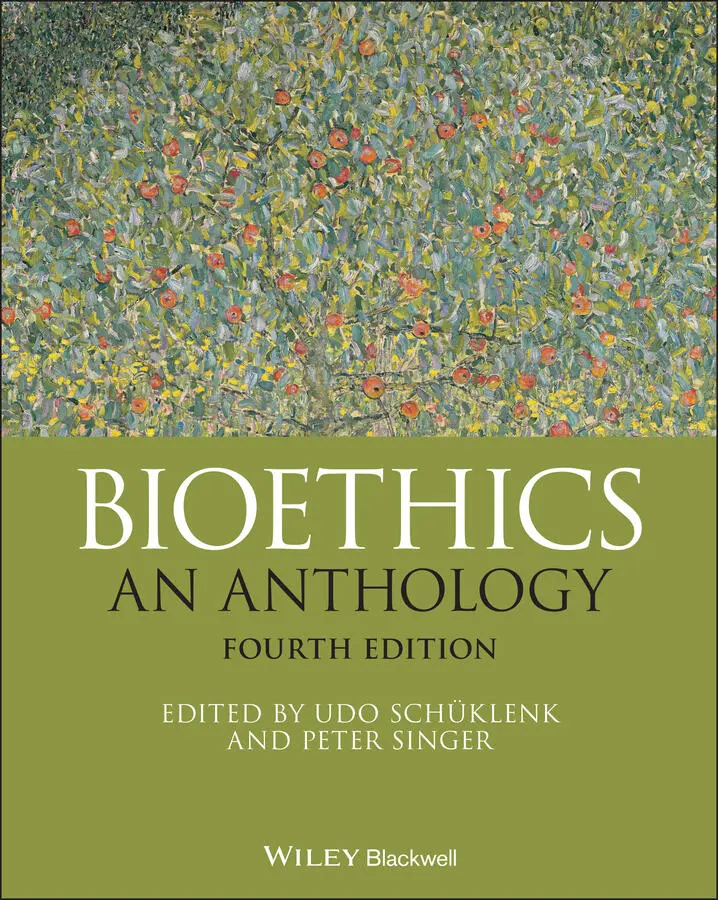
- Название:Bioethics
- Автор:
- Жанр:
- Год:неизвестен
- ISBN:нет данных
- Рейтинг книги:4 / 5. Голосов: 1
-
Избранное:Добавить в избранное
- Отзывы:
-
Ваша оценка:
Bioethics: краткое содержание, описание и аннотация
Предлагаем к чтению аннотацию, описание, краткое содержание или предисловие (зависит от того, что написал сам автор книги «Bioethics»). Если вы не нашли необходимую информацию о книге — напишите в комментариях, мы постараемся отыскать её.
For more than two decades,
has been widely regarded as the definitive single-volume compendium of seminal readings on both traditional and cutting-edge ethical issues in biology and medicine. Acclaimed for its scope and depth of coverage, this landmark work brings together compelling writings by internationally-renowned bioethicist to help readers develop a thorough understanding of the central ideas, critical issues, and current debate in the field.
Now fully revised and updated, the fourth edition contains a wealth of new content on ethical questions and controversies related to the COVID-19 pandemic, advances in CRISPR gene editing technology, physician-assisted death, public health and vaccinations, transgender children, medical aid in dying, the morality of ending the lives of newborns, and much more. Throughout the new edition, carefully selected essays explore a wide range of topics and offer diverse perspectives that underscore the interdisciplinary nature of bioethical study. Edited by two of the field’s most respected scholars, Covers an unparalleled range of thematically-organized topics in a single volume Discusses recent high-profile cases, debates, and ethical issues Features three brand-new sections: Conscientious Objection, Academic Freedom and Research, and Disability Contains new essays on topics such as brain death, life and death decisions for the critically ill, experiments on humans and animals, neuroethics, and the use of drugs to ease the pain of unrequited love Includes a detailed index that allows the reader to easily find terms and topics of interest
remains a must-have resource for all students, lecturers, and researchers studying the ethical implications of the health-related life sciences, and an invaluable reference for doctors, nurses, and other professionals working in health care and the biomedical sciences.
Bioethics — читать онлайн ознакомительный отрывок
Ниже представлен текст книги, разбитый по страницам. Система сохранения места последней прочитанной страницы, позволяет с удобством читать онлайн бесплатно книгу «Bioethics», без необходимости каждый раз заново искать на чём Вы остановились. Поставьте закладку, и сможете в любой момент перейти на страницу, на которой закончили чтение.
Интервал:
Закладка:
15 15Note carefully the reasons he gives on the bottom of p. 316.
Introduction
Developments in reproductive medicine have, over the past 50 years, presented us with remarkable new options, giving us increasing control over our fertility. Effective contraception and sterilization procedures have separated sex from reproduction, while various infertility treatments, such as in vitro fertilization, have dramatically increased the possibilities for reproduction without sex. Fertile couples are now able to limit and space the number of children they are going to have, while those who were once considered infertile are able to have children.
There are also new opportunities to decide what our children will be like. Prenatal diagnosis of fetuses and testing of in vitro embryos allows prospective parents to decide not to bring a disabled child into the world, even without the use of abortion. (Those who accept the view defended by Patrick Lee and Rober P. George in the previous Part of this Anthology will not be mollified by a procedure that still involves the discarding of a viable human embryo.) The same techniques allow parents to select the sex of their child. Cloning and genetic modification of offspring are now possible for several species of mammals, and some think that it is only a matter of time before they take place in humans as well.
A wide range of different issues are covered in this Part of the Anthology . Two interrelated clusters of questions, whilst by no means exhaustive of the ethical issues raised, are central to many of the discussions presented here: the limits, if any, to reproductive freedom, and the rights or interests of future children.
Assisted Reproduction
Being unable to have children can be a source of profound grief and great unhappiness. But some widely accepted technologies and procedures for overcoming infertility continue to raise troubling ethical issues. Fertility drugs given to women to enhance the production of eggs can lead to multiple pregnancies. When a woman carries more than one fetus, infants are frequently born prematurely and, if not stillborn, may have to spend long periods in neonatal intensive care. There is also an increased risk of brain damage and other serious disabilities.
In the first article in this Part, Greg Pence (“The McCaughey Septuplets: God’s Will or Human Choice?”) describes the case of 29‐year‐old Bobbi McCaughey, whose use of a fertility drug led to her giving birth, in 1996, to seven infants. All survived, but with a range of different disabilities. While aware of the risks, the couple had rejected the idea of selectively aborting a number of the fetuses, saying that whatever happened was “God’s will”. But, writes Pence, it is difficult to hold God responsible for any children turning out disabled or dead: “If God was clear about anything in this case, it was that the McCaugheys should not have kids. Otherwise, why did He make them infertile?” Rather than being able to claim that God is responsible, Pence argues, those who take fertility drugs should, if necessary, be willing to reduce the number of fetuses “for the good of the children” born.
One outcome of the new reproductive techniques is that they make it easier for same‐sex couples to have children who are genetically related to at least one of them.
A few years ago, to discuss the provision of assisted reproduction to same‐sex couples would have been pushing the frontiers of what is socially acceptable.
With increasing acceptance of same‐sex marriage, and of the rights of same‐sex couples to have children, however, the use of assisted reproduction by same‐sex couples is increasing, and no longer seems as shocking as it once did. Timothy F. Murphy in “The Meaning of Synthetic Gametes for Gay and Lesbian People and Bioethics too” asks why so many ethical analyses of such technologies still treat same‐sex couples’ use of them as controversial, while the same questions are not raised when it comes to opposite‐sex couples. He responds to arguments defending the view that children ought to be conceived only under certain natural conditions, noting that there is no evidence that children who are conceived by other means are harmed in any way by the conditions of their conception and parentage.
Other authors have argued that anonymous donor gametes are problematic because that option would separate children from their biological parents. David Velleman offers such an account. He thinks that without knowledge of one’s genetic parents children would suffer an information deficit in terms of what kind of life they could expect with genes like theirs. Murphy tackles this argument by pointing to the fact that children conceived of the synthetic gametes of a same‐sex couple would not actually suffer such an information deficit, and so new technologies could actually insist in overcoming the disadvantage Velleman is concerned about.
Murphy concludes his analysis by addressing the objection from shared genetics. He rejects the idea that shared genetics is a necessary condition for good parenthood, agreeing instead with Thomas Murray, who argued that what makes for good parenthood is a moral commitment to one’s offspring.
When controversial new reproductive possibilities are first mooted, those opposed to the innovation often argue that the children produced by it will be harmed in some way. This argument was used against the introduction of in vitro fertilization, and it was also used against same‐sex couples being allowed to have children. So far, such arguments have generally lacked evidence; but in any case, should we accept the assumption that if children produced by a new reproductive technique were in some way less well‐off than other children, this would be a ground for not permitting the new technique? Derek Parfit offers an argument against this assumption in his article “Rights, Interests, and Possible People.” He asks readers to consider the case of a woman who wants to stop taking contraceptive pills in order to have another child. She is told by her doctor that she is suffering from a temporary condition that will result in any child she conceives now having a disability – although one that is still compatible with living a worthwhile life. If she waits three months, on the other hand, she will conceive a normal child. Many people think that if the woman decides not to wait, she will be harming her child. But, Parfit argues, this conclusion does not follow. If the woman were to wait, she would not be having this child, but a different child – a child conceived three months later from a different egg and a different sperm. Based on the assumption that the first child, while disabled, has a life worth living, it would thus be difficult to claim that the disabled child has been harmed by having been brought into existence. His life is still better than no life at all.
If Parfit is correct on this point, could it still be claimed that single women and lesbian couples should be denied access to infertility services for the sake of their as‐yet‐unconceived children? On the face of it, this could be argued only if these children were going to have lives so devoid of happiness and whatever else makes a life worth living that non‐existence is preferable to existence. Given that this is an implausible supposition, denying access to infertility services to same‐sex couples would prevent the existence of children who would very probably have lived worthwhile lives. We can hardly justify a prohibition on the use of assisted reproduction on the grounds that the prohibition is in the best interests of the children who would be born as a result of that use, if the children would have worthwhile lives, and without the availability of the technique, would not be born at all.
Читать дальшеИнтервал:
Закладка:
Похожие книги на «Bioethics»
Представляем Вашему вниманию похожие книги на «Bioethics» списком для выбора. Мы отобрали схожую по названию и смыслу литературу в надежде предоставить читателям больше вариантов отыскать новые, интересные, ещё непрочитанные произведения.

Обсуждение, отзывы о книге «Bioethics» и просто собственные мнения читателей. Оставьте ваши комментарии, напишите, что Вы думаете о произведении, его смысле или главных героях. Укажите что конкретно понравилось, а что нет, и почему Вы так считаете.