Bioethics
Здесь есть возможность читать онлайн «Bioethics» — ознакомительный отрывок электронной книги совершенно бесплатно, а после прочтения отрывка купить полную версию. В некоторых случаях можно слушать аудио, скачать через торрент в формате fb2 и присутствует краткое содержание. Жанр: unrecognised, на английском языке. Описание произведения, (предисловие) а так же отзывы посетителей доступны на портале библиотеки ЛибКат.
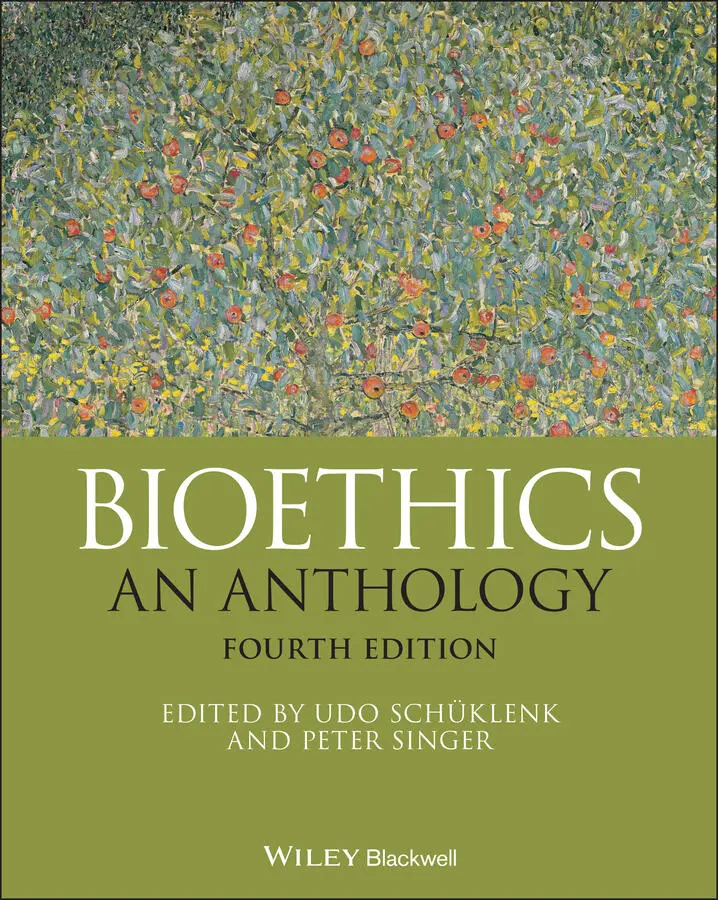
- Название:Bioethics
- Автор:
- Жанр:
- Год:неизвестен
- ISBN:нет данных
- Рейтинг книги:4 / 5. Голосов: 1
-
Избранное:Добавить в избранное
- Отзывы:
-
Ваша оценка:
Bioethics: краткое содержание, описание и аннотация
Предлагаем к чтению аннотацию, описание, краткое содержание или предисловие (зависит от того, что написал сам автор книги «Bioethics»). Если вы не нашли необходимую информацию о книге — напишите в комментариях, мы постараемся отыскать её.
For more than two decades,
has been widely regarded as the definitive single-volume compendium of seminal readings on both traditional and cutting-edge ethical issues in biology and medicine. Acclaimed for its scope and depth of coverage, this landmark work brings together compelling writings by internationally-renowned bioethicist to help readers develop a thorough understanding of the central ideas, critical issues, and current debate in the field.
Now fully revised and updated, the fourth edition contains a wealth of new content on ethical questions and controversies related to the COVID-19 pandemic, advances in CRISPR gene editing technology, physician-assisted death, public health and vaccinations, transgender children, medical aid in dying, the morality of ending the lives of newborns, and much more. Throughout the new edition, carefully selected essays explore a wide range of topics and offer diverse perspectives that underscore the interdisciplinary nature of bioethical study. Edited by two of the field’s most respected scholars, Covers an unparalleled range of thematically-organized topics in a single volume Discusses recent high-profile cases, debates, and ethical issues Features three brand-new sections: Conscientious Objection, Academic Freedom and Research, and Disability Contains new essays on topics such as brain death, life and death decisions for the critically ill, experiments on humans and animals, neuroethics, and the use of drugs to ease the pain of unrequited love Includes a detailed index that allows the reader to easily find terms and topics of interest
remains a must-have resource for all students, lecturers, and researchers studying the ethical implications of the health-related life sciences, and an invaluable reference for doctors, nurses, and other professionals working in health care and the biomedical sciences.
Bioethics — читать онлайн ознакомительный отрывок
Ниже представлен текст книги, разбитый по страницам. Система сохранения места последней прочитанной страницы, позволяет с удобством читать онлайн бесплатно книгу «Bioethics», без необходимости каждый раз заново искать на чём Вы остановились. Поставьте закладку, и сможете в любой момент перейти на страницу, на которой закончили чтение.
Интервал:
Закладка:
The HFEA is in essentially the same position as ACRE in the 1990s. Its legal responsibilities stop it from addressing the public’s real concerns, about the trends of objectification, consumerism and eugenics, and where these technologies, step by step, are taking us. As long as HFEA continues to work this way, the head of steam will continue to build, and who knows how it will be released.
Clearly what is needed is an ethical discourse that can articulate and discuss people’s real, long‐term concerns, and can balance them against the demands of individual cases. Here we see a key distinction from the debate over GMOs, where the pressure for ‘progress’ was driven by the cold and unsympathetic imperatives of science and the market, with no clear benefit to people. With reproductive technology we risk being overwhelmed by a tidal wave of sentiment about sick children, blinding us to where these decisions are leading. In public discussion of the Whitaker case, many parents said they would do anything to save their sick child. God preserve us from people who will do anything! We must not make public policy, with profound long‐term consequences, on the basis of individual families’ desperation, however much we may empathise with them.
Ultimately, an adequate ethical discourse needs to reassess the dominant imperative to eliminate all disease and suffering, and the moral blackmail which is wielded at those who dare to suggest that other concerns might have equal importance. For if we fail to do so, we will find, not so far in the future, that the consequences of abandoning principle after principle will be felt not only in terms of a moral vacuum, but in the profound suffering of real human beings, in ways that we can now only begin to imagine.
12 The Moral Status of Human Cloning: Neo‐Lockean Persons versus Human Embryos
Michael Tooley
Introduction
Cloning human organisms may have quite different goals. The object may be to produce a human organism that will develop into a normal person. Alternatively, the goal may be to produce a human embryo for scientific research purposes, or as a source of stem cells to be used in medical treatments. Yet another possibility is the creation of a human to serve as a future organ bank for some presently existing person. In this essay, I shall consider whether cloning is or is not morally permissible in each of these three cases.
1 A Crucial Concept: neo‐Lockean Persons
1.1 John Locke’s concept of a person
In chapter 27of An Essay Concerning Human Understanding , John Locke (1632–1704) discussed the idea of identity, and there he distinguished between the identity of a man – that is, of a human animal – and the identity of a person. As regards the former, Locke’s view was as follows:
This also shows wherein the identity of the same man consists: viz. in nothing but a participation of the same continued life, by constantly fleeting particles of matter, in succession vitally united to the same organized body. (chap. 27, para. 6)
As regards the concept of a person, however, Locke offered a very different account:
… to find wherein personal identity consists, we must consider what person stands for; which I think, is a thinking intelligent being that has reason and reflection and can consider itself as itself, the same thinking thing in different times and places; which it does only by that consciousness which is inseparable from thinking and, as it seems to me, essential to it …. For since consciousness always accompanies thinking, and it is that that makes everyone to be what he calls self , and thereby distinguishes himself from all other thinking things: in this alone consists personal identity , i.e. the sameness of a rational being. (chap.27, para. 9)
Not all of this is as clear as it could be, and philosophers have offered slightly different interpretations of Locke’s concept of personal identity, and thus of his concept of a person. What is crucial here, however, are not the details, but simply that, on Locke’s account, a person is an entity that (1) has conscious mental states at some times, (2) has the capacity for thought at some times, and (3) has thoughts at some times that are mentally linked to conscious states at other times.
Locke’s concept of a person is clearly very different from his concept of a human animal. It could turn out, of course, that all human animals, at any time, are in fact persons, in Locke’s sense. We shall see shortly, however, that there are very strong scientific arguments against that possibility.
1.2 The concept of a neo‐Lockean person
I shall sometimes use the expression “neo‐Lockean person,” and this for three reasons. First of all, as just mentioned, disagreements exist concerning the correct interpretations of the passages where Locke introduces his idea of a person, and no stand need be taken on that issue. Secondly one might want to include in one's concept of a person elements that Locke does not mention, such as desires concerning one’s mental states at other times. Thirdly, the term “person” is sometimes used, especially by those who believe that abortion is seriously wrong, in two other, very different ways: sometimes as a purely evaluative term, meaning simply “entity with a right to life,” and sometimes as a purely biological expression, meaning “member of the biologically defined species homo sapiens .” Such uses of the term “person” contain no reference at all to consciousness, or to the capacity for thought, or to any mental states whatsoever. The expression “neo‐Lockean person” functions, then, to rule out such interpretations.
Constant use of that expression, however, would become a bit tiresome, so I shall often simply use the term “person,” with the understanding that it is always an abbreviation of “neo‐Lockean person.”
What, then, do I mean by “person”/ “neo‐Lockean person”? The answer is that a neo‐Lockean person is an entity that has, at least at one time , a memory involving a conscious thought about an earlier state of consciousness . Something that has never enjoyed a single state of consciousness is thus not a neo‐Lockean person. Similarly, something that has never had a conscious thought cannot be a neo‐Lockean person. Finally, something that has never had a memory thought about an earlier state of consciousness cannot be a neo‐Lockean person.
A neo‐Lockean person exists, then, when the consciousness condition , the conscious thought condition, and the memory thought conditions are all satisfied.
1.3 Distortions of the concept of a neo‐Lockean person
Arguments are rarely offered against the view that only neo‐Lockean persons have a right to life, and when offered, they inevitably misrepresent the concept of a neo‐Lockean person. A typical example is Christopher Kaczor who, in his book The Ethics of Abortion , considers the following possible necessary conditions for existing as a neo‐Lockean person at a time: (1) being self‐aware at that time; (2) having an immediately exercisable capacity for self‐awareness; (3) having functional hardware that is a basis of the capacity for self‐awareness; (4) having an active potentiality for reacquiring a capacity for self‐awareness; (5) having a passive potentiality for reacquiring the capacity for self‐awareness (2014, 31–5).
All of this is a complete failure – or an unwillingness – to recognize what lies at the heart of the concept of a neo‐Lockean person, namely, the existence of a memory that, if accessed, will involve a thought about an earlier state of consciousness to which it was causally linked. All of us have some memories, however, that we are able to access at some times, though not at others, and the inability to access a memory at a given time does not mean that the memory no longer exists. So none of the conditions that Kaczor mentions are necessary for the continued existence of a neo‐Lockean person: as long as the memory exists, the neo‐Lockean person exists, and the memory exists as long as the neural basis for it exists.
Читать дальшеИнтервал:
Закладка:
Похожие книги на «Bioethics»
Представляем Вашему вниманию похожие книги на «Bioethics» списком для выбора. Мы отобрали схожую по названию и смыслу литературу в надежде предоставить читателям больше вариантов отыскать новые, интересные, ещё непрочитанные произведения.

Обсуждение, отзывы о книге «Bioethics» и просто собственные мнения читателей. Оставьте ваши комментарии, напишите, что Вы думаете о произведении, его смысле или главных героях. Укажите что конкретно понравилось, а что нет, и почему Вы так считаете.