Bioethics
Здесь есть возможность читать онлайн «Bioethics» — ознакомительный отрывок электронной книги совершенно бесплатно, а после прочтения отрывка купить полную версию. В некоторых случаях можно слушать аудио, скачать через торрент в формате fb2 и присутствует краткое содержание. Жанр: unrecognised, на английском языке. Описание произведения, (предисловие) а так же отзывы посетителей доступны на портале библиотеки ЛибКат.
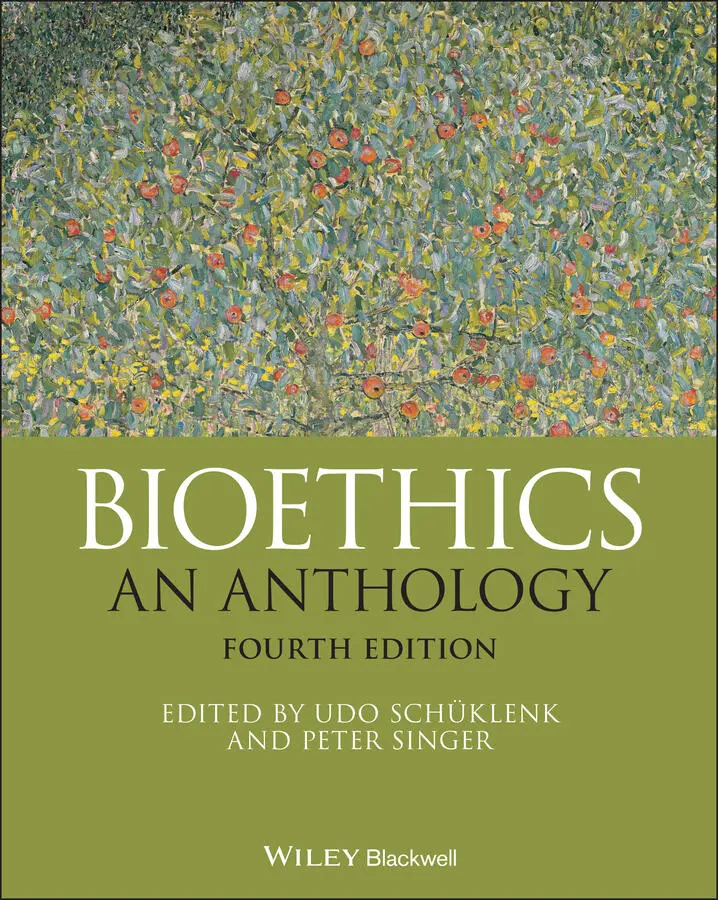
- Название:Bioethics
- Автор:
- Жанр:
- Год:неизвестен
- ISBN:нет данных
- Рейтинг книги:4 / 5. Голосов: 1
-
Избранное:Добавить в избранное
- Отзывы:
-
Ваша оценка:
Bioethics: краткое содержание, описание и аннотация
Предлагаем к чтению аннотацию, описание, краткое содержание или предисловие (зависит от того, что написал сам автор книги «Bioethics»). Если вы не нашли необходимую информацию о книге — напишите в комментариях, мы постараемся отыскать её.
For more than two decades,
has been widely regarded as the definitive single-volume compendium of seminal readings on both traditional and cutting-edge ethical issues in biology and medicine. Acclaimed for its scope and depth of coverage, this landmark work brings together compelling writings by internationally-renowned bioethicist to help readers develop a thorough understanding of the central ideas, critical issues, and current debate in the field.
Now fully revised and updated, the fourth edition contains a wealth of new content on ethical questions and controversies related to the COVID-19 pandemic, advances in CRISPR gene editing technology, physician-assisted death, public health and vaccinations, transgender children, medical aid in dying, the morality of ending the lives of newborns, and much more. Throughout the new edition, carefully selected essays explore a wide range of topics and offer diverse perspectives that underscore the interdisciplinary nature of bioethical study. Edited by two of the field’s most respected scholars, Covers an unparalleled range of thematically-organized topics in a single volume Discusses recent high-profile cases, debates, and ethical issues Features three brand-new sections: Conscientious Objection, Academic Freedom and Research, and Disability Contains new essays on topics such as brain death, life and death decisions for the critically ill, experiments on humans and animals, neuroethics, and the use of drugs to ease the pain of unrequited love Includes a detailed index that allows the reader to easily find terms and topics of interest
remains a must-have resource for all students, lecturers, and researchers studying the ethical implications of the health-related life sciences, and an invaluable reference for doctors, nurses, and other professionals working in health care and the biomedical sciences.
Bioethics — читать онлайн ознакомительный отрывок
Ниже представлен текст книги, разбитый по страницам. Система сохранения места последней прочитанной страницы, позволяет с удобством читать онлайн бесплатно книгу «Bioethics», без необходимости каждый раз заново искать на чём Вы остановились. Поставьте закладку, и сможете в любой момент перейти на страницу, на которой закончили чтение.
Интервал:
Закладка:
A second objection involves the idea of the “complete reprogramming” of the mind of a human animal – where all of that human animal’s current memories are replaced by totally different, apparent memories, and, similarly, whatever other mental states and traits that may be crucial for personal identity, such as one’s personality traits, are also replaced by completely different ones. The neo‐Lockean person would not survive such reprogramming, but the human animal would do so, and would have a future like ours. Moreover, if the neo‐Lockean person that initially existed had traits making for an unhappy life, whereas the neo‐Lockean person who existed after the reprogramming had traits conducive to a very good life, the reprogramming would have enabled the human animal in question to have a better future like ours. The question, accordingly, is how Marquis’s deprivation account of the wrongness of killing can explain how such complete reprogramming of a human’s mind is morally wrong.
My basic claims are then, first, that such “reprogramming” of the mind of a human animal is morally just as wrong as killing a human animal, and secondly, that the wrongness of such reprogramming cannot be explained in terms of depriving an animal – as contrasted with a neo‐Lockean person – of certain future goods.
2.3.4 Against human organ banks?
The objection to the creation of human organ banks is that, just as in the case of the killing human embryos used either to produce stems cells or for scientific research, one is violating the rights of an individual by damaging its brain. The arguments in support of this claim, however, are the arguments just considered, and found wanting.
3 Cloning to Produce Persons
Let us now turn to the question of whether the use of cloning to produce future persons is in principle morally acceptable or not. In this section, I shall first focus on the question whether such cloning is intrinsically wrong. Then I shall consider whether cloning to produce persons is wrong instead because of its consequences .
3.1 Is cloning that aims at producing future persons intrinsically wrong?
Let us begin by considering the two lines of argument that Dan Brock (1998, 151–5) thought were crucial. The first argument appeals to what might initially be described as the right of a person to be a unique individual, but which, in the end, must be characterized instead as the right of a person to a genetically unique nature. The second argument then appeals to the idea that a person has a right to a future that is, in a certain sense, open.
3.1.1 Does a person have a right to a genetically unique nature?
Many people feel that being a unique individual is important, and the basic thrust of this first attempt to show that cloning aimed at producing persons is intrinsically wrong involves the idea that the uniqueness of individuals would be impaired in some way by cloning. In response, I think that one might very well question whether uniqueness is important. If, for example, it turned out that there was, perhaps on some distant planet, a person who was qualitatively identical to oneself, down to the last detail, both physical and psychological, would that really make one's own life less valuable, less worth living?
In thinking about this, it is important to distinguish two different cases: first, the case where the two lives are qualitatively identical due to the operation of deterministic causal laws; secondly, the case where it just happens that both individuals are always in similar situations in which they freely decide upon the same actions, have the same thoughts and feelings, and so on. The second of these scenarios, I suggest, is not troubling. The first, on the other hand, may be, but if it is, is it because there is a person who is qualitatively indistinguishable from oneself, or, rather, because one's life is totally determined?
I am inclined to question, accordingly, the perhaps rather widely held view that uniqueness is important for the value of one's life. Fortunately, however, one need not settle that issue in the present context, since cloning does not produce a person who is qualitatively indistinguishable from the individual who was cloned, for, as is shown by the case of identical twins, two individuals with the same genetic makeup, even when raised within the same family, at the same time, will differ in many respects.
How great are those differences? The result of one study was as follows:
On average, our questionnaires show that the personality traits of identical twins have a 50 percent correlation. The traits of fraternal twins, by contrast, have a correlation of 25 percent, non‐twin siblings a correlation of 11 percent and strangers a correlation of close to zero.
(Bouchard, 1995, 54)
Why is the correlation not higher in the case of identical twins? A common answer is that the environment must play a role, and if that is right, it is also natural to think that it must be one’s experiences within one’s family, during the time that one is maturing, that account for the differences. Judith Rich Harris, however, in her book The Nurture Assumption , develops a very strong argument, based on findings by behavioral geneticists, against the view that one’s family plays a significant role in the type of person one turns out to be, and she then argues that it is one’s peer group that is crucial.
Although Harris makes out a strong case for her view, there is an alternative hypothesis that deserves serious consideration – one suggested by a remark by Steven Pinker in his book, How the Mind Works , where he points out that “the genetic assembly instructions for a mental organ do not specify every connection in the brain as if they were a wiring schematic for a Heathkit radio” (1997, 35). Perhaps identical twins, differ, then, because of differences in the wiring of their brains before birth, due to small, more or less accidental events, within their brains at that time.
In any case, regardless of what theory, or combination of theories, is correct, the crucial point is that the personality traits of an individual and his or her clone should, on average, exhibit no more than a 50 percent correlation; moreover, if one thinks that the environment, as normally understood – that is, postnatally – plays an important role, the correlation presumably will generally be even less, given that an individual and his or her clone will typically be raised at different times, and in generations that may differ substantially as regards basic beliefs and fundamental values.
Accordingly, the present argument, if it is to have any chance, must shift from the claim that a person has a right to absolute uniqueness to an appeal to the very different claim that a person has a right to a genetically unique nature. How does the argument fare when thus reformulated?
An initial point worth noticing is that any appeal to a claimed right to a genetically unique nature poses a difficulty for theists: if there is such a right, why has God created a world where identical twins can arise? Many features of the world, of course, are rather surprising if one thinks our world was created by an omnipotent, omniscient, and morally perfect person, so the theist who appeals to a right to a genetically unique nature may simply reply that the presence of twins is just another facet of the general problem of evil. If, however, as I have argued elsewhere (Tooley and Plantinga 2008, 70–150, and 2019, 51–72), evil provides a strong, evidential argument against the existence of God, that response is not very promising.
How can one approach the question of whether persons have a right to a genetically unique nature? Some writers who reject this claim are content to rest with a burden of proof approach. Here the idea is that although it may be that many people think that being a unique individual in the sense of not being qualitatively identical with anyone else is an important part of what is valuable about being a person, the idea that persons have a right to a genetically unique identity is one that, by contrast, has been introduced only recently. Those who advance the latter claim, therefore, need to offer a reason for thinking it is true.
Читать дальшеИнтервал:
Закладка:
Похожие книги на «Bioethics»
Представляем Вашему вниманию похожие книги на «Bioethics» списком для выбора. Мы отобрали схожую по названию и смыслу литературу в надежде предоставить читателям больше вариантов отыскать новые, интересные, ещё непрочитанные произведения.

Обсуждение, отзывы о книге «Bioethics» и просто собственные мнения читателей. Оставьте ваши комментарии, напишите, что Вы думаете о произведении, его смысле или главных героях. Укажите что конкретно понравилось, а что нет, и почему Вы так считаете.