Bioethics
Здесь есть возможность читать онлайн «Bioethics» — ознакомительный отрывок электронной книги совершенно бесплатно, а после прочтения отрывка купить полную версию. В некоторых случаях можно слушать аудио, скачать через торрент в формате fb2 и присутствует краткое содержание. Жанр: unrecognised, на английском языке. Описание произведения, (предисловие) а так же отзывы посетителей доступны на портале библиотеки ЛибКат.
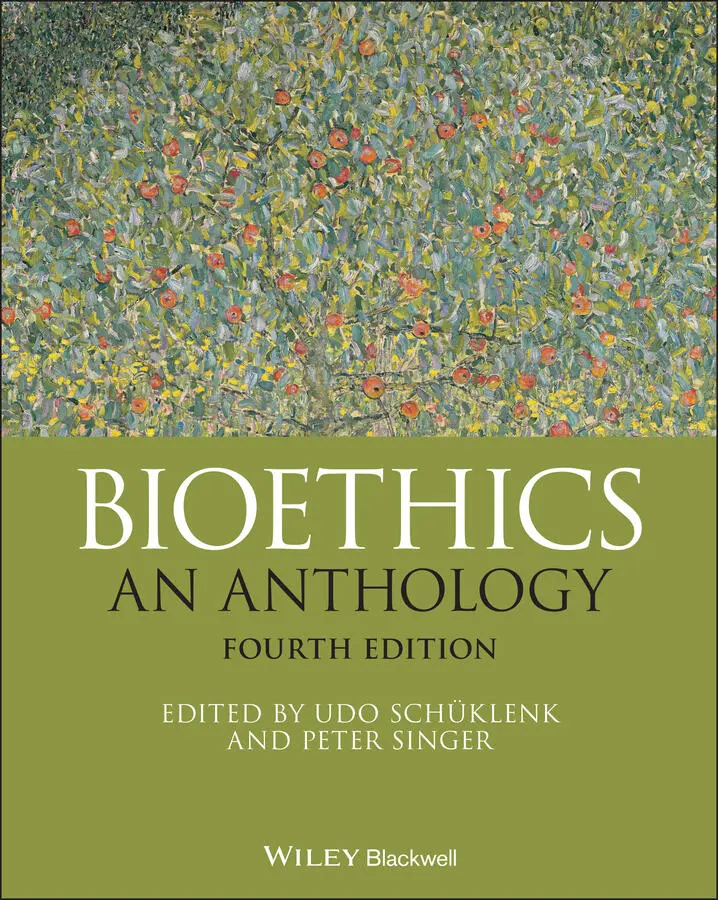
- Название:Bioethics
- Автор:
- Жанр:
- Год:неизвестен
- ISBN:нет данных
- Рейтинг книги:4 / 5. Голосов: 1
-
Избранное:Добавить в избранное
- Отзывы:
-
Ваша оценка:
Bioethics: краткое содержание, описание и аннотация
Предлагаем к чтению аннотацию, описание, краткое содержание или предисловие (зависит от того, что написал сам автор книги «Bioethics»). Если вы не нашли необходимую информацию о книге — напишите в комментариях, мы постараемся отыскать её.
For more than two decades,
has been widely regarded as the definitive single-volume compendium of seminal readings on both traditional and cutting-edge ethical issues in biology and medicine. Acclaimed for its scope and depth of coverage, this landmark work brings together compelling writings by internationally-renowned bioethicist to help readers develop a thorough understanding of the central ideas, critical issues, and current debate in the field.
Now fully revised and updated, the fourth edition contains a wealth of new content on ethical questions and controversies related to the COVID-19 pandemic, advances in CRISPR gene editing technology, physician-assisted death, public health and vaccinations, transgender children, medical aid in dying, the morality of ending the lives of newborns, and much more. Throughout the new edition, carefully selected essays explore a wide range of topics and offer diverse perspectives that underscore the interdisciplinary nature of bioethical study. Edited by two of the field’s most respected scholars, Covers an unparalleled range of thematically-organized topics in a single volume Discusses recent high-profile cases, debates, and ethical issues Features three brand-new sections: Conscientious Objection, Academic Freedom and Research, and Disability Contains new essays on topics such as brain death, life and death decisions for the critically ill, experiments on humans and animals, neuroethics, and the use of drugs to ease the pain of unrequited love Includes a detailed index that allows the reader to easily find terms and topics of interest
remains a must-have resource for all students, lecturers, and researchers studying the ethical implications of the health-related life sciences, and an invaluable reference for doctors, nurses, and other professionals working in health care and the biomedical sciences.
Bioethics — читать онлайн ознакомительный отрывок
Ниже представлен текст книги, разбитый по страницам. Система сохранения места последней прочитанной страницы, позволяет с удобством читать онлайн бесплатно книгу «Bioethics», без необходимости каждый раз заново искать на чём Вы остановились. Поставьте закладку, и сможете в любой момент перейти на страницу, на которой закончили чтение.
Интервал:
Закладка:
Secondly, consider cases where the goal is not to produce a person capable of doing certain things, but a certain sort of person. Perhaps this is the kind of case that Kitcher has in mind when he speaks of interfering with human autonomy. But is it really morally problematic to attempt to create persons with certain dispositions, rather than others? Is it morally wrong, for example, to attempt to produce, via cloning, individuals who will, because of their genetic makeup, be disposed not to suffer from conditions that may cause considerable pain, such as arthritis, or from life‐threatening diseases, such as cancer, high blood pressure, strokes, and heart attacks? Or to attempt to produce individuals who will have a cheerful temperament, or who will not be disposed to depression, to anxiety, to schizophrenia, or to Alzheimer's disease?
It seems unlikely that Kitcher, or others, would want to say that producing individuals who will be constitutionally disposed in the ways just indicated is a case of interfering with human autonomy. But then what are the traits such that attempting to create a person with those traits is a case of interfering with human autonomy? Perhaps Kitcher, when he speaks about creating a particular kind of person, is thinking not just of any properties that persons have, but, more narrowly, of such things as personality traits, or traits of character, or the having of certain interests? But again one can ask whether there is anything morally problematic about attempting to create persons with such properties. Some personality traits are desirable, and parents typically encourage their children to develop those traits. Some character traits are virtues, and others are vices, and both parents and society attempt to encourage the acquisition of the former, and to discourage the acquisition of the latter. Finally, many interests – in music, art, mathematics, science, games, physical activities – can add greatly to the quality of one's life, and once again, parents typically expose their children to relevant activities, and help their children to achieve levels of proficiency that will enable them to enjoy those pursuits.
The upshot is that if cloning that aimed at producing people who would be more likely to possess various personality traits, or traits of character, or who would be likely to have certain interests was wrong because it would be interfering with personal autonomy, then the childrearing practices of almost all parents would stand condemned on precisely the same grounds. But such a claim, surely, is deeply counterintuitive.
In addition, however, one need not rest content with an appeal to intuitions here. The same conclusion follows on many high‐order moral theories. Suppose, for example, that one is again behind a Rawlsian veil of ignorance, where one is deciding between societies that differ as regards their approaches to the rearing of children. Would it be rational to choose a society where parents did not attempt to encourage their children to develop personality traits that would contribute to the latter's happiness? Or a society where parents did not attempt to instill in their children a disposition to act in ways that are morally right? Or one where parents made no attempt to develop various interests in their children that they believed would add to their lives? It is, I suggest, hard to see how such a choice could be a rational one, given that one would be opting, it would seem, for a society where one would be less likely to have a life that, on average, would be more worth living.
I suggest, therefore, that contrary to what Philip Kitcher has claimed, it is not true that most cloning scenarios are morally repugnant, and that, in particular, there is, in general, nothing morally problematic about aiming at creating a child with specific attributes.
3.2 Consequentialist objections to cloning to produce persons
Let us now turn to the question of whether cloning that aims at the production of neo‐Lockean persons might nevertheless be morally problematic because of undesirable consequences . I shall consider two arguments in support of this view.
3.2.1 Cloned persons would have lives less worth living because of reduced life expectancy
The first argument, and the one that raises a very important issue, deserving serious consideration, involves the question of how cloned individuals will fare when it comes to aging, since it has been suggested that Dolly, who died at the age of six years, may have had a significantly reduced life expectancy by having been developed from the nucleus of a six‐year‐old sheep. Here is the basis of the worry:
As early as the 1930s investigators took note of pieces of noncoding DNA – DNA that does not give rise to protein – at the ends of each chromosome, which they called telomeres (from the Greek words for “end” and “part”). When the differentiated cells of higher organisms undergo mitosis, the ordinary process of cell division, not all of the DNA in their nuclei is replicated. The enzyme that copies DNA misses a small piece at the ends of each chromosome, and so the chromosomes get slightly shorter each time a cell divides. As long as each telomere remains to buffer its chromosome against the shortening process, mitosis does not bite into any genes (remember that the telomeres are noncoding, much like the leaders at the ends of a reel of film). Eventually, however, the telomeres get so short that they can no longer protect the vital parts of the chromosome. At that point the cell usually stops dividing and dies.
(Ronald Hart, Angelo Turturro, and Julian Leakey, 1997, 48)
The question, accordingly, is whether Dolly started life with cells whose chromosomes had telomeres whose length was comparable to those in the cells of a six‐year‐old sheep. Perhaps not, since it may be that once a nucleus has been transplanted into an egg from which the nucleus has been removed, there is some mechanism that will produce an enzyme – called telomerase – that can create full‐length telomeres. The risk, however, is surely a serious one, and provides grounds, in view of the following argument, for holding, not only that one should not at this point attempt to produce people by cloning, but also that there should be a temporary legal prohibition on cloning humans where the goal is to produce persons.
The argument rests on what is known as the “non‐identity problem,” which was the first discussed by Gregory Kavka in his article “The Paradox of Future Individuals” (1981), and then considered at length by Derek Parfit (1984, 351–79). The problem can be raised by comparing two cases:
Mary learns that if she becomes pregnant immediately, her child will suffer from defect X, but still have a life worth living, whereas if she waits three months to become pregnant, she will have a completely normal child. Mary decides not to wait, and gives birth to Johnny.
Jane is pregnant, and learns that unless she takes a certain drug – which has no side effects – she will give birth to a child who will suffer from defect X, but still have a life worth living. Jane decides not to take the drug, and gives birth to Billy.
How does Mary’s action compare with Jane’s? Most people, I think, initially view the two actions as equally bad. Notice, however, that while Billy can later argue that what Jane did was seriously wrong because he was worse off because of what Jane decided not to do, Johnny cannot argue that what Mary did was seriously wrong because of what Mary did, since Johnny has a life worth living, and had Mary waited, Johnny would not have existed, so Mary has not made Johnny worse off.
If Mary’s action is morally as problematic as Jane’s, and if it is true that a cloned person will have a significantly lower life expectancy than a person who is not cloned, then we have a serious objection to cloning that aims at producing a person,, unless the cloned person will have a life that is significantly better in other ways, or there is no other way of producing a person in the circumstances that will be satisfactory. The former scenario seems rather unlikely, but this is not so for the second possibility, since there is a type of case, to be discussed shortly, where cloning may very well be morally justified, namely, where parents want to clone one of their children to have a child who can save the first child’s life. In an earlier essay on cloning, I failed to consider such possibilities, and thus mistakenly concluded that the possibility of a reduction in life expectancy in the case of cloned individuals provided strong grounds for “a temporary, legal prohibition on the cloning of humans when the goal is to produce persons” (1998, 76).
Читать дальшеИнтервал:
Закладка:
Похожие книги на «Bioethics»
Представляем Вашему вниманию похожие книги на «Bioethics» списком для выбора. Мы отобрали схожую по названию и смыслу литературу в надежде предоставить читателям больше вариантов отыскать новые, интересные, ещё непрочитанные произведения.

Обсуждение, отзывы о книге «Bioethics» и просто собственные мнения читателей. Оставьте ваши комментарии, напишите, что Вы думаете о произведении, его смысле или главных героях. Укажите что конкретно понравилось, а что нет, и почему Вы так считаете.