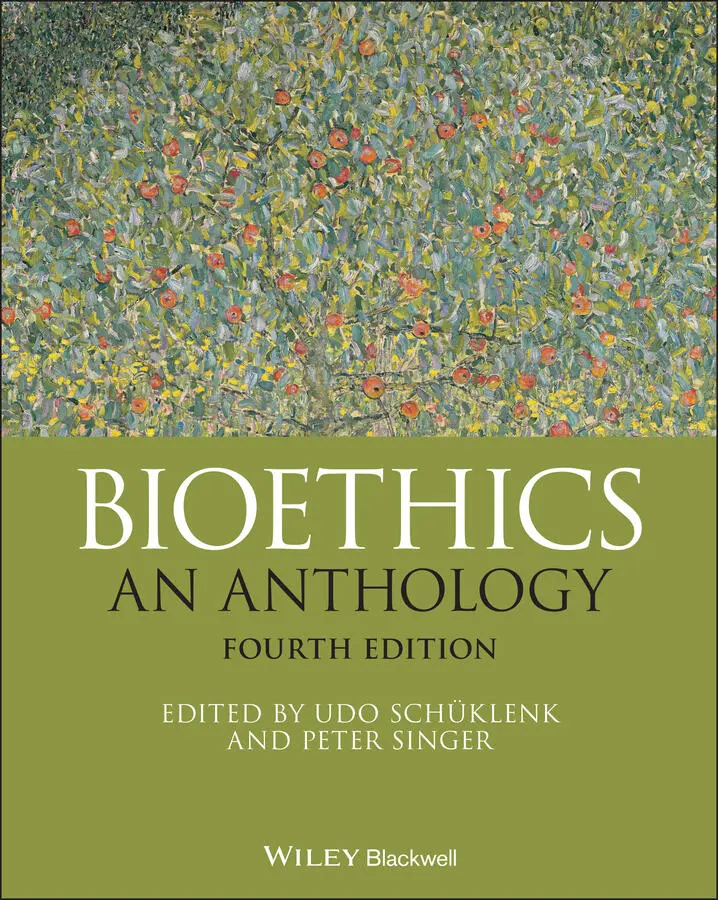
Bioethics
Здесь есть возможность читать онлайн «Bioethics» — ознакомительный отрывок электронной книги совершенно бесплатно, а после прочтения отрывка купить полную версию. В некоторых случаях можно слушать аудио, скачать через торрент в формате fb2 и присутствует краткое содержание. Жанр: unrecognised, на английском языке. Описание произведения, (предисловие) а так же отзывы посетителей доступны на портале библиотеки ЛибКат.
- Название:Bioethics
- Автор:
- Жанр:
- Год:неизвестен
- ISBN:нет данных
- Рейтинг книги:4 / 5. Голосов: 1
-
Избранное:Добавить в избранное
- Отзывы:
-
Ваша оценка:
Bioethics: краткое содержание, описание и аннотация
Предлагаем к чтению аннотацию, описание, краткое содержание или предисловие (зависит от того, что написал сам автор книги «Bioethics»). Если вы не нашли необходимую информацию о книге — напишите в комментариях, мы постараемся отыскать её.
For more than two decades,
has been widely regarded as the definitive single-volume compendium of seminal readings on both traditional and cutting-edge ethical issues in biology and medicine. Acclaimed for its scope and depth of coverage, this landmark work brings together compelling writings by internationally-renowned bioethicist to help readers develop a thorough understanding of the central ideas, critical issues, and current debate in the field.
Now fully revised and updated, the fourth edition contains a wealth of new content on ethical questions and controversies related to the COVID-19 pandemic, advances in CRISPR gene editing technology, physician-assisted death, public health and vaccinations, transgender children, medical aid in dying, the morality of ending the lives of newborns, and much more. Throughout the new edition, carefully selected essays explore a wide range of topics and offer diverse perspectives that underscore the interdisciplinary nature of bioethical study. Edited by two of the field’s most respected scholars, Covers an unparalleled range of thematically-organized topics in a single volume Discusses recent high-profile cases, debates, and ethical issues Features three brand-new sections: Conscientious Objection, Academic Freedom and Research, and Disability Contains new essays on topics such as brain death, life and death decisions for the critically ill, experiments on humans and animals, neuroethics, and the use of drugs to ease the pain of unrequited love Includes a detailed index that allows the reader to easily find terms and topics of interest
remains a must-have resource for all students, lecturers, and researchers studying the ethical implications of the health-related life sciences, and an invaluable reference for doctors, nurses, and other professionals working in health care and the biomedical sciences.
Bioethics — читать онлайн ознакомительный отрывок
Ниже представлен текст книги, разбитый по страницам. Система сохранения места последней прочитанной страницы, позволяет с удобством читать онлайн бесплатно книгу «Bioethics», без необходимости каждый раз заново искать на чём Вы остановились. Поставьте закладку, и сможете в любой момент перейти на страницу, на которой закончили чтение.
Интервал:
Закладка:
Subsequent developments, however, provide serious grounds for concluding that the telomere‐shortening argument is unsound. First of all, an article by Narumi Ogonuki and others, entitled “Early Death of Mice Cloned from Somatic Cells,” says that it appears that, in the case of mice, early deaths resulted, not from shortened telomeres but from some “malfunction in the immune system” (2002, 253), and the authors also note that
Telomere shortening is known to be associated with cellular aging. It has recently been reported that, after cloning, telomere length can be restored to its original length by nuclear transfer, implying that the lifespan of clones might not be shortened” (2002, 254).
The most important and detailed scientific publication to date seems to be one by K. D. Sinclair et al. – “Healthy Ageing of Cloned Sheep.” In that study, they closely examined “13 cloned sheep aged (7–9 years old), including four from the cell line that gave rise to Dolly” (2016, 1), and there they say that the consensus is that “telomere length is generally restored during nuclear reprogramming” (2016, 7). The concluding paragraph of their article is then as follows:
In conclusion, although the efficiency of SCNT [somatic‐cell nuclear transfer] has improved in recent years, its overall efficiency remains low, with high embryonic and gestational losses compared to natural mating and assisted reproduction. A relatively high proportion of clones also fail to successfully make the transition to extra‐uterine life, some harboring congenital defects, such as observed in the kidney. For those clones that survive beyond the perinatal period, however, the emerging consensus, supported by the current data, is that they are healthy and seem to age normally” (2016, 8).
In the light of the above, I believe that there are good grounds for setting aside the telomere‐shortening argument against human cloning aimed at producing persons. This is an important conclusion, since if telomere shortening and reduced life expectancy were the case, then one would have a strong argument against cloning where the goal is to produce a person.
3.2.2 The low rate of success objection
Can one then appeal instead to the unreliability of the outcome to argue that there should be a legal ban on human cloning where the goal is to produce a person? That is an ethically difficult question. On the one hand, with regard to the “high embryonic and gestational losses compared to natural mating and assisted reproduction,” it is very doubtful that many women would make an informed choice to run those risks associated with cloning, but if a woman had a very strong desire to produce a cloned individual, or was willing to take part in such an experiment if adequately compensated, then it is hard to see how “embryonic and gestational losses” could justify a legal prohibition.
On the other hand, the situation differs as regards failures “to successfully make the transition to extra‐uterine life,” since there the crucial issue is whether cloning may lead to the death of a neo‐Lockean person. That in turn depends on the answer to the scientific question of when developing humans acquire the capacities that are relevant to neo‐Lockean personhood – especially the capacity for thought.
When I surveyed the scientific evidence many years ago (1983, 347–412), it seemed to me that both the psychological and the neurophysiological evidence supported the conclusion that the capacity for thought is only acquired postnatally. It may be that current evidence supports the opposite conclusion, in which case there would be grounds for not allowing human cloning until techniques are improved to eliminate failures “to successfully make the transition to extra‐uterine life.” Or perhaps we do not yet have a definitive answer to the scientific question, in which case a legal prohibition would be in order until either we do have an answer, or until cloning techniques are appropriately improved.
3.2.3 Brave New World objections
Next, there is an objection not frequently encountered in scholarly discussions, but rather common in the popular press, involving scenarios where human beings are cloned in large numbers to serve as slaves, or as enthusiastic soldiers in a dictator's army. Such scenarios, however, seem very implausible. Is it really at all likely that, were cloning to become available, society would for some unknown reason decide that its rejection of slavery had really been a mistake? Or that a dictator who was unable to conscript a sufficient army from the existing citizenry could induce people to undertake a massive cloning program, in order that, eighteen years or so down the line, he would finally have the army he needed?
3.3 Arguments in favor of cloning to produce persons
If the arguments to show that cloning human persons is intrinsically wrong are, as I have argued, implausible, and if the crucial objection appealing to undesirable consequences can be satisfactorily answered, either now, or in the future, either by an increase in our scientific knowledge or by advances in cloning techniques, are there now, or would there then be, good reasons to move ahead with the cloning of humans where the aim is to bring persons into existence? I shall argue that there are.
The considerations that, other things being equal, support the implementation of cloning aimed at producing persons fall into four main categories: first, there are considerations related to the well‐being of the person who is produced via the cloning; secondly, there are cases where those benefited are already existing persons; thirdly, there is a consideration that involves the possibility of benefits to both cloned persons and their parents; finally, there are benefits to society at large, including contributions to important scientific knowledge, and resulting benefits for anyone rearing a child, cloned or otherwise.
3.3.1 Cloning to avoid the transmission of hereditary diseases
Inherited diseases fall into various categories, depending on whether they involve a single gene, multiple genes, a chromosomal disorder, or mitochondrial inheritance. If one focuses just on the single gene case, one has, for example, cystic fibrosis, sickle cell anemia, hemochromatosis, and Huntington’s disease. If cloning were implemented, then – as John Roberson (1994) and Dan Brock (1998, 146) pointed out – provided that only one of the potential parents had the defective gene, a clone could be made using a cell from the one who does not suffer from the genetic defect, and the result would be a child who was free of the inheritable disease, and also genetically related to one member of the couple – something that many might find preferable to using a donor egg or donor sperm, where the resulting child would involve a genetic contribution from a third party.
3.3.2 Happier and healthier individuals
Secondly, cloning would have the advantage over sexual reproduction that it should make it possible to increase the likelihood that the person created will enjoy a healthier and happier life. For to the extent that one's genetic constitution has a bearing upon how long one is likely to live, upon what diseases, both physical and mental, one is likely to suffer from, and upon whether one will have traits of character or temperament that make for happiness, or, instead, for unhappiness, by cloning a person who has enjoyed a long life, who has remained mentally alert, rather than falling prey to Alzheimer's disease or dementia, who has not suffered from cancer, arthritis, heart attacks, stroke, high blood pressure, etc., and who has exhibited no tendencies to depression or schizophrenia, etc., one is increasing the chances that the individual created will also enjoy a healthy and happy life.
Читать дальшеИнтервал:
Закладка:
Похожие книги на «Bioethics»
Представляем Вашему вниманию похожие книги на «Bioethics» списком для выбора. Мы отобрали схожую по названию и смыслу литературу в надежде предоставить читателям больше вариантов отыскать новые, интересные, ещё непрочитанные произведения.

Обсуждение, отзывы о книге «Bioethics» и просто собственные мнения читателей. Оставьте ваши комментарии, напишите, что Вы думаете о произведении, его смысле или главных героях. Укажите что конкретно понравилось, а что нет, и почему Вы так считаете.