Bioethics
Здесь есть возможность читать онлайн «Bioethics» — ознакомительный отрывок электронной книги совершенно бесплатно, а после прочтения отрывка купить полную версию. В некоторых случаях можно слушать аудио, скачать через торрент в формате fb2 и присутствует краткое содержание. Жанр: unrecognised, на английском языке. Описание произведения, (предисловие) а так же отзывы посетителей доступны на портале библиотеки ЛибКат.
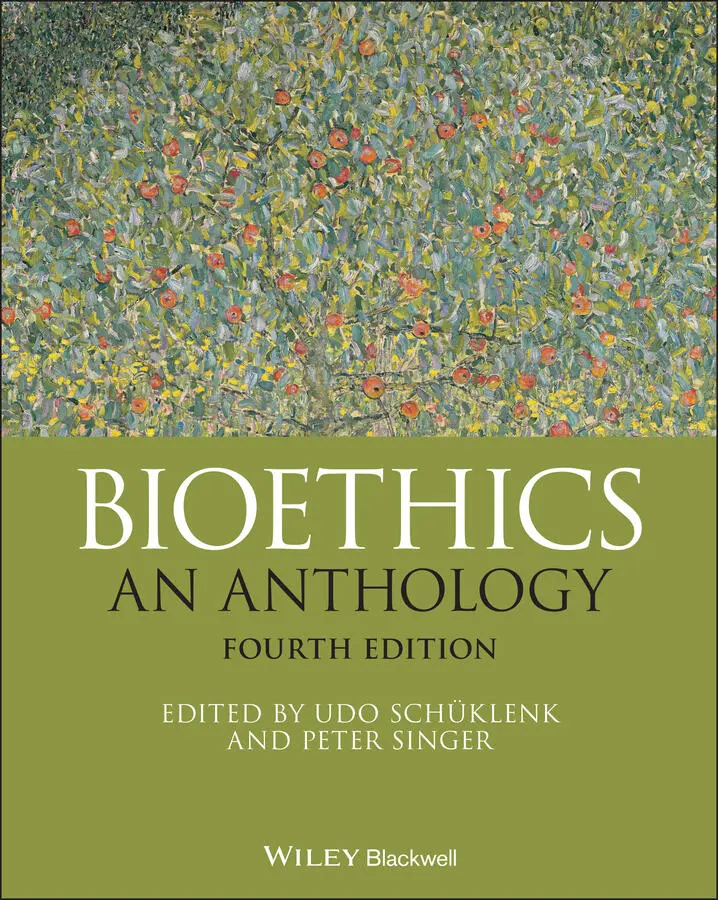
- Название:Bioethics
- Автор:
- Жанр:
- Год:неизвестен
- ISBN:нет данных
- Рейтинг книги:4 / 5. Голосов: 1
-
Избранное:Добавить в избранное
- Отзывы:
-
Ваша оценка:
Bioethics: краткое содержание, описание и аннотация
Предлагаем к чтению аннотацию, описание, краткое содержание или предисловие (зависит от того, что написал сам автор книги «Bioethics»). Если вы не нашли необходимую информацию о книге — напишите в комментариях, мы постараемся отыскать её.
For more than two decades,
has been widely regarded as the definitive single-volume compendium of seminal readings on both traditional and cutting-edge ethical issues in biology and medicine. Acclaimed for its scope and depth of coverage, this landmark work brings together compelling writings by internationally-renowned bioethicist to help readers develop a thorough understanding of the central ideas, critical issues, and current debate in the field.
Now fully revised and updated, the fourth edition contains a wealth of new content on ethical questions and controversies related to the COVID-19 pandemic, advances in CRISPR gene editing technology, physician-assisted death, public health and vaccinations, transgender children, medical aid in dying, the morality of ending the lives of newborns, and much more. Throughout the new edition, carefully selected essays explore a wide range of topics and offer diverse perspectives that underscore the interdisciplinary nature of bioethical study. Edited by two of the field’s most respected scholars, Covers an unparalleled range of thematically-organized topics in a single volume Discusses recent high-profile cases, debates, and ethical issues Features three brand-new sections: Conscientious Objection, Academic Freedom and Research, and Disability Contains new essays on topics such as brain death, life and death decisions for the critically ill, experiments on humans and animals, neuroethics, and the use of drugs to ease the pain of unrequited love Includes a detailed index that allows the reader to easily find terms and topics of interest
remains a must-have resource for all students, lecturers, and researchers studying the ethical implications of the health-related life sciences, and an invaluable reference for doctors, nurses, and other professionals working in health care and the biomedical sciences.
Bioethics — читать онлайн ознакомительный отрывок
Ниже представлен текст книги, разбитый по страницам. Система сохранения места последней прочитанной страницы, позволяет с удобством читать онлайн бесплатно книгу «Bioethics», без необходимости каждый раз заново искать на чём Вы остановились. Поставьте закладку, и сможете в любой момент перейти на страницу, на которой закончили чтение.
Интервал:
Закладка:
3.3.3 Enabling individuals to have a genetically related child who otherwise could not do so
A third reason for implementing cloning is that it would benefit people who already exist.
3.3.3.1 Infertility
One way, as Dan Brock and others (Eisenberg, 1976; LaBar, 1984; Robertson, 1994) have pointed out, is that “Human cloning would allow women who have no ova or men who have no sperm to produce an offspring that is biologically related to them” (Brock, 1998, 146).” Another advantage, also noted by Brock, is that “Embryos might be cloned, either by nuclear transfer or embryo splitting, in order to increase the number of embryos for implantation and improve the chances of successful conception.” (1998, 146).
3.3.3.2 Children for homosexual couples
Many people still believe not only that homosexuality is deeply wrong, but also that homosexual sexual relations should be illegal, and, indeed, severely punished – as had been the case in the United States for many years: “All states had laws against sodomy by 1960” (Mattachine Society, 1964, 1), often with very long maximum terms of imprisonment – and even life imprisonment in the case of one state (GLAPN, 2007, 1).These attitudes were deeply rooted in religious views, especially Christian and Islamic teachings, and the current decline in religious beliefs has been accompanied by a decline in such beliefs about homosexuality (Pew Research Center, 2013).
In the United States, a major turning point was the Supreme Court decision, in 2003 in Lawrence v. Texas , that laws against sodomy were unconstitutional, and since then there has been a dramatic change in the attitudes of many Americans on several issues involving homosexuals. Thus, in 2019, a Gallup poll found that 73% of Americans believe that homosexual relations should be legal, while since 2016, over 60% have believed that same‐sex marriages should be recognized by law as valid. In addition, by 2019, 75% of Americans believed that homosexual couples should be allowed to adopt children (PPRI, 2019).
Since such views are very widely accepted by philosophers working in ethics, and since the contrary views are generally rooted in religious beliefs, such as those of evangelical Protestants in the United States – beliefs that there are strong arguments against – there are good grounds for concluding that homosexuals should be allowed to adopt children. If so, then another important advantage of implementing the cloning of persons is that, as Philip Kitcher (1997, 61) and others have noted, cloning would seem to be a desirable method of providing a homosexual couple with children that they could raise, since, in the case of a gay couple, each child could be a clone of one person, while in the case of a lesbian couple, every child could, in a sense, be biologically connected with both people:
A lesbian couple wishes to have a child. Because they would like the child to be biologically connected to each of them, they request that a cell nucleus from one of them be inserted into an egg from the other, and that the embryo be implanted in the uterus of the woman who donated the egg (1997, 61). 1
3.3.4 Cloning to save existing persons
Another reason for implementing cloning is suggested by the well‐known case of the Ayala parents in California (Grogan, 1990), who decided to have another child in the hope – which turned out to be successful ‐‐ that the resulting child would be able to donate bone marrow for a transplant operation that would save the life of their teenage daughter who was suffering from leukemia. If cloning had been possible at the time, a course of action would have been available to them that, unlike having another child in the normal way, would not have been chancy: if they could have cloned the child who was ill, a tissue match would have been certain.
3.3.5 More satisfying childrearing: Individuals with desired traits
Many couples would like to raise children who possess certain traits. In some cases they might prefer to have children who have physical abilities enabling them to perform at a high level in certain sporting activities. Or they might prefer to have children having intellectual capabilities enabling them to enjoy mathematics, or science. Or perhaps they would prefer to have children with traits that would enable them to engage in, and enjoy, various aesthetic pursuits.
Some of the traits that people might like their children to have presumably have a very strong hereditary basis, while others are such as a child, given both the relevant genes, and the right environment, might be more likely to develop. To the extent that the traits in question fall in either of these categories, the production of children via cloning would enable more couples to raise children with traits that they judge to be desirable.
3.3.6 Using self‐knowledge to increase the chance that childrearing will go well for both oneself and one’s children
There is a second way in which cloning could make childrearing more satisfactory, for both parents and their children, and it emerges if one recalls one's own childhood. Most people, when they do this, remember things that they liked, that contributed to their happiness, and other things that had the opposite effect. These might be ways they were treated by their parents, or, instead, interactions with their peers. The thought, then, is that by raising a child who is a clone of one of the parents, the knowledge the relevant parent has of how he or she was raised, or treated by her or his peers, can enable one both to relate to one’s child in a way better attuned to the psychological makeup of the child, and also to have a better sense of peer group interactions that may significantly detract from one’s child’s happiness. In addition, given the greater psychological similarity existing between the child and one of the parents, that parent will better be able, at any point, to appreciate the child's point of view. So there should be a greater likelihood both that such a couple will find childrearing a more rewarding experience, and that their child will have a happier childhood through being better understood, and from having parents who know how the treatment by one’s peers may negatively impact one’s happiness.
3.3.7 Benefiting society: Producing people who have the potential for making significant contributions to human well‐being
One quite familiar suggestion is that one might benefit mankind by cloning individuals who have made extremely significant contributions to society. In the form that it is usually put, where it is assumed that if, for example, one had been able to clone Albert Einstein, the result would be an individual who would also make some very significant contributions to science, the idea does not seem especially plausible. In the first place, whether an individual will turn out to do highly creative work, rather than being determined simply by his or her genetic makeup, surely depends upon traits whose acquisition is a matter either of the environment in which the individual grows up, or, alternatively, in view of Pinker’s point, of the prenatal wiring of that person’s brain.
Could it not be argued in response, however – at least if one sets aside the second of those possibilities – that one could control the environment as well, raising a clone of Einstein, for example, in an environment as similar as possible to that in which Einstein was raised? That, of course, might prove difficult. Even if it could be done, however, it is not clear that would be sufficient, since great creative achievements may depend upon things that are to some extent accidental, and whose occurrence is not ensured by the combination of one’s genetic makeup, the prenatal wiring of one’s brain, and the general kind of environment in which one grows up. Many great mathematicians, for example, have developed an intense interest in numbers at an early age, and even if one leaves aside the prenatal brain‐wiring view, is there good reason to think that, had one been able to clone Carl Friedrich Gauss, and reared that person in an environment similar to Gauss's, that person would have developed a similar interest in numbers, and gone on to achieve great things in mathematics? Or is it likely that a clone of Einstein, raised in an environment similar to Einstein’s, would have wondered, as Einstein did, how the world would appear if one could travel as fast as light, and would then have pondered the questions that fascinated Einstein, and that led ultimately to the development of revolutionary theories in physics?
Читать дальшеИнтервал:
Закладка:
Похожие книги на «Bioethics»
Представляем Вашему вниманию похожие книги на «Bioethics» списком для выбора. Мы отобрали схожую по названию и смыслу литературу в надежде предоставить читателям больше вариантов отыскать новые, интересные, ещё непрочитанные произведения.

Обсуждение, отзывы о книге «Bioethics» и просто собственные мнения читателей. Оставьте ваши комментарии, напишите, что Вы думаете о произведении, его смысле или главных героях. Укажите что конкретно понравилось, а что нет, и почему Вы так считаете.