Bioethics
Здесь есть возможность читать онлайн «Bioethics» — ознакомительный отрывок электронной книги совершенно бесплатно, а после прочтения отрывка купить полную версию. В некоторых случаях можно слушать аудио, скачать через торрент в формате fb2 и присутствует краткое содержание. Жанр: unrecognised, на английском языке. Описание произведения, (предисловие) а так же отзывы посетителей доступны на портале библиотеки ЛибКат.
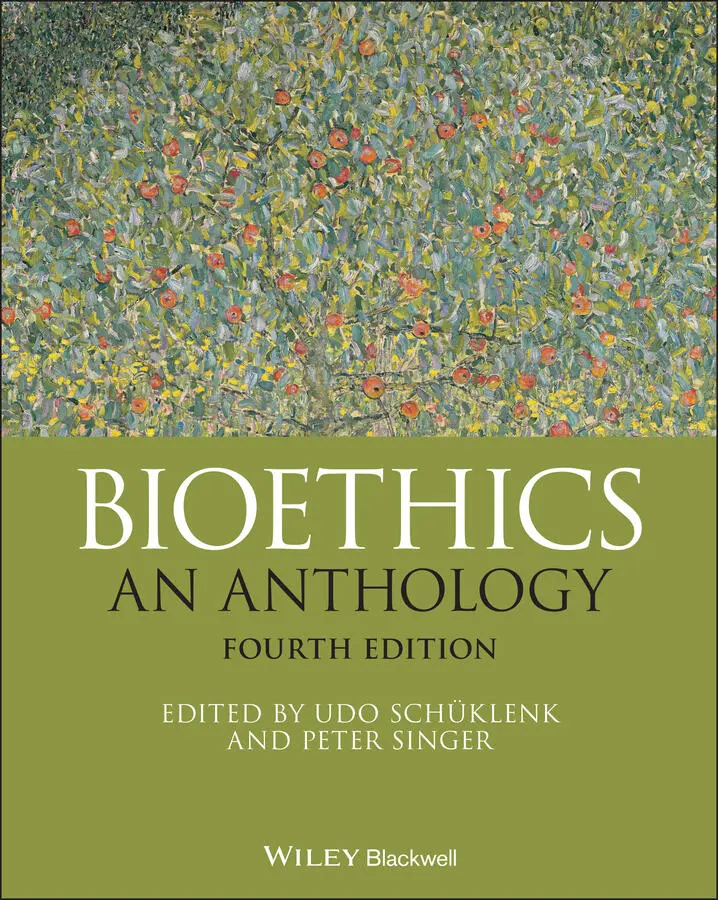
- Название:Bioethics
- Автор:
- Жанр:
- Год:неизвестен
- ISBN:нет данных
- Рейтинг книги:4 / 5. Голосов: 1
-
Избранное:Добавить в избранное
- Отзывы:
-
Ваша оценка:
Bioethics: краткое содержание, описание и аннотация
Предлагаем к чтению аннотацию, описание, краткое содержание или предисловие (зависит от того, что написал сам автор книги «Bioethics»). Если вы не нашли необходимую информацию о книге — напишите в комментариях, мы постараемся отыскать её.
For more than two decades,
has been widely regarded as the definitive single-volume compendium of seminal readings on both traditional and cutting-edge ethical issues in biology and medicine. Acclaimed for its scope and depth of coverage, this landmark work brings together compelling writings by internationally-renowned bioethicist to help readers develop a thorough understanding of the central ideas, critical issues, and current debate in the field.
Now fully revised and updated, the fourth edition contains a wealth of new content on ethical questions and controversies related to the COVID-19 pandemic, advances in CRISPR gene editing technology, physician-assisted death, public health and vaccinations, transgender children, medical aid in dying, the morality of ending the lives of newborns, and much more. Throughout the new edition, carefully selected essays explore a wide range of topics and offer diverse perspectives that underscore the interdisciplinary nature of bioethical study. Edited by two of the field’s most respected scholars, Covers an unparalleled range of thematically-organized topics in a single volume Discusses recent high-profile cases, debates, and ethical issues Features three brand-new sections: Conscientious Objection, Academic Freedom and Research, and Disability Contains new essays on topics such as brain death, life and death decisions for the critically ill, experiments on humans and animals, neuroethics, and the use of drugs to ease the pain of unrequited love Includes a detailed index that allows the reader to easily find terms and topics of interest
remains a must-have resource for all students, lecturers, and researchers studying the ethical implications of the health-related life sciences, and an invaluable reference for doctors, nurses, and other professionals working in health care and the biomedical sciences.
Bioethics — читать онлайн ознакомительный отрывок
Ниже представлен текст книги, разбитый по страницам. Система сохранения места последней прочитанной страницы, позволяет с удобством читать онлайн бесплатно книгу «Bioethics», без необходимости каждый раз заново искать на чём Вы остановились. Поставьте закладку, и сможете в любой момент перейти на страницу, на которой закончили чтение.
Интервал:
Закладка:
25 Rawls, John (1971). A Theory of Justice, Cambridge, MA: Harvard University Press.
26 Robertson, John A. (1994). “The Question of Human Cloning,” Hastings Center Report 24, 6–14.
27 Sinclair, K. D., et al (2016). “Healthy ageing of cloned sheep,” Nature Communications, 26 July, 2016, 1–10.
28 Tooley, Michael, and Plantinga, Alvin (2008). Knowledge of God, Oxford: Blackwell Publishing.
29 Tooley, Michael, Wolf‐Devine, Celia, Devine, Philip E. and Jaggar, Alison M. (2009). Abortion: Three Perspectives, New York: Oxford University Press.
30 Tooley, Michael (1983). Abortion and Infanticide, Oxford: Clarendon Press.
31 ————, (1998). “The Moral Status of the Cloning of Humans,” In James Humber and Robert Almeder (eds.), Biomedical Ethics Reviews: Human Cloning, Humana Press, Totowa, New Jersey, 65–101.
32 ————, (2019). The Problem of Evil, Cambridge: Cambridge University Press.
Note
1 1Although Kitcher mentions this idea as initially attractive, in the end he rejects it, on the grounds that cloning “interferes with human autonomy” (1997, 61) – a view that I considered, and argued against, in section 3.1.5.
Introduction
Our genes play an important role in what kind of people we are – whether we are, for example, short or tall, healthy or sick, mentally slow or bright; and while there is debate about the extent to which certain characteristics are inherited or the product of our environment, it is difficult to deny that some characteristics at least have a genetic basis. To deny this would, as Jonathan Glover points out in “Questions about Some Uses of Genetic Engineering” amount to thinking “that it is only living in kennels which makes dogs different from cats”.
Genetic manipulation, sometimes also referred to as genetic engineering, involves intervening at the genetic level in order to eliminate, modify, or enhance certain genetic traits or conditions. Recent scientific breakthroughs, including the mapping of the human genome, have added significantly to our understanding of our genes, and provide increasing and unprecedented possibilities for control over our genetic destiny. Should we make use of this knowledge, and to which ends? Should we, for example, use genetic manipulation only to prevent serious genetic disorders, or should we also use it for the enhancement of certain traits and characteristics?
The distinction between gene therapy and gene enhancement is not clear‐cut. While it might be agreed that increasing the height a boy is expected to reach at maturity from 170 cm to 190 cm is a form of enhancement, what if we are seeking to increase his expected height from 150 cm to 170 cm? The same appears to be true when we are looking at a trait such as intelligence. Increasing a person’s IQ by 20 points from 110 to 130 would generally be considered enhancement, but would raising her IQ from 90 to 110 be therapy or of enhancement? The answer ultimately depends, David B. Resnik argues in “The Moral Significance of the Therapy–Enhancement Distinction in Human Genetics,” on contested philosophical distinctions, such as the distinctions between health and disease, and normality and abnormality.
Despite some fuzziness at the margins, we do, however, often have a plausible understanding of where the boundary between therapy and enhancement should be drawn. The next question is whether this boundary is morally significant. Again, many people think the answer is “yes.” They take the view that gene therapy, as an extension of the conventional goals of medicine, is morally acceptable, while enhancement is morally problematic. But are the arguments in support of the ethical significance of these distinctions sound?
Some people reject positive genetic engineering on the grounds of risk; but is risk – even significant risk – a sufficient reason to rule out all genetic interventions? Jonathan Glover argues that the fact that a practice involves risks is not sufficient to show that it is morally wrong, or should be banned. In some cases, the dangers of not proceeding might be greater than the dangers of proceeding selectively and cautiously. Moreover, would considerations of risk be a reason against all positive interventions, or against only some of them? And would it be a reason against positive or enhancing genetic interventions only, or also a reason against therapeutic or negative interventions?
Arguments about risk are important, but do not go to the heart of the objections to genetic engineering. Even if gene therapy could be shown to be relatively safe, one oft‐heard objection – that it involves “playing God” – would remain. But this objection, as Glover and others argue, is unpersuasive. Taken literally, it obviously will not appeal to non‐believers; and, if understood metaphorically as a prohibition on interfering with “God’s creation,” that is, with nature, it would seem to rule out not only all genetic engineering (whether positive or negative), but all other medical interventions as well.
A more plausible way of understanding the “playing God” argument might be to see it as an objection to eugenic schemes, where, as Glover puts it, necessarily fallible people with limited horizons are making God‐like decisions to improve the human race. Past eugenic programs in Europe (and particularly in Nazi Germany), Great Britain, and the United States continue to cast a dark shadow over contemporary genetics. These programs were widely associated with a variety of often highly questionable coercive government schemes intended to “improve” the gene pool. The question of whether positive genetic engineering is morally acceptable must, however, Glover argues, be separated from the question of whether particular state‐controlled eugenic programs are acceptable. One might think that it is wrong for state authorities to decide who should and should not be able to have children, and what these children should be like, but not wrong if individual parents were to make these kinds of reproductive decision themselves.
Those who are most enthusiastic about genetic enhancement call themselves transhumanists to signify that they think it desirable to move beyond the human nature that we have inherited from the long and blind process of evolutionary selection. Nick Bostrom in “In Defense of Posthuman Dignity,” defends transhumanism against the criticism that if we change our nature, we will lose our human dignity. Though the idea of human dignity is often invoked, the values behind it are rarely made explicit. Bostrom distinguishes different things that we might mean by “human dignity.” He then defends, as the title of his essay indicates, “posthuman dignity” – that is the idea that there is moral worth in seeing human nature as dynamic and changing, and in seeking to make moral progress by improving it.
Francis S. Collins was appointed Director of the United States National Institutes of Health (NIH), one of the world’s largest public funders of biomedical research, in 2009. Prior to that, he directed the National Human Genome Research Institute, in which capacity he played a leading role in mapping and sequencing the human genome. In his “Statement on NIH Funding of Research Using Gene‐Editing Technologies in Human Embryos,” Collins defends NIH’s long‐standing policy against funding research involving the use of gene‐editing technologies in human embryos. As he points out, NIH also does not fund research proposals that alter genes in ways that may be passed on to future generations. Collins notes that some of this research is being done in China, and cites legislation and regulations that exclude the possibility of such research in the US.
Читать дальшеИнтервал:
Закладка:
Похожие книги на «Bioethics»
Представляем Вашему вниманию похожие книги на «Bioethics» списком для выбора. Мы отобрали схожую по названию и смыслу литературу в надежде предоставить читателям больше вариантов отыскать новые, интересные, ещё непрочитанные произведения.

Обсуждение, отзывы о книге «Bioethics» и просто собственные мнения читателей. Оставьте ваши комментарии, напишите, что Вы думаете о произведении, его смысле или главных героях. Укажите что конкретно понравилось, а что нет, и почему Вы так считаете.