Lee G. Bolman - Reframing Organizations
Здесь есть возможность читать онлайн «Lee G. Bolman - Reframing Organizations» — ознакомительный отрывок электронной книги совершенно бесплатно, а после прочтения отрывка купить полную версию. В некоторых случаях можно слушать аудио, скачать через торрент в формате fb2 и присутствует краткое содержание. Жанр: unrecognised, на английском языке. Описание произведения, (предисловие) а так же отзывы посетителей доступны на портале библиотеки ЛибКат.
- Название:Reframing Organizations
- Автор:
- Жанр:
- Год:неизвестен
- ISBN:нет данных
- Рейтинг книги:4 / 5. Голосов: 1
-
Избранное:Добавить в избранное
- Отзывы:
-
Ваша оценка:
Reframing Organizations: краткое содержание, описание и аннотация
Предлагаем к чтению аннотацию, описание, краткое содержание или предисловие (зависит от того, что написал сам автор книги «Reframing Organizations»). Если вы не нашли необходимую информацию о книге — напишите в комментариях, мы постараемся отыскать её.
The Structural Frame The Human Resource Frame The Political Frame The Symbolic Frame The
has been updated with new information on cross-sector collaboration, generational differences, virtual environments, globalization, cross-cultural communication, and more, with an expanded Instructor’s Guide that includes summaries, mini-assessments, videos, and extra resources.
Reframing Organizations — читать онлайн ознакомительный отрывок
Ниже представлен текст книги, разбитый по страницам. Система сохранения места последней прочитанной страницы, позволяет с удобством читать онлайн бесплатно книгу «Reframing Organizations», без необходимости каждый раз заново искать на чём Вы остановились. Поставьте закладку, и сможете в любой момент перейти на страницу, на которой закончили чтение.
Интервал:
Закладка:
The death knell for Kodak came in the mid‐1970s with the invention of the digital camera. Ironically, it was invented in one of the company's labs by one of its own engineers in an era when Kodak sold more than 85 percent of cameras and 90 percent of film in the U.S. Upper management's reaction: “It's cute, but don't tell anyone about it” (Chunka, 2012). Kodak's protection of its film‐based strategy and inability to see that digital would come to dominate the marketplace led to its decline and eventual bankruptcy in January, 2012. What kept Kodak from adapting to a changing world? Kodak's structuring led to a system that channeled the activities and thinking of top management in one primary direction: film. In that context, any effort to promote digital cameras required swimming upstream against a strong current.
A similar thing happened at Xerox. Xerox researchers had developed the concepts for the graphical user interface and mouse, but the company's structure and business model were built around photocopying, not personal computers. Steve Jobs at Apple and Bill Gates at Microsoft immediately saw the market potential that Xerox executives missed. Kodak and Xerox, like many other companies, were never able to capitalize on their own inventions because they fell outside the corporate mind‐set. Christensen (1997) calls it “the innovator's dilemma,” and notes that one reason firms get stuck in the past is that standard cost‐benefit analysis usually tells them that they will get a better return by investing in the tried and true instead of something new and unproven. As at Kodak and Xerox, the game is often lost before the numbers begin to tell a different story.
STRUCTURAL FORMS AND FUNCTIONS
Structure provides the architecture for pursuing an organization's strategic goals. It is a blueprint for expectations and exchanges among internal players (executives, managers, employees) and external constituencies (such as customers, competitors, regulators, and clients). Like an animal's skeleton or a building's framework, structure both enhances and constrains what an organization can do. The alternative design possibilities are virtually infinite, limited only by human preferences and capacities, technological limits, and constraints in the surroundings.
Think about the structural variations possible in a four‐person traditional nuclear family. Maybe Dad makes major economic decisions, while Mom deals with the home front and supervises kids. Or Mom works, Dad putters, kids are pretty much left to their own devices and conflict centers around who is responsible for shopping and making meals. Or kids leave for college, Mom and Dad both work, and they hire a housekeeper to handle domestic chores. Questions arise concerning who is responsible for managing the new employee and how much discretion this new person will have to make home‐front decisions. The possibilities are infinite.
Exhibit 3.1. Structures of Six Tech Companies.
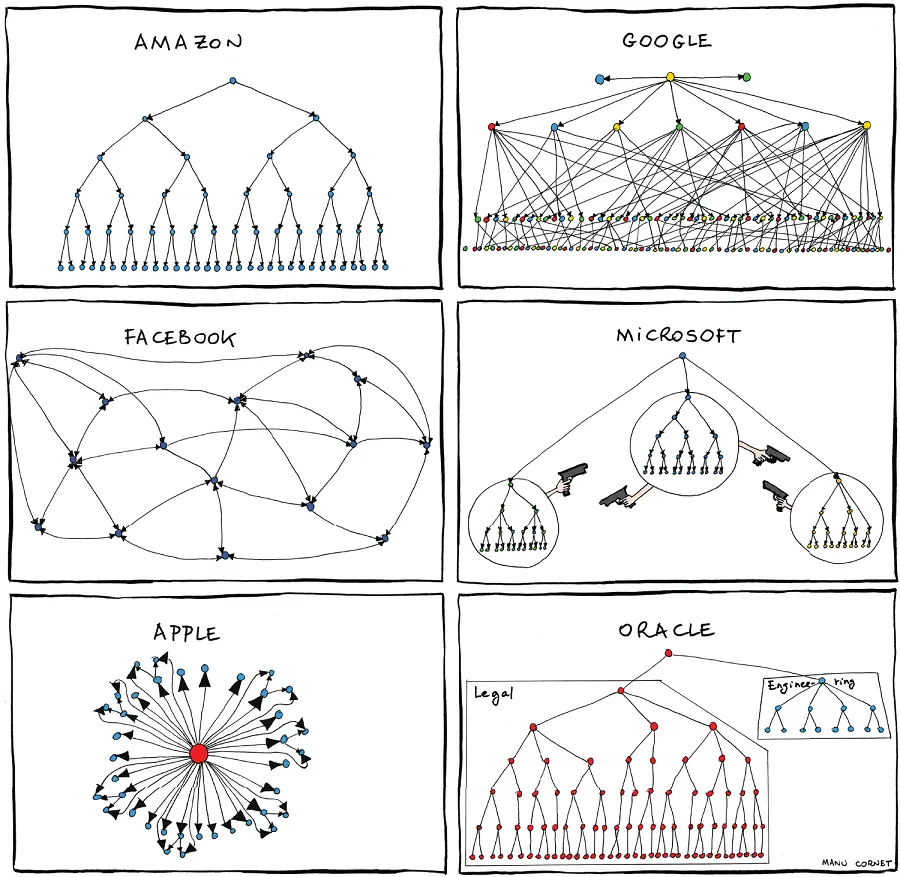
Source : © 2011, Manu Cornet. Used by permission of artist.
Imagine then the range of structural options in a large company. Manu Cornet provides a provocative example in his images of organization charts for six prominent tech companies (see Exhibit 3.1). Even though his depictions are more impressionistic than literal, they capture characteristics that traditional corporate portrayals miss. Microsoft's official chart never depicted different divisions at war with one another, and one tech executive suggested that Facebook's structure probably has “a bit more centralized gravitational pull” (Lambert, 2011). But the depiction of Apple as a hub with many spokes captures the essence of how Steve Jobs ran his company. Amazon may not be as stereotypically bureaucratic as shown in the chart, but it does thrive on a tight structure controlled by top management. Beyond the variation among these tech giants, there are still many more structural possibilities. Think of Zappo's free‐wheeling holacracy or W. L. Gore's lattice arrangements. Every successful company evolves its own unique combination of strategy and structure.
We often assume that people prefer structures with more choices and latitude (Leavitt, 1978), but this is not always the case. A study by Moeller (1968), for example, explored the effects of structure on teacher morale in two school systems. One was loosely structured and encouraged wide participation in decision making. The other had centralized authority and a clear chain of command. Moeller was surprised to find the opposite of what he expected: faculty morale was higher in the district with a tighter structure. Teachers seemed to prefer clarity of expectations, roles, and lines of authority.
United Parcel Service, “Big Brown,” provides a contemporary example of the positive benefits of structural certainty and clarity. In the company's early days, UPS delivery employees were “scampering messenger boys” (Niemann, 2007). Since then, computer technology has curtailed employee discretion, and every step from pickup to delivery is highly programmed. Detailed instructions specify placement of packages on delivery trucks. Drivers follow computer‐generated routes (which minimize mileage and left turns to save time and gas). Newly scheduled pickups automatically download into the nearest driver's route plan.
UPS calculates in advance the number of steps to your door. If a driver sees you while walking briskly to your door, you'll receive a friendly greeting. Look carefully and you'll probably notice the automated van lock the driver carries. Given such a tight leash, you might expect demoralized employees. But, the technology makes the job easier and enables drivers to be more productive. As one driver remarked to us: “We are happy robots.”
As these examples suggest, tighter structure is sometimes better—and sometimes not. Adler and Borys (1996) argue that the type of structure is as important as the amount or rigidity. There are good rules and bad ones. Formal structure enhances morale if it helps us get our work done. It has a negative impact if it gets in our way, buries us in red tape, or makes it too easy for management to control us. Equating structure with rigid bureaucracy confuses “two very different kinds of machines, those designed to de‐skill work and those designed to leverage users' skills” (p. 69).
Structure, then, need not be machinelike or inflexible. Architecture in stable environments is often hierarchical and rules‐oriented. But recent years have witnessed remarkable inventiveness in designing structures emphasizing flexibility, participation, and quality. A prime example is BMW, the luxury automaker whose success formula relies on a combination of stellar quality and rapid innovation:
Just about everyone working for the Bavarian automaker—from the factory floor to the design studios to the marketing department—is encouraged to speak out. Ideas bubble up freely and there is never a penalty for proposing a new way of doing things, no matter how outlandish. The company has become an industry benchmark for high‐performance premium cars, customized production, and savvy brand management. (Edmondson, 2006, p. 72)
Dramatic changes in technology, information flows, and the business environment have rendered old structures obsolete at an unprecedented rate, spawning a new interest in organizational design (Bryan and Joyce, 2007; Joseph and Gaba, 2020; Stanford, 2015). Pressures of globalization, competition, technology, customer expectations, and workforce dynamics have prompted organizations worldwide to rethink and redesign structural prototypes.
Читать дальшеИнтервал:
Закладка:
Похожие книги на «Reframing Organizations»
Представляем Вашему вниманию похожие книги на «Reframing Organizations» списком для выбора. Мы отобрали схожую по названию и смыслу литературу в надежде предоставить читателям больше вариантов отыскать новые, интересные, ещё непрочитанные произведения.
![Lee Jungmin - Хвала Орку 1-128 [некоммерческий перевод с корейского]](/books/33159/lee-jungmin-hvala-orku-1-thumb.webp)










Обсуждение, отзывы о книге «Reframing Organizations» и просто собственные мнения читателей. Оставьте ваши комментарии, напишите, что Вы думаете о произведении, его смысле или главных героях. Укажите что конкретно понравилось, а что нет, и почему Вы так считаете.