Lee G. Bolman - Reframing Organizations
Здесь есть возможность читать онлайн «Lee G. Bolman - Reframing Organizations» — ознакомительный отрывок электронной книги совершенно бесплатно, а после прочтения отрывка купить полную версию. В некоторых случаях можно слушать аудио, скачать через торрент в формате fb2 и присутствует краткое содержание. Жанр: unrecognised, на английском языке. Описание произведения, (предисловие) а так же отзывы посетителей доступны на портале библиотеки ЛибКат.
- Название:Reframing Organizations
- Автор:
- Жанр:
- Год:неизвестен
- ISBN:нет данных
- Рейтинг книги:4 / 5. Голосов: 1
-
Избранное:Добавить в избранное
- Отзывы:
-
Ваша оценка:
Reframing Organizations: краткое содержание, описание и аннотация
Предлагаем к чтению аннотацию, описание, краткое содержание или предисловие (зависит от того, что написал сам автор книги «Reframing Organizations»). Если вы не нашли необходимую информацию о книге — напишите в комментариях, мы постараемся отыскать её.
The Structural Frame The Human Resource Frame The Political Frame The Symbolic Frame The
has been updated with new information on cross-sector collaboration, generational differences, virtual environments, globalization, cross-cultural communication, and more, with an expanded Instructor’s Guide that includes summaries, mini-assessments, videos, and extra resources.
Reframing Organizations — читать онлайн ознакомительный отрывок
Ниже представлен текст книги, разбитый по страницам. Система сохранения места последней прочитанной страницы, позволяет с удобством читать онлайн бесплатно книгу «Reframing Organizations», без необходимости каждый раз заново искать на чём Вы остановились. Поставьте закладку, и сможете в любой момент перейти на страницу, на которой закончили чтение.
Интервал:
Закладка:
Exhibit 2.2. Systems Model with Delay.
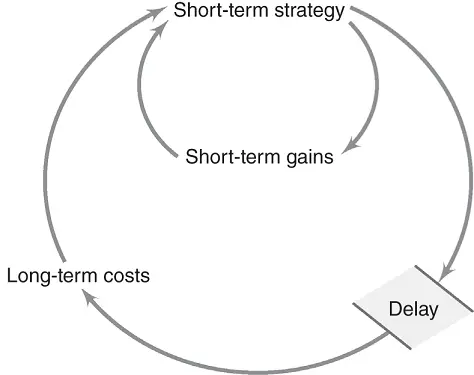
Both Oshry and Senge argue that our failure to read system dynamics traps us in cycles of blaming and self‐defense. Problems are always someone else's fault. Unlike Senge, who sees gaps between cause and effect as primary barriers to learning, Argyris and Schön (1978, 1996) emphasize managers' fears and defenses. As a result, “the actions we take to promote productive organizational learning actually inhibit deeper learning” (Argyris and Schön, 1996, p. 281).
According to Argyris and Schön, our behavior obstructs learning because we avoid undiscussable, verboten issues and carefully tiptoe around organizational taboos. That helps us avoid immediate conflict and discomfort in the moment, but in doing so we create a double bind. We can't solve problems without dealing with issues we have tried to hide. Yet discussing them would expose our cover‐up. Facing that double bind, Volkswagen engineers and Wuhan officials hid their cover‐up until outsiders caught on. Desperate maneuvers to hide the truth and delay the inevitable made the day of reckoning more catastrophic.
MAKING SENSE OF AMBIGUITY AND COMPLEXITY
Organizations try to cope with complexity and uncertainty by getting smarter or making their worlds simpler. One approach to getting smarter is developing better systems and technology to collect and process data. Another is to hire or develop professionals with sophisticated expertise in handling thorny problems. To simplify their environment, organizations often break complex issues into smaller chunks and assign slices to specialized individuals or units. These and other methods are often helpful but not always sufficient. Despite the best efforts, as we have seen or experienced, surprising—and sometimes appalling—events still happen. We need better ways to anticipate problems and wrestle with them once they arrive.
In trying to make sense of complicated and ambiguous situations, humans are often in over their heads, their brains too taxed to decode all the complexity around them. At best, managers can hope to achieve “bounded rationality,” which Foss and Weber (2016) describe in terms of three dimensions:
1 Processing capacity: Limits of time, memory, attention, and computing speed mean that the brain can only process a fraction of the information that might be relevant in each situation.
2 Cognitive economizing: Cognitive limits force human decision makers to use short‐cuts—rules of thumb, mental models, or frames—in order to trim complexity and messiness down to manageable size.
3 Cognitive biases: Humans tend to interpret incoming information to confirm their existing beliefs, expectations, and values. They often welcome confirming information while ignoring or rejecting disconfirming signals.
Benson (2016) frames cognitive biases in terms of four broad tendencies that create a self‐reinforcing cycle (see Exhibit 2.3). To cope with information overload, we filter out most data and take in only what seems important and consistent with our current mind‐set. That gives us an incomplete picture, but we fill in the gaps to make everything fit with our current beliefs. Then, in order to act quickly instead of getting lost in thought, we favor the easy and obvious over the complex or difficult. We then code our experience into memory by discarding specifics and retaining generalities or by using a few specifics to represent a larger whole. This reinforces our current mental models, which then shape how we process experience in the future.
Exhibit 2.3. Cognitive Biases.
| Cognitive Challenge | Solution | Risk |
|---|---|---|
| Too much data to process | Filter out everything except what we see as important and consistent with our current beliefs | Miss things that are important or could help us learn |
| Tough to make sense of a confusing, ambiguous world | Fill in gaps, make things fit with our existing stories and mental models | Create and perpetuate false beliefs and narratives |
| Need to act quickly | Jump to conclusions—favor the simple and obvious over the messy and complex | Quick decisions and actions lead to mistakes and get us in trouble |
| Memory overload | Discard specifics to form generalities or use a few specifics to represent the whole | Error and bias in memory reinforce current mind‐sets and biases in information‐processing |
To a greater or lesser degree, we all rely on these cognitive short‐cuts. President Donald Trump regularly provided visible examples in his tweet storms and off‐the‐cuff communications. In March, 2017, he tweeted that his predecessor, Barack Obama was a “bad (or sick) guy” for tapping Trump's phones prior to the election. Trump apparently based this claim on an article from the right‐wing website Breitbart. Since the charge aligned with Trump's worldview, he figured it must be true and continued to insist he was right even after investigators concluded it never happened.
These biases and limits in human thinking and the complexity of human systems often lead us to act before we really understand what's going on. As one highly placed female executive reported to us, “I thought I'd covered all the bases, but then I suddenly realized that the rest of my team were playing football.” Faced with an unending barrage of puzzles or “messes,” managers first need to grasp an accurate picture of what is happening in the moment. Then they must move to a deeper level of understanding, asking, “What is really going on here?” This step omitted, managers too often rush to judgment, forming superficial analyses and pouncing on the solutions nearest at hand or most in vogue. Market share declining? Try strategic planning. Customer complaints? Put in a quality program. Profits down? Time to reengineer or downsize. A better alternative is to think, to probe more deeply into what is really going on, and to develop an accurate diagnosis. The ability to size up a situation quickly is at the heart of leadership. Admiral Carlisle Trost, former Chief of Naval Operations, once remarked, “The first responsibility of a leader is to figure out what is going on … That is never easy to do because situations are rarely black or white, they are a pale shade of gray … they are seldom neatly packaged.”
It all adds up to a simple truth that is easy to overlook. The world we perceive is an image we construct in our minds. Ellen Langer, the author of Mindfulness (1989), captures this viewpoint succinctly: “What we have learned to look for in situations determines mostly what we see” (Langer, 2009, p. 33). The ideas or theories we hold determine whether a given situation is foggy or clear, mildly interesting or momentous, a paralyzing disaster, or a genuine learning experience. Personal theories are essential because of a basic fact about human perception: in any situation, there is simply too much happening for us to attend to everything. We drown in a sea of complexity. To help us understand what is going on and what to do next, well‐grounded, deeply ingrained personal theories offer two advantages: they tell us what is important and what is safe to ignore, and they group scattered bits of information into coherent patterns. Mental models shape reality.
Research in neuroscience has called into question the old adage, “seeing is believing.” It has been challenged by its converse: “Believing is seeing.” The brain constructs its own images of reality and then projects them onto the external world (Eagleman, 2011). “Mental models are deeply held internal images of how the world works, images that limit us to familiar ways of thinking and acting. Very often, we are not consciously aware of our mental models or the effects they have on our behavior” (Senge, 1990, p. 8). Reality is therefore what each of us believes it to be. Shermer (2012) tells us that “beliefs come first, explanations for beliefs follow.” Once we form beliefs, we search for ways to explain and defend them. Today's experience becomes tomorrow's fortified theology.
Читать дальшеИнтервал:
Закладка:
Похожие книги на «Reframing Organizations»
Представляем Вашему вниманию похожие книги на «Reframing Organizations» списком для выбора. Мы отобрали схожую по названию и смыслу литературу в надежде предоставить читателям больше вариантов отыскать новые, интересные, ещё непрочитанные произведения.
![Lee Jungmin - Хвала Орку 1-128 [некоммерческий перевод с корейского]](/books/33159/lee-jungmin-hvala-orku-1-thumb.webp)










Обсуждение, отзывы о книге «Reframing Organizations» и просто собственные мнения читателей. Оставьте ваши комментарии, напишите, что Вы думаете о произведении, его смысле или главных героях. Укажите что конкретно понравилось, а что нет, и почему Вы так считаете.