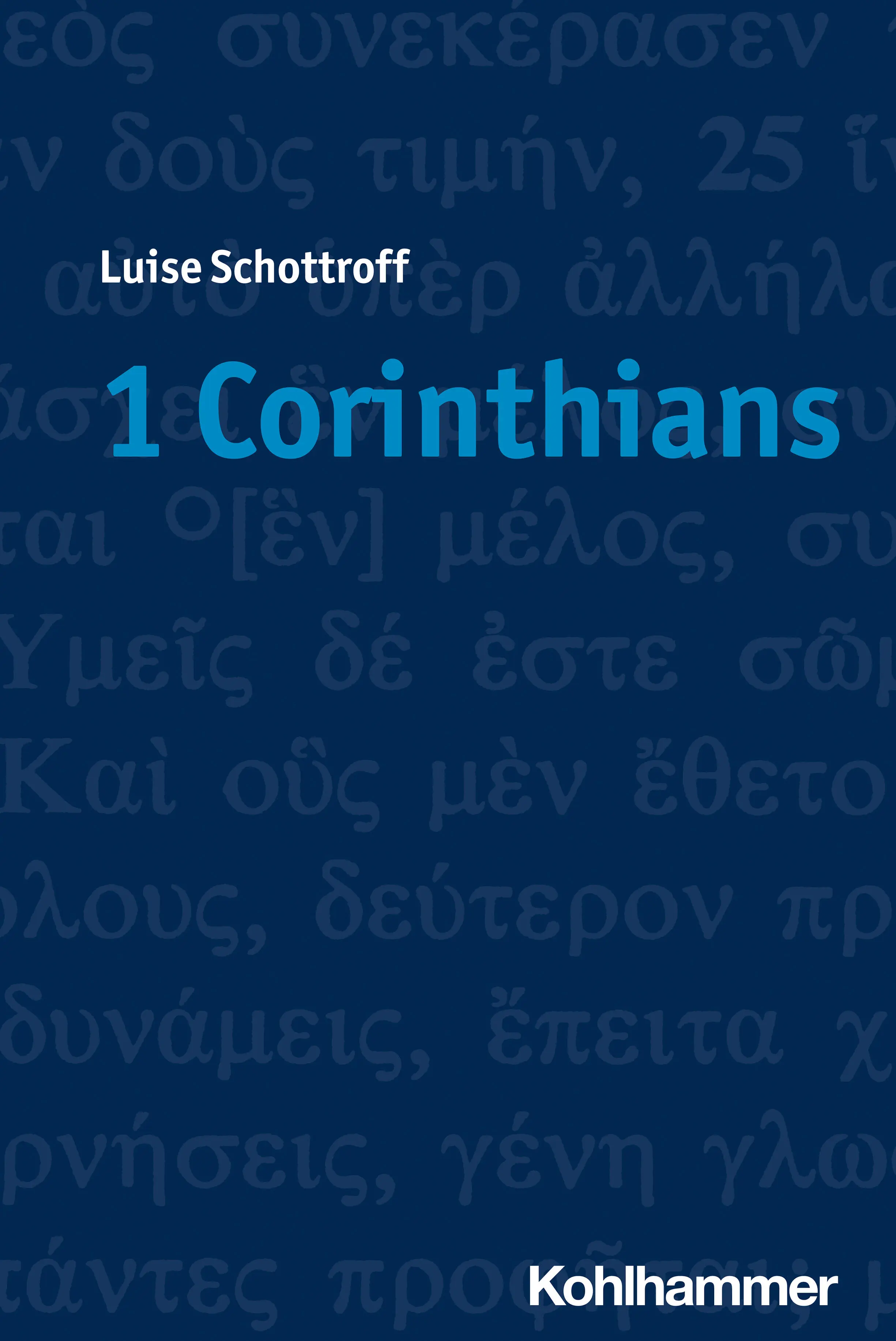
Luise Schottroff - 1 Corinthians
Здесь есть возможность читать онлайн «Luise Schottroff - 1 Corinthians» — ознакомительный отрывок электронной книги совершенно бесплатно, а после прочтения отрывка купить полную версию. В некоторых случаях можно слушать аудио, скачать через торрент в формате fb2 и присутствует краткое содержание. Жанр: unrecognised, на английском языке. Описание произведения, (предисловие) а так же отзывы посетителей доступны на портале библиотеки ЛибКат.
- Название:1 Corinthians
- Автор:
- Жанр:
- Год:неизвестен
- ISBN:нет данных
- Рейтинг книги:5 / 5. Голосов: 1
-
Избранное:Добавить в избранное
- Отзывы:
-
Ваша оценка:
1 Corinthians: краткое содержание, описание и аннотация
Предлагаем к чтению аннотацию, описание, краткое содержание или предисловие (зависит от того, что написал сам автор книги «1 Corinthians»). Если вы не нашли необходимую информацию о книге — напишите в комментариях, мы постараемся отыскать её.
The English version is based on the German 2nd edition. It was translated by Everett R. Kalin, Professor Emeritus for New Testament at Pacific Lutheran Theological Seminary at Berkely/CA.
1 Corinthians — читать онлайн ознакомительный отрывок
Ниже представлен текст книги, разбитый по страницам. Система сохранения места последней прочитанной страницы, позволяет с удобством читать онлайн бесплатно книгу «1 Corinthians», без необходимости каждый раз заново искать на чём Вы остановились. Поставьте закладку, и сможете в любой момент перейти на страницу, на которой закончили чтение.
Интервал:
Закладка:
The oneness of the God of Israel(8:4–6), in the sense of the »Hear, O Israel/ Shema Israel ,« is acknowledged by them as well as by the Jewish people. In Chapters 8–10 Paul discusses the Halakic consequences of the uniqueness of God for everyday life in Corinth. This everyday life is defined by cults that are foreign to Israel. For believers in the Messiah, even the religions with which they were formerly associated are now alien cults in which they are no longer able to participate. The Pauline halakah/interpretation on these issues moves within the framework of the halakah of the Judaism of that period. It follows from 7:19 that Paul takes it as self-evident that the believers in the Messiah from the nations observe the Torah unreservedly, even if he just as self-evidently assumes that the males, in contrast to Jewish males, are not circumcised. He does not have in view here a limited Torah for the nations (see on 7:19). Rather, it is clear that particular aspects of Jewish life distinguish the Jewish people as ethnos and therefore are not practiced by people who belong to another ethnos , especially the temple worship in Jerusalem (10:18) and circumcision. It can be assumed that all other aspects of Jewish life that are in accord with the Torah, in so far as they are not mentioned in the Pauline text, also apply to the lives of the non-Jewish people of the Messiah in Corinth: Sabbath observance, food laws and others. In Chapters 8–10 Paul discusses how to relate to other gods and not food laws, as is often assumed. The temple tax does not appear to be paid, but the collection for Jerusalem (16:1–4) is understood as an expression of the relationship to Jerusalem and therewith to Israel. 101The relationship to Israel is interpreted by Paul as an adoption by God 102or also as a joining with or turning to the God of Israel (Acts 15:19, 14:15).
So, believers in the Messiah from the nations commit themselves to the oneness of the God of Israel (8:4–6) and to observing the entire Torah (7:19). Israel’s ancestors become their ancestors as well (10:1)—and yet they continue to belong to a different ethnos .
From the perspective of those on the outside, they later received the name christianoior christiani . 103This designation signifies that they are understood by those on the outside to be a Jewish messianic group, just as there were others before them and are others alongside them in Judaism. As such they are also persecuted by Rome, for there is an ongoing policy of Roman mistrust against Jewish messianism. 104In texts of the first century and the beginning of the second, the word christianoi or christiani ought to have been translated »followers of the Messiah.« The word Christian implies a separation from Judaism, which was the view neither of those within nor of those on the outside.
The question about the identity of believers in the Messiah in Corinth has no simple answer. Non-Jewish people lived in a Jewish way and bound themselves unreservedly to the God of Israel. The question of their identity, in terms of inner and outside authorities, was apparently raised by no one. Correspondingly, even the question of what a Ioudaios was exactly was not the object of definitions. But when the issue was raised at all, it was answered by listing various aspects of one’s way of life. 105
In view of the way later Christians wrote history, also with respect to the congregation in Corinth, this much is clear: the separation from Judaism that was later practiced by those on the Christian side is often projected backward into the first century, but this view of history is false. There was neither a separation from Judaism asserted by people of the Messiah from the nations nor was there a separation asserted over against them by Jewish members of the synagogue who denied that Jesus was the Messiah. Also, from the Roman side, both groups were subject to the same social pressure and political mistrust. The politics of separation, then, was the work of certain »Church Fathers« in the second century. 106
Only after the Jewish defeat against Rome in 70 CE, to make determinations for the fiscus Judaicus , did Roman authorities have an interest in knowing exactly who was Jewish and who wasn’t. 107In this context, short descriptions emerge that could fit believers in the Messiah from the nations: » inprofessi Judaicam viverent vitam /people who, without professing to be Jewish, lived in accord with Jewish ritual.« 108Cassius Dio reports about two relatives of the emperor who were condemned as atheists and then appends a generalizing notice about » alloi es ta tōn Ioudaiōn ēthē exokellontes /others who drifted into Jewish ways.« 109Even if it is not possible to conclude with certainty whether this is about believers in the Messiah from the nations or about others from the nations who were sympathetic to Judaism, these references are of interest for 1 Corinthians. They show what the views on such groups from the outside look like.
Shaye Cohen (1999, 140–174) has listed six heuristic categories for the »Beginnings of Jewishness« (for example, to acknowledge the power of the Jewish God and/or to practice some or several Jewish rituals). They show how we can envision the way of life of people from the nations who in some way or other lived as Jews without being Jewish. They were amorphous, undefined and decentralized processes. The findings for the Corinthian congregation merely add a variant to this picture, one variant among many, which, however, does fit into the picture as a whole.
1:26–31
26 Consider yourselves, sisters and brothers; you are called. There are, namely, among you not many educated by background, not many powerful, not many from elite families. 27 Much rather, God has chosen the uneducated of the world in order to shame the educated; and the weak of the world God has chosen, in order to shame the strong. 28 And the little people and the despised of the world, God has chosen, those who count for nothing, to take the power of those who are something. 29 That is happening so that no human being is presumptuous before God. 30 Through God you are connected with the Messiah Jesus, who has granted us from God the capacity for wisdom and righteousness and healing and liberation. 31 Thus comes to pass what has been written: Let the one who would be great, praise the greatness of the Eternal One.
The biography of the brothers and sisters belonging to the congregation in Corinth is itself a testimony to the resurrection of the one who was crucified. »Consider …,« the text begins: God’s intervention into the power structures is evident in you yourselves. God has called those who are at the bottom of the heap in the city of Corinth: the uneducated and powerless and people who already through their origin belong to society’s losers; »the nobodies« from the perspective of those on top, as v. 28 puts it. The transformation that God’s intervention has affected means for these »nobodies« that they have become the body of Christ (1:30a) and that Christ’s wisdom has taken form in them (30b; see already 1:5). In this event the educated and mighty lose their power (1:27–29). They can no longer boast in their possessions (1:29). What is the significance of all that in concrete terms?
In this text Paul is reaching back into the biblical tradition: the election of the poor by God and the election of tiny Israel (see only 1 Sam 2:7–10; Deut 7:6–8). He interprets the Scripture for his own time; he applies it to the experiences of the people in the Corinthian congregation. He refers explicitly to Jer 9:22–23 [Eng. Bible, 9:23–24. Trans.] (in 1:29, 31), implicitly to the broad stream of tradition about the gospel for the poor in Scripture (in 1:26–28).
Читать дальшеИнтервал:
Закладка:
Похожие книги на «1 Corinthians»
Представляем Вашему вниманию похожие книги на «1 Corinthians» списком для выбора. Мы отобрали схожую по названию и смыслу литературу в надежде предоставить читателям больше вариантов отыскать новые, интересные, ещё непрочитанные произведения.








Обсуждение, отзывы о книге «1 Corinthians» и просто собственные мнения читателей. Оставьте ваши комментарии, напишите, что Вы думаете о произведении, его смысле или главных героях. Укажите что конкретно понравилось, а что нет, и почему Вы так считаете.