Rethinking Prototyping
Здесь есть возможность читать онлайн «Rethinking Prototyping» — ознакомительный отрывок электронной книги совершенно бесплатно, а после прочтения отрывка купить полную версию. В некоторых случаях можно слушать аудио, скачать через торрент в формате fb2 и присутствует краткое содержание. Жанр: unrecognised, на английском языке. Описание произведения, (предисловие) а так же отзывы посетителей доступны на портале библиотеки ЛибКат.
- Название:Rethinking Prototyping
- Автор:
- Жанр:
- Год:неизвестен
- ISBN:нет данных
- Рейтинг книги:3 / 5. Голосов: 1
-
Избранное:Добавить в избранное
- Отзывы:
-
Ваша оценка:
Rethinking Prototyping: краткое содержание, описание и аннотация
Предлагаем к чтению аннотацию, описание, краткое содержание или предисловие (зависит от того, что написал сам автор книги «Rethinking Prototyping»). Если вы не нашли необходимую информацию о книге — напишите в комментариях, мы постараемся отыскать её.
The Design Modelling Symposium Berlin 2013 would like to challenge the participants to reflect on the possibility of computational systems that bridge design phase and occupancy of buildings. This rethinking of the designed artifact beyond its physical has had profound effects on other industries already. How does it affect architecture and engineering?
At the scale of engineering and building systems new perspectives may open up by engaging built form as a continuous prototype, which can track and respond during use and serve as a real world implementation of its design model. This has been tried many times from intelligent façades to smart homes and networked grids but much of it was only technology driven and not approached from a more holistic design perspective.
Rethinking Prototyping — читать онлайн ознакомительный отрывок
Ниже представлен текст книги, разбитый по страницам. Система сохранения места последней прочитанной страницы, позволяет с удобством читать онлайн бесплатно книгу «Rethinking Prototyping», без необходимости каждый раз заново искать на чём Вы остановились. Поставьте закладку, и сможете в любой момент перейти на страницу, на которой закончили чтение.
Интервал:
Закладка:
We assume a given family of curves that outline a surface. Alternatively, take a modeling surface and chose a family of curves on them, such as the evenly spaced geodesics of (Wallner et al 2010) or (Kahlert et al 2011). If a network of (conjugate) directions is already given e.g. through methods of (Alliez et al 2003) or (Bommes et al 2009), one can also choose one of the families as input curves.
4.1 Connecting Developable and Tangent Developable
Given a family of curves, we will construct a strip between two consecutive curves that consists of conical panels i.e. panels that lie on general cones, see sec. 3.3.
As outlined in sec. 3.2, the construction of a connecting developable surface between two curves is solved, but the angle between the ruling and the curves’ tangents can behave wildly, especially if curves have small perturbations.
On the other extreme, one could choose one of the two curves – call it the base curve b – and, if an underlying surface S is given, construct the tangent developable surface G as in sec. 3.1. The rulings of G are by definition the conjugate directions for the points of b , so this is the method of ( Wallner et al 2010 ). In general, the second or target curve will not lie on G.
4.2 Outline of the Algorithm
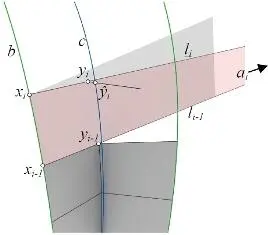
Fig. 6 Illustration explaining the approximation algorithm: a base curve b (green) is followed smoothly, while a second curve c (blue) serves as a target. Points xi-1 and xi are on b, ŷi is on c; the lines li-1 and li are coplanar and meet in apex ai – see the algorithm in the main text for further explanations.
Our algorithm is a combination of the most important characteristics of the constructions outlined in sec. 3.2. We input a base curve and a target curve, which lie in parallel planes. If they were general space curves, step 2 would have to be adapted to accommodate for tangent planes. The output is a strip of developable surfaces precisely through the base curve and approximately following the target curve.
1 Connect the start point x0 of the base curve b and the start point y0 of the target curve c with a line l0.
2 Choose a point xi on b and a point zi on c, e.g. by subdividing the curves a given number of times, see sec. 4.3 for choice of direction.
3 Compute b’s tangent tb(xi). In a small neighborhood of given size around zi, compute tangents to c. Choose the one with minimum angle to tb(xi), the corresponding point is ŷi.
4 Project ŷi onto the plane spanned by li-1 and xi to get yi.
5 The line connecting xi and yi is coplanar with li-1, they intersect in a point ai (or they are parallel).
6 Form a conical surface with the curve segment of b from xi-1 to xi and the apex ai (or a cylindrical surface)
7 The line through xi and yi is the next li. Or, if you want to get closer to t, take a point between yi and ŷi within a given threshold and thus get the next li.
8 Repeat steps 2 to 7 until you reach the end of b.
For a family of curves number them consecutively and use the even numbers as base curves and the odd numbers as target curves, see Fig. 7. Then, every strip has a neighbor with whom it shares a base curve and one neighbor sharing a target curve. Intersect the latter two strips to get a new curve, approximating the target curve and lying on both adjacent strips. In most cases, this intersection curve will be very ragged and thus unaesthetic. We therefore trim the strips with an auxiliary surface through the target curve, which can be a bisector of the strips or a general cone through the target curve.
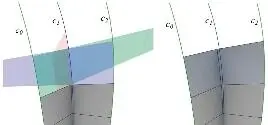
Fig. 7 (left) If the intersection of the strip between c0 and c1 and the strip between c1 and c2 is too ragged, an auxiliary surface through the target curve c1 is constructed. (right) The resulting conical panels and the new curve close to the target curve c1.
4.3Choice of ruling direction
For most algorithms approximating an input surface by a developable surface ( Rose et al 2007 ) there is no explicit choice of ruling direction, which makes no difference in computer graphics, but if the panels are to be built, the ruling directions determine two of the panels’ edges, thus having significant impact on the overall look.
As mentioned in sec. 3.2, the conjugate direction (assuming an underlying surface S ) is a good choice for the ruling but need not intersect the other curve. We mimic the construction of the tangent developable surface locally by fitting a cone, whose second ruling (the first is already given by the previous iteration) should ideally intersect b in a right angle (see the choice of zi in the step 1 of the algorithm). Note that this can only be the case if b were a principal curvature line of S , see ( Pottmann et al 2007 ).
It follows that the algorithm gives the most pleasing results if the chosen family of input curves is part of a conjugate network of curves, such as a family of principal curvature lines, as can be expected.
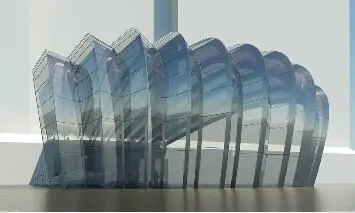
Fig. 8 Design study Hotel Entrance with conical glass panels, where the curve network can be divided such that the base curves are ridges and the target curves valleys. This design could also be built with planar panels, but then the panels would not yield smooth reflection lines.
5 Examples
We present examples of architectural projects that are yet to be realized. The examples are either based on our own architectural designs, like Fig. 8, or actual projects that have not yet seen completion like in Fig. 9. They were constructed following the algorithm of sec. 4.2 with these predefined values:
| Fig. 8 | Fig. 9 | |
| Average Panel Size (in mm) | 2.00 x 1000 | 1.00 x 1000 |
| Number of Subdivisions | 2. | 1. |
| Max. Tangent Deviation | 3. | 1. |
| Max. Panel Deviation | 0 | 2. |
Table 1 Parameters of the examples
In Tab.1 average panel size and all other measures are in millimeters. The number of subdivisions refers to step 1 of the algorithm and sets the number of panels each strip has. The maximum tangent deviation refers to the size of the neighborhood in step 2, in which one looks for parallel tangents. The maximum panel deviation is the threshold of step 6 and defines how far two consecutive panels can be apart; this number will be lower in practice because of cold bending.
Fig. 8 shows an architectural study where the curve network can be divided such that the base curves are ridges and the target curves valleys.
The algorithm works very well here because neighboring strips meet almost at a right angle, which makes intersecting them easier. Note that this design could also be built with planar panels, but then appearance of the reflection lines would be completely different.
The last example in Fig. 9 is an actual project, where the new free-form design serves as an extension to a historical building. Note that the curve network does not directly follow the main curvature lines and yet the algorithm gives good results. The main difference to the example in Fig. 8 lies in the fact that two adjacent strips meet in a very obtuse angle, thus trimming with an auxiliary surface (see the last paragraph of sec. 4.2) is necessary.
Читать дальшеИнтервал:
Закладка:
Похожие книги на «Rethinking Prototyping»
Представляем Вашему вниманию похожие книги на «Rethinking Prototyping» списком для выбора. Мы отобрали схожую по названию и смыслу литературу в надежде предоставить читателям больше вариантов отыскать новые, интересные, ещё непрочитанные произведения.

Обсуждение, отзывы о книге «Rethinking Prototyping» и просто собственные мнения читателей. Оставьте ваши комментарии, напишите, что Вы думаете о произведении, его смысле или главных героях. Укажите что конкретно понравилось, а что нет, и почему Вы так считаете.