Rethinking Prototyping
Здесь есть возможность читать онлайн «Rethinking Prototyping» — ознакомительный отрывок электронной книги совершенно бесплатно, а после прочтения отрывка купить полную версию. В некоторых случаях можно слушать аудио, скачать через торрент в формате fb2 и присутствует краткое содержание. Жанр: unrecognised, на английском языке. Описание произведения, (предисловие) а так же отзывы посетителей доступны на портале библиотеки ЛибКат.
- Название:Rethinking Prototyping
- Автор:
- Жанр:
- Год:неизвестен
- ISBN:нет данных
- Рейтинг книги:3 / 5. Голосов: 1
-
Избранное:Добавить в избранное
- Отзывы:
-
Ваша оценка:
Rethinking Prototyping: краткое содержание, описание и аннотация
Предлагаем к чтению аннотацию, описание, краткое содержание или предисловие (зависит от того, что написал сам автор книги «Rethinking Prototyping»). Если вы не нашли необходимую информацию о книге — напишите в комментариях, мы постараемся отыскать её.
The Design Modelling Symposium Berlin 2013 would like to challenge the participants to reflect on the possibility of computational systems that bridge design phase and occupancy of buildings. This rethinking of the designed artifact beyond its physical has had profound effects on other industries already. How does it affect architecture and engineering?
At the scale of engineering and building systems new perspectives may open up by engaging built form as a continuous prototype, which can track and respond during use and serve as a real world implementation of its design model. This has been tried many times from intelligent façades to smart homes and networked grids but much of it was only technology driven and not approached from a more holistic design perspective.
Rethinking Prototyping — читать онлайн ознакомительный отрывок
Ниже представлен текст книги, разбитый по страницам. Система сохранения места последней прочитанной страницы, позволяет с удобством читать онлайн бесплатно книгу «Rethinking Prototyping», без необходимости каждый раз заново искать на чём Вы остановились. Поставьте закладку, и сможете в любой момент перейти на страницу, на которой закончили чтение.
Интервал:
Закладка:
However, the focus in the present case is a different one. The principle interest is not a reduction of data but rather a concentration. The architect should be given a tool that allows him or her to design in great complexity and in an incredible richness, while only having a small number of strings to pull. Designing in the frequency domain does mean not to specify the position in time and space of every instance but it assumes always a continuity. One data point implies already a pattern. What works for one (e.g. sound or stock market prices) or two-dimensional data – illustrated in the present work with the example of wood grain textures – is without further ado scalable to three or more dimensions. Rhythms in space of matter and void can be analyzed and synthesized, orchestrating spatial patterns.

Fig. 11 Average image of all the 144 samples of Fig. 1
Fig. 12 Average image enhanced to cover the entire contrast range

Fig. 13 Same reduction ratio applied to the number of pixels
References
Gleick, J., 2011: The Information: A History, a Theory, a Flood . New York, Pantheon Books.
Kohonen, T., 2001: Self-Organizing Maps . Berlin etc., Springer.
Meier, E., 2007: The Wood Database . http://www.wood-database.com/, By Woodworkers, For Woodworkers.
Schindler, C. and M. Salmerón Espinosa, 2011: ZipShape Mouldless Bending II – A Shift from Geometry to Experience in Respecting Fragile Place /29th eCAA De Conference Proceedings, Ljubljana 2011.
Shannon, C. E. and W. Weaver, 1949: The Mathematical Theory of Communication . Urbana, University of Illinois Press.
Szeliski, R., 2011: Computer Vision Algorithms and Applications . London, Springer.
Wendykier, P. and J. G. Nagy, 2010: Parallel Colt: A High-Performance Java Library for Scientific Computing and Image Processing. ACM Trans. Math. Softw . 37(3): 1-22.
Yoshida, H., 2012: Bridging Synthetic and Organic Materiality: Gradient Transitions in Material Connections. Biologically-Inspired Computing for the Arts: Scientific Data through Graphics , IGI Global: 81-88.
Enhancing Free-Form Architecture with Conical Panels
Bernhard Blaschitz, Benjamin Schneider and René Ziegler
AbstractEnhancing a given architectural free-form shape to feasibility often involves the approximation by a developable surface, either as an intermediate step for further planarization or to build single curved panels. Over the last years, many theoretical approaches have been presented that require optimization frameworks or mathematical equation solvers that are not readily available for the practitioner.
The new approach we present in this work takes a family of curves and constructs strips of conical and cylindrical panels between them. Two panels touch along a common ruling, which almost follows the conjugate direction. Planarization and development of the strip into the plane follow naturally. An easy, step-by-step algorithm that can be scripted in any CAD software is presented, as well as examples from architecture.
Bernhard Blaschitz, Benjamin Schneider and René Ziegler
Waagner-Biro Stahlbau AG, Vienna, Austria
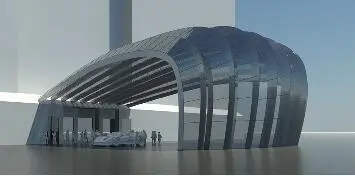
Fig. 1 Design Study based on the algorithm of this work. The family of curves shown as steel beams was approximated with strips of conical panels, which are easier to manufacture in glass than general double curved elements.
1 Introduction
The evolution of a digital shape, described as a NURBS surface, into a discrete model and its further development into a built structure made out of many components with material-immanent characteristics, poses new challenges for architects, structural engineers and building firms. A close interdisciplinary collaboration, sometimes even with mathematicians and computer scientists, an exact understanding of the parties involved in the project and a consistent parametric data model are therefore the key to a successful project.
This has been enabled by the developments of digital modeling software and fabrication techniques. Computers have helped to push the boundaries that define which architectural forms can be realized. Because of new complex shapes which can be generated, and due to the development of new tools, which can rationalize and refine the complex geometries into easier buildable and more cost beneficial solutions. This enables the client to afford freeform architecture, which in the past would have been vastly more expensive.
1.1 Previous Work
Experience in building free-formed envelopes show that single curved elements are much easier to design, to produce and to install than general, double curved panels (Shelden 2002) or (Glaeser and Gruber 2007) even though there has been great improvement in the design of double curved molds (Raun et al 2012) and their repetitive use (Eigensatz et al 2010).
The focus of research over the last ten years has been planar panels, which can either be constructed directly (Glymph et al 2004), optimized from curve networks (Liu et al 2011) or by a physics based approach (Piker 2012). All optimization frameworks share a strong dependency on a good starting value, which determines aesthetics and convergence. Note that the four corners of the conical panels presented in this work already lie in a plane, so planarization is an inherent feature of the method.
The class of developable surfaces subsumes general cones, cylinders and tangent surfaces to a space curve. Numerous papers have dealt with the task of approximating a general shape with a developable surface (e.g. Aumann 2004, Chu and Séquin 2002, Frey 2004 or Liu et al 2006), but most of them require a computational framework to solve non-linear equations or insights into mathematical optimization, (Pottmann et al 2008) or (Zadravec et al 2010) that are not readily available for the practitioner. In computer graphics most papers use triangular meshes to compute developable surfaces (Rose et al 2007), (Julius et al 2005) or (Wang and Tang 2004) but ruling directions play no significant role.
1.2 Contribution of the present paper
In contrast to most of these methods, this paper does not directly approximate a given surface or mesh, but rather assumes a family of curves that outline a surface. Through two consecutive curves, strips of developable patches are spanned that allow the user to control the direction of the edges.
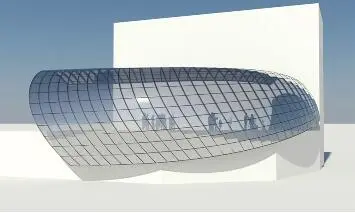
Fig. 2 Architectural study constructed with the methods of this work. Not only curvature lines can be used for panel alignment, but also general curves.
After showing the differences between single curved and double curved glass panels in design and production in section 2, we review all geometrical concepts necessary for understanding this work in section 3.
Читать дальшеИнтервал:
Закладка:
Похожие книги на «Rethinking Prototyping»
Представляем Вашему вниманию похожие книги на «Rethinking Prototyping» списком для выбора. Мы отобрали схожую по названию и смыслу литературу в надежде предоставить читателям больше вариантов отыскать новые, интересные, ещё непрочитанные произведения.

Обсуждение, отзывы о книге «Rethinking Prototyping» и просто собственные мнения читателей. Оставьте ваши комментарии, напишите, что Вы думаете о произведении, его смысле или главных героях. Укажите что конкретно понравилось, а что нет, и почему Вы так считаете.