Rethinking Prototyping
Здесь есть возможность читать онлайн «Rethinking Prototyping» — ознакомительный отрывок электронной книги совершенно бесплатно, а после прочтения отрывка купить полную версию. В некоторых случаях можно слушать аудио, скачать через торрент в формате fb2 и присутствует краткое содержание. Жанр: unrecognised, на английском языке. Описание произведения, (предисловие) а так же отзывы посетителей доступны на портале библиотеки ЛибКат.
- Название:Rethinking Prototyping
- Автор:
- Жанр:
- Год:неизвестен
- ISBN:нет данных
- Рейтинг книги:3 / 5. Голосов: 1
-
Избранное:Добавить в избранное
- Отзывы:
-
Ваша оценка:
Rethinking Prototyping: краткое содержание, описание и аннотация
Предлагаем к чтению аннотацию, описание, краткое содержание или предисловие (зависит от того, что написал сам автор книги «Rethinking Prototyping»). Если вы не нашли необходимую информацию о книге — напишите в комментариях, мы постараемся отыскать её.
The Design Modelling Symposium Berlin 2013 would like to challenge the participants to reflect on the possibility of computational systems that bridge design phase and occupancy of buildings. This rethinking of the designed artifact beyond its physical has had profound effects on other industries already. How does it affect architecture and engineering?
At the scale of engineering and building systems new perspectives may open up by engaging built form as a continuous prototype, which can track and respond during use and serve as a real world implementation of its design model. This has been tried many times from intelligent façades to smart homes and networked grids but much of it was only technology driven and not approached from a more holistic design perspective.
Rethinking Prototyping — читать онлайн ознакомительный отрывок
Ниже представлен текст книги, разбитый по страницам. Система сохранения места последней прочитанной страницы, позволяет с удобством читать онлайн бесплатно книгу «Rethinking Prototyping», без необходимости каждый раз заново искать на чём Вы остановились. Поставьте закладку, и сможете в любой момент перейти на страницу, на которой закончили чтение.
Интервал:
Закладка:
The main contribution of this paper, an approach to approximate given boundary curves with panels made of general cylinders and general cones, can be found in section 4. No further optimization is employed. All results can be scripted in standard CAD software without the need of external libraries or mathematical software. Since the desired application is architecture, the presented algorithm also allows the user to enter tolerances regarding the distance of panels. Examples and architectural studies are shown in section 5 and we conclude with a summary in section 6.
2 Application to architectural design with bent glass panels
Due to the rise of complex free-form shapes in architecture the glass industry had to develop new strategies and adapt their production lines. Now we differentiate between two main bending methods, the Annealed Glass Bending and the Tempered Glass Bending. These two techniques differ in the type of glass used, bending tools or machines and application of the fabricated elements. Based on many associated parameters of the glass, like edge curvature or panel geometry (Fig. 3) the costs for producing cylindrical and conical glass is quite the same, but costs for double curved glass are much more higher.
For double curved panels one needs to build a mould for every shape. (Eigensatz et al 2010) propose a method for computing different types of curved panels for given panel edges. Their algorithm depends on the choice of a coordinate system in the panel’s centre, which in turn determines the direction of curvature lines and thus reflection properties. Furthermore, the panel’s edge curves have to be given.
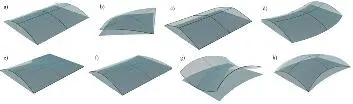
Fig. 3 Special glass panel types: a) cylindrical, b) cylindrical, edges not aligned, c) paraboloid, d) toroidal, e) double curved, three edges aligned, f) conical, g) anticlastic, h) synclastic. Panel types a, b c, f are developable, and therefore ruled surfaces, panels d, e, g and h are double curved surfaces.
There are a few advantages of conical glass elements over double curved elements. They are more cost efficiency and easier installation. This depends primarily on the geometry of the edges and further the sealing of the joints of watertight structures.
Cylindrical panels and elements of annealed glass that are based on ruled surfaces can be produced with the same technique (Fig. 1).
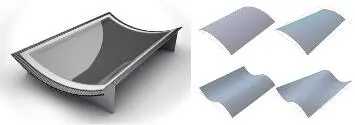
Fig. 4 Annealed Glass Bending with gravity force method is set up as depicted left and produces ruled surfaces, of which the types on the right are special cases: rotational cylindrical, rotational conical, general cylindrical and general conical (from top left to bottom right).
3 Geometrical Prerequisites
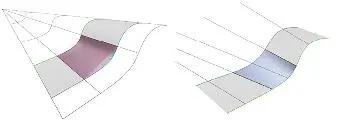
Fig. 5 (Left) for a conical surface, all rulings intersect in a common apex; (right) a general ruled surface does not fulfill this property. For an arbitrary point on either of the colored curves, the directions of its tangent and the intersecting ruling are called conjugate.
The tangent surfaces of space curves, general cylinders and general cones are subsumed in the class of developable surfaces. They are a subclass of ruled surfaces i.e. surfaces that carry a family of lines, with the special property that the tangent plane along a ruling does not change its direction, see (Do Carmo 1976).
3.1 Conjugate Directions
The tangent planes of a curve c(u) on a surface envelope a developable surface G, called the tangent developable. For a point x on c(u), there is exactly one tangent to the curve c(u) and exactly one ruling of G that touches at x; the directions of these two lines are called conjugate, see Fig. 5. If two families of curves on a surface are such that through every point, there is one member of each family and their directions are conjugate, we speak of a conjugate network of curves. For equivalent definitions of conjugate directions see (Zadravec et al 2010), who give different examples of conjugate networks, the most important of which are principal curvature lines.
(Liu et al 2011) show that conjugate networks are a good choice for the initialization of a planarization algorithm, which can be derived from the analytical definition of conjugate directions (Do Carmo 1976). We will use conjugate directions for the choice of a ruling direction of developable strips in sec. 4.3.
3.2 Developable Surfaces and Planarization
If one wants to approximate a given surface with developable surfaces or planar quads via an optimization, principal curvature networks are a good starting point, see (Liu et al 2011) and (Pottmann et al 2008).
To approximate a given surface with almost rectangular panels, see (Wallner et al. 2010), which relies on finding geodesic lines of almost constant distance, see (Kahlert et al 2011).
A completely different approach is to start with two curves and construct a developable surface between them, see (Pottmann et al 2007), by connecting points with coplanar tangents with a line l, i.e. the tangents and l lie in the same plane E. These planes E envelope a surface, the connecting developable surface, and the lines l are its rulings. Note that this surface is not unique for given input curves. The angle between the ruling l and the curves’ tangents varies. This approach has been followed by (Subag and Elber 2006) for the approximation with NURBS surfaces.
If one curve is given and the other one is to be approximated, this approach leads to nonlinear equations and has been done for B-spline curves and a developable B-spline by (Aumann 2004) and (Chu and Séquin 2002).
3.3 Conical and Cylindrical Panels
Take a general space curve c(u), connect every point on it and an arbitrary point a (the apex) through a line segment to get a surface s(u,v) = v • c(u) + (1-v) • a. In this parameterization, the u-isolines are the straight lines (rulings of the developable surface) and the v-isolines are curves similar to c(u). If you take any curve segment on a v-isoline and the corresponding, similar curve segment on another v-isoline, you have a conical panel i.e. a patch that lies on a general cone and two of the border curves lie on intersecting lines. We will model developable strips with these in section 4. The four - if you chose the apex instead of one the v-isolines, there are only three - corner points lie on the plane spanned by the bordering rulings, so planarization is obvious. Cylindrical panels are even easier, v-isolines are congruent to c(u) and u-isolines are parallel line segments, planarize as above.
Note that in both cases the u- and v-isolines form a conjugate curve network of sec. 3.1, as the cone (or cylinder) is c(u)’s tangent developable.
4 Modelling with Conical Panels
In this section we will present the main contribution of our work, after relating it to known methods in sec. 4.1. For two given curves we will construct a strip of conical panels i.e. a single curved surface by a direct algorithm in sec. 4.2. In sec. 4.3 we will explain how to choose a ruling direction that relates to the theory of conjugate directions, see sec. 3.3. Examples that have been constructed using this algorithm and suggestions for the predefined thresholds can be found in sec. 5.
Читать дальшеИнтервал:
Закладка:
Похожие книги на «Rethinking Prototyping»
Представляем Вашему вниманию похожие книги на «Rethinking Prototyping» списком для выбора. Мы отобрали схожую по названию и смыслу литературу в надежде предоставить читателям больше вариантов отыскать новые, интересные, ещё непрочитанные произведения.

Обсуждение, отзывы о книге «Rethinking Prototyping» и просто собственные мнения читателей. Оставьте ваши комментарии, напишите, что Вы думаете о произведении, его смысле или главных героях. Укажите что конкретно понравилось, а что нет, и почему Вы так считаете.