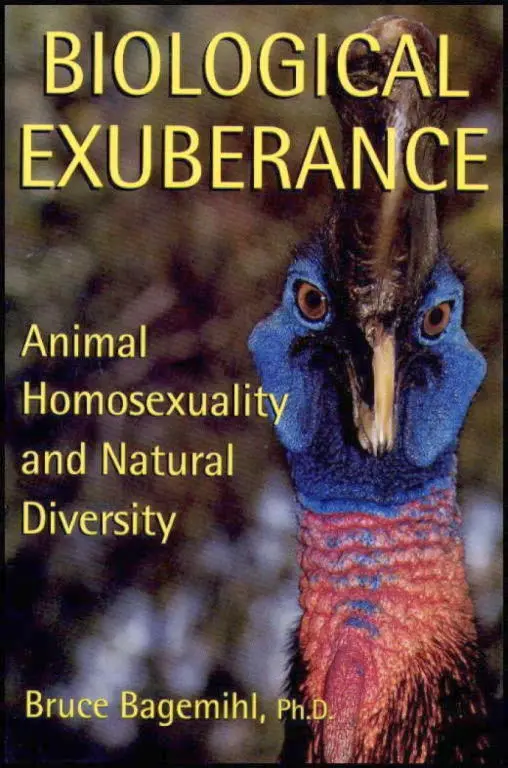
Bruce Bagemihl - Biological Exuberance
Здесь есть возможность читать онлайн «Bruce Bagemihl - Biological Exuberance» весь текст электронной книги совершенно бесплатно (целиком полную версию без сокращений). В некоторых случаях можно слушать аудио, скачать через торрент в формате fb2 и присутствует краткое содержание. Город: New York, Год выпуска: 2012, ISBN: 2012, Издательство: St. Martin's Press, Жанр: sci_zoo, на английском языке. Описание произведения, (предисловие) а так же отзывы посетителей доступны на портале библиотеки ЛибКат.
- Название:Biological Exuberance
- Автор:
- Издательство:St. Martin's Press
- Жанр:
- Год:2012
- Город:New York
- ISBN:0312192398
- Рейтинг книги:4 / 5. Голосов: 1
-
Избранное:Добавить в избранное
- Отзывы:
-
Ваша оценка:
Biological Exuberance: краткое содержание, описание и аннотация
Предлагаем к чтению аннотацию, описание, краткое содержание или предисловие (зависит от того, что написал сам автор книги «Biological Exuberance»). Если вы не нашли необходимую информацию о книге — напишите в комментариях, мы постараемся отыскать её.
Best Book One of the New York Public Library’s “25 Books to Remember” for 1999 Homosexuality in its myriad forms has been scientifically documented in more than 450 species of mammals, birds, reptiles, insects, and other animals worldwide.
is the first comprehensive account of the subject, bringing together accurate, accessible, and nonsensationalized information. Drawing upon a rich body of zoological research spanning more than two centuries, Bruce Bagemihl shows that animals engage in all types of nonreproductive sexual behavior. Sexual and gender expression in the animal world displays exuberant variety, including same-sex courtship, pair-bonding, sex, and co-parenting—even instances of lifelong homosexual bonding in species that do not have lifelong heterosexual bonding.
Part 1, “A Polysexual, Polygendered World,” begins with a survey of homosexuality, transgender, and nonreproductive heterosexuality in animals and then delves into the broader implications of these findings, including a valuable perspective on human diversity. Bagemihl also examines the hidden assumptions behind the way biologists look at natural systems and suggests a fresh perspective based on the synthesis of contemporary scientific insights with traditional knowledge from indigenous cultures.
Part 2, “A Wondrous Bestiary,” profiles more than 190 species in which scientific observers have noted homosexual or transgender behavior. Each profile is a verbal and visual “snapshot” of one or more closely related bird or mammal species, containing all the documentation required to support the author’s often controversial conclusions.
Lavishly illustrated and meticulously researched, filled with fascinating facts and astonishing descriptions of animal behavior,
is a landmark book that will change forever how we look at nature.
[May contain tables!]
Biological Exuberance — читать онлайн бесплатно полную книгу (весь текст) целиком
Ниже представлен текст книги, разбитый по страницам. Система сохранения места последней прочитанной страницы, позволяет с удобством читать онлайн бесплатно книгу «Biological Exuberance», без необходимости каждый раз заново искать на чём Вы остановились. Поставьте закладку, и сможете в любой момент перейти на страницу, на которой закончили чтение.
Интервал:
Закладка:
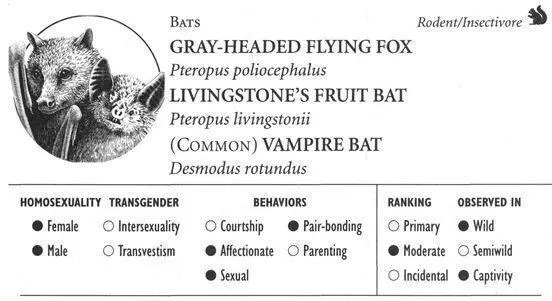
IDENTIFICATION: A large bat with an enormous wingspan (up to 4 feet), a doglike face, dark brown fur, a light gray head, and a reddish yellow mantle. DISTRIBUTION: Eastern Australia. HABITAT: Tropical and subtropical forests; roosts in trees. STUDY AREA: Near Brisbane, southeastern Queensland, Australia.
IDENTIFICATION: Similar to Gray-headed, except coat is black with tawny shoulders and groin; wingspan over 3 feet. DISTRIBUTION: Anjouan and Mohéli Islands, Comoros Archipelago (Indian Ocean); critically endangered. HABITAT: Upland forests. STUDY AREA: Jersey Wildlife Preservation Trust, England.
IDENTIFICATION: A small bat with grayish brown fur and pointed ears. DISTRIBUTION: Northern Mexico through central Chile, Argentina, Uruguay; Trinidad. HABITAT: Forests, open areas; roosts in caves, tree hollows. STUDY AREAS: Hacienda La Pacifica and Parque Nacional de Santa Rosa, Costa Rica; University of the West Indies, Trinidad.
Gray-headed Flying Foxes live in groups known as CAMPS, which may contain many thousands of individuals. These camps are segregated by sex for most of the year: males and females roost in separate trees—or in separate locations within the same tree—except during the breeding season (generally March-April). Some individuals become nomadic, solitary, or much less gregarious following the breeding season. Livingstone’s Fruit Bats appear to have a polygamous mating system, in which males mate with multiple female partners but do not participate in raising their offspring. Vampire Bat colonies may contain up to 2,000 individuals, although most have 20–100. The female group is the primary social unit, consisting of 8–12 females (many of whom are related to each other) and their young. Males sometimes form “bachelor” groups of up to 8 individuals, or they may roost in the same tree with female groups.
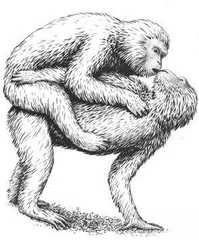
Behavioral Expression: Gray-headed Flying Foxes of both sexes engage in a form of mutual homosexual grooming and caressing when they are in their separate camps. One animal wraps its wings around another of the same sex in an embrace, licking and gently biting the chest and wings of its partner, rubbing its head on the other’s chest, and grooming it with its claws. Males may have an erection while they do this, and individuals generally utter a continuous pulsed, grating call while engaged in this activity. Livingstone’s Fruit Bats participate in similar forms of grooming and other homosexual activities. Combined with bouts of intense body licking—either mutual or one-sided—both males and females in this species sometimes lick, nuzzle, and sniff the genitals of a same-sex partner (one male was even seen to drink another’s urine as part of this activity). Clasping, play-wrestling, and gentle mouthing or biting of the partner occur as well. This may lead to homosexual mounting, in which one Bat grips the other from behind, holding the scruff of its neck in its mouth (as in heterosexual mating, although males do not usually experience erections or penetration during same-sex activity). Females sometimes mount their adult daughters and vice versa. In one instance, a daughter repeatedly approached, pursued, and mounted her mother for extended periods, and even successfully fought off males who were interested in mating with her mother.
Male Vampire Bats also participate in sexual grooming and licking of one another. Two males hang belly to belly, each with an erect penis. One male then works his tongue over the entire body of the other male, paying particular attention to licking the other male’s genitals. Sometimes one male will masturbate himself while licking his partner, using his free foot to rub his own penis. Although overt sexual behavior has not been observed among female Vampire Bats, females do form long-lasting bonds with one another. Companions share the same roost, groom one another, huddle together, and go foraging with each other. Another important aspect of these female companionships is blood-sharing: one female feeds the other by “donating” or regurgitating blood for her to consume (males also occasionally engage in reciprocal blood-sharing). Associations like these can last for five to ten years or more, and some females bond with several different female companions simultaneously.
Frequency: Overt sexual behavior among Gray-headed Flying Foxes and Vampire Bats probably occurs only occasionally (and is more common in male Flying Foxes than in females), but various same-sex activities occur regularly in Livingstone’s Fruit Bats (in captivity). In Vampire Bats, between one-half and three-quarters of all companionships or close associations are between females.
Orientation: Little is known of the individual life histories of these Bats, and so it is difficult to draw any definitive conclusions regarding the orientation of their sexual behavior. Nevertheless, it is likely that many Gray-headed Flying Foxes are seasonally bisexual, since they participate in homosexual activities when they are in the sex-segregated camps during the nonbreeding season. Among Vampire Bats in captivity, some males seem to show what amounts to a preference for homosexual activity, since they bypass females in order to interact sexually with another male (although it is not known whether this “preference” is temporary or long-lasting). Livingstone’s Fruit Bats may be simultaneously bisexual, able to alternate between same-sex and opposite-sex activities in a relatively short span of time.
Heterosexuality in all three of these species of Bats is characterized by a variety of nonreproductive sexual behaviors. Gray-headed Flying Foxes copulate throughout the year, including outside the breeding season when females cannot get pregnant, and mating also takes place during pregnancy. In addition, males have a distinct annual hormonal cycle that affects sperm production, with the result that many of their matings are nonprocreative. Male Livingstone’s Fruit Bats sometimes participate in heterosexual mounting without an erection or penetration, and females may REVERSE mount males as well. A prominent feature of Gray-headed Flying Fox sexual behavior is oral sex, in which the male deeply tongues the female’s genitalia for long periods. Both male and female Livingstone’s Fruit Bats also lick the genitals of their partners during heterosexual interactions. In Vampire Bats, masturbation occurs among younger males, while male Livingstone’s Fruit Bats have been observed licking their own penises to erection. Female Vampire Bats sometimes mate with several different males in succession. In this species, a vaginal plug forms in the female’s reproductive tract following copulation, which may prevent insemination from subsequent matings. When not in heat females frequently refuse to mate with males altogether, especially aggressive ones. Heterosexual relations in Livingstone’s Fruit Bats are also less than amicable: females sometimes cuff males or otherwise refuse their advances, and partners may threaten, wrestle, cuff, and bite each other during actual courtship and mating. Vampire Bats have developed an alternative form of parenting behavior in their female groups known as FOOD SHARING: females sometimes help each other feed infants by regurgitating blood for young that are not their own.
Male Serotine Bats ( Eptesicus serotinus ) , a Eurasian species, have been observed making sexual advances toward other males in captivity. While suspended upside down, one male approaches another with his penis erect and mounts him from behind, grasping him above the neck and thrusting his penis between the other male’s legs (under the membrane that stretches between his limbs). Homosexual activity in several species of British Bats is also common among wild males during the spring and summer (i.e., outside of the breeding season). These include Noctules ( Nyctalus noctula ) , Common Pipistrelles ( Pipistrellus pipistrellus ) , Brown Long-eared Bats ( Plecotus auritus ) , Daubenton’s Bats ( Myotis daubentonii ) , and Natterer’s Bats (Myotis nattereri) (including interspecies encounters between the latter two). Among wild Little Brown Bats ( Myotis lucifugus ) in North America, males often mount other males (as well as females) during the late fall, when many of the mounted individuals are semitorpid. These same-sex copulations usually include ejaculation, and the mounted animal often makes a squawking vocalization. Homosexual behavior also occurs in several other species of Fruit Bats: male Rodrigues Fruit Bats ( Pteropus rodricensis ) participate in same-sex mounting, while younger male Indian Fruit Bats ( Pteropus giganteus ) often mount one another (with erections and thrusting) while play-wrestling.
Читать дальшеИнтервал:
Закладка:
Похожие книги на «Biological Exuberance»
Представляем Вашему вниманию похожие книги на «Biological Exuberance» списком для выбора. Мы отобрали схожую по названию и смыслу литературу в надежде предоставить читателям больше вариантов отыскать новые, интересные, ещё непрочитанные произведения.










Обсуждение, отзывы о книге «Biological Exuberance» и просто собственные мнения читателей. Оставьте ваши комментарии, напишите, что Вы думаете о произведении, его смысле или главных героях. Укажите что конкретно понравилось, а что нет, и почему Вы так считаете.