Bruce Bagemihl - Biological Exuberance
Здесь есть возможность читать онлайн «Bruce Bagemihl - Biological Exuberance» весь текст электронной книги совершенно бесплатно (целиком полную версию без сокращений). В некоторых случаях можно слушать аудио, скачать через торрент в формате fb2 и присутствует краткое содержание. Город: New York, Год выпуска: 2012, ISBN: 2012, Издательство: St. Martin's Press, Жанр: sci_zoo, на английском языке. Описание произведения, (предисловие) а так же отзывы посетителей доступны на портале библиотеки ЛибКат.
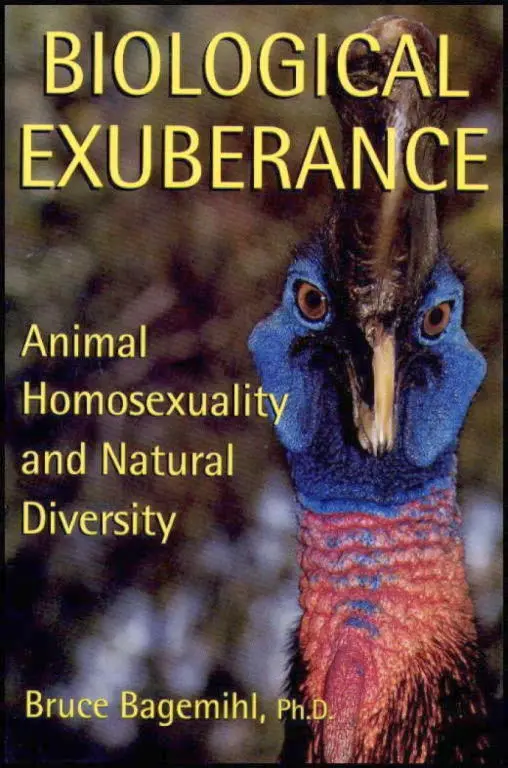
- Название:Biological Exuberance
- Автор:
- Издательство:St. Martin's Press
- Жанр:
- Год:2012
- Город:New York
- ISBN:0312192398
- Рейтинг книги:4 / 5. Голосов: 1
-
Избранное:Добавить в избранное
- Отзывы:
-
Ваша оценка:
Biological Exuberance: краткое содержание, описание и аннотация
Предлагаем к чтению аннотацию, описание, краткое содержание или предисловие (зависит от того, что написал сам автор книги «Biological Exuberance»). Если вы не нашли необходимую информацию о книге — напишите в комментариях, мы постараемся отыскать её.
Best Book One of the New York Public Library’s “25 Books to Remember” for 1999 Homosexuality in its myriad forms has been scientifically documented in more than 450 species of mammals, birds, reptiles, insects, and other animals worldwide.
is the first comprehensive account of the subject, bringing together accurate, accessible, and nonsensationalized information. Drawing upon a rich body of zoological research spanning more than two centuries, Bruce Bagemihl shows that animals engage in all types of nonreproductive sexual behavior. Sexual and gender expression in the animal world displays exuberant variety, including same-sex courtship, pair-bonding, sex, and co-parenting—even instances of lifelong homosexual bonding in species that do not have lifelong heterosexual bonding.
Part 1, “A Polysexual, Polygendered World,” begins with a survey of homosexuality, transgender, and nonreproductive heterosexuality in animals and then delves into the broader implications of these findings, including a valuable perspective on human diversity. Bagemihl also examines the hidden assumptions behind the way biologists look at natural systems and suggests a fresh perspective based on the synthesis of contemporary scientific insights with traditional knowledge from indigenous cultures.
Part 2, “A Wondrous Bestiary,” profiles more than 190 species in which scientific observers have noted homosexual or transgender behavior. Each profile is a verbal and visual “snapshot” of one or more closely related bird or mammal species, containing all the documentation required to support the author’s often controversial conclusions.
Lavishly illustrated and meticulously researched, filled with fascinating facts and astonishing descriptions of animal behavior,
is a landmark book that will change forever how we look at nature.
[May contain tables!]
Biological Exuberance — читать онлайн бесплатно полную книгу (весь текст) целиком
Ниже представлен текст книги, разбитый по страницам. Система сохранения места последней прочитанной страницы, позволяет с удобством читать онлайн бесплатно книгу «Biological Exuberance», без необходимости каждый раз заново искать на чём Вы остановились. Поставьте закладку, и сможете в любой момент перейти на страницу, на которой закончили чтение.
Интервал:
Закладка:
*asterisked references discuss homosexuality/transgender
* Barnett, S. A. (1958) “An Analysis of Social Behavior in Wild Rats.” Proceedings of the Zoological Society of London 130:107-52.
* Happold, M. (1976) “Social Behavior of the Conilurine Rodents (Muridae) of Australia.” Zeitschrift für Tierpsychologie 40:113–82.
Künkele, J., and H. N. Hoeck (1995) “Communal Suckling in the Cavy Galea musteloides. ” Behavioral Ecology and Sociobiology 37:385–91.
* Lacher, T. E., Jr. (1981) “The Comparative Social Behavior of Kerodon rupestris and Galea spixii and the Evolution of Behavior in the Caviidae.” Bulletin of the Carnegie Museum of Natural History 17:1–71.
* Marsden, H. M., and N. R. Holler (1964) “Social Behavior in Confined Populations of the Cottontail and the Swamp Rabbit.” Wildlife Monographs 13:1–39.
*Pfaffenberger, G. S., F. W. Weckerly, and T. L. Best (1986) “Male Pseudohermaphroditism in a Population of Kangaroo Rats, Dipodomys ordii. ” Southwestern Naturalist 31:124–26.
*Rood, J. P. (1972) “Ecological and Behavioral Comparisons of Three Genera of Argentine Cavies.” Animal Behavior Monographs 5:1–83.
*———(1970) “Ecology and Social Behavior of the Desert Cavy ( Microcavia australis ) . ” American Midland Naturalist 83:415–54.
Stahnke, A., and H. Hendrichs (1990) “Cavy Rodents.” In Grzimek’s Encyclopedia of Mammals, vol. 3, pp. 325-37. New York: McGraw-Hill.

IDENTIFICATION: A small (less than I foot long) insectivore with sandy-colored spines, white underparts, and prominent ears. DISTRIBUTION: Central Asia, Middle East. HABITAT: Steppe, desert. STUDY AREA: Research Laboratory for Comparative Insectivorology, Vienna, Austria; subspecies H.a. syriacus.
Long-eared Hedgehogs live in burrows and are largely nocturnal and solitary, although small groups of animals may gather at feeding or resting sites. Males take no part in parental care.
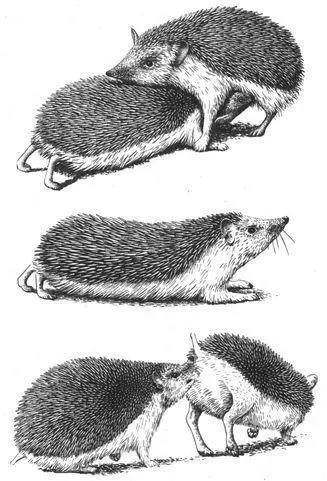
Behavioral Expression: Homosexual interactions in female Long-eared Hedgehogs involve a great deal of courtship and affectionate behaviors as well as direct sexual encounters, frequently consisting of oral sex. A typical lesbian interaction begins, often at dusk, with two females rubbing each other, sliding along each other’s body, and cuddling. One female might also crawl directly under the other, sliding back from her throat to her belly. Another courtship display involves one female stretching out full length and pressing her belly against the ground with a concave “arch” in her back. During sexual contact, females intensively lick, sniff, and nibble on each other’s genitals. Sometimes, to have better access, one female will raise the hindquarters of the other high into the air with her paws and lower jaw, lifting her partner’s hind legs clear off the ground while she continues licking. At other times, one or both females will present their raised hindquarters as an invitation for the other to mount as in heterosexual copulation. Often the presenting female is in such a state of arousal that her hindquarters are actually lifted too high for the other female to fully mount her, although she may try. In captivity, homosexual encounters have been observed between adult sisters, that is, members of the same litter.
Frequency: Homosexual interactions occur frequently between females paired together in captivity, but the incidence of this activity in wild Long-eared Hedgehogs is not known.
Orientation: Female Long-eared Hedgehogs may have a latent capacity for bisexual or homosexual behavior, since same-sex activity surfaces when females are kept together without males. However, it appears that this may initiate a preference for homosexuality that can be long-lasting: one pair of females who courted and had sex with each other refused to participate in heterosexual activity for more than two years after they were separated, although eventually both did mate with males and reproduce.
Oral-genital stimulation is a frequent component of heterosexual encounters in Long-eared Hedgehogs, with males licking and sniffing the female’s genitals. Cannibalism also occurs in this species: animals may eat already dead hedgehogs or else kill them directly and then devour them.
Homosexual activity occurs in several species of Tree Shrews, a group of animals found in Southeast Asia and thought to have affiliations with insectivores (and possibly also primates). In Common Tree Shrews ( Tupaia glis ) , for example, about a third of all sexual activity occurs between females, including sexual approaches and following, genital licking and sniffing, and mounting. Same-sex mounting has also been observed in Slender Tree Shrews ( T. gracilis ) , Mountain Tree Shrews ( T. montana ) , and Long-footed Tree Shrews ( T. longipes ) . In the latter species, mounting between females accounts for about 9 percent of all mounting activity. Female Long-footed Tree Shrews sometimes form consortships with one another as well; these typically last longer than heterosexual consortships (several months as opposed to several hours) and involve mutual grooming, lying on or next to each other, and sleeping together. Male and female homosexuality also occur in North American Porcupines (Erethizon dorsatum), including periods of exclusive homosexual activity among males.
*asterisked references discuss homosexuality/transgender
*Kaufmann, J. H. (1965) “Studies on the Behavior of Captive Tree Shrews (Tupaia glis ) . ” Folia Primatologica 3:50–74.
*Kinsey, A. C., W. B. Pomeroy, C. E. Martin, and P. H. Gebhard (1953) Sexual Behavior in the Human Female. Philadelphia: W. B. Saunders.
Maheshwari, U. K. (1984) “Food of the Long Eared Hedgehog in Ravine Near Agra.” Acta Theriologica 29:133–37.
*Poduschka, W. (1981) “Abnormes Sexualverhalten Zusammengehaltener, Weiblicher Hemiechinus auritus syriacus (Insectivora: Erinaceinae) [Abnormal Sexual Behavior of Confined Female Hemiechinus auritus syriacus ] . ” Bijdragen tot de Dierkunde 51:81–88.
Prakash, I. (1953) “Cannibalism in Hedgehogs.” Journal of the Bombay Natural History Society 51:730–31.
Reeve, N. (1994) Hedgehogs. London: T. and A. D. Poyser.
Schoenfeld, M., and Y. Yom-Tov (1985) “The Biology of Two Species of Hedgehogs, Erinaceus europaeus concolor and Hemiechinus auritus aegyptus, in Israel.” Mammalia 49:339–55.
*Sorenson, M.W., and C. H. Conaway (1968) “The Social and Reproductive Behavior of Tupaia montana in Captivity.” Journal of Mammalogy 49:502–12.
*———(1966) “Observations on the Social Behavior of Tree Shrews in Captivity.” Folia Primatologica 4:124–45.
Читать дальшеИнтервал:
Закладка:
Похожие книги на «Biological Exuberance»
Представляем Вашему вниманию похожие книги на «Biological Exuberance» списком для выбора. Мы отобрали схожую по названию и смыслу литературу в надежде предоставить читателям больше вариантов отыскать новые, интересные, ещё непрочитанные произведения.











Обсуждение, отзывы о книге «Biological Exuberance» и просто собственные мнения читателей. Оставьте ваши комментарии, напишите, что Вы думаете о произведении, его смысле или главных героях. Укажите что конкретно понравилось, а что нет, и почему Вы так считаете.