Bruce Bagemihl - Biological Exuberance
Здесь есть возможность читать онлайн «Bruce Bagemihl - Biological Exuberance» весь текст электронной книги совершенно бесплатно (целиком полную версию без сокращений). В некоторых случаях можно слушать аудио, скачать через торрент в формате fb2 и присутствует краткое содержание. Город: New York, Год выпуска: 2012, ISBN: 2012, Издательство: St. Martin's Press, Жанр: sci_zoo, на английском языке. Описание произведения, (предисловие) а так же отзывы посетителей доступны на портале библиотеки ЛибКат.
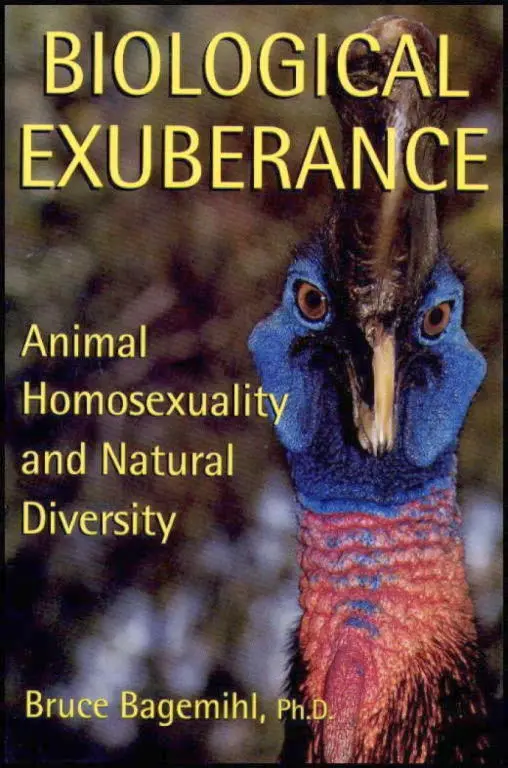
- Название:Biological Exuberance
- Автор:
- Издательство:St. Martin's Press
- Жанр:
- Год:2012
- Город:New York
- ISBN:0312192398
- Рейтинг книги:4 / 5. Голосов: 1
-
Избранное:Добавить в избранное
- Отзывы:
-
Ваша оценка:
Biological Exuberance: краткое содержание, описание и аннотация
Предлагаем к чтению аннотацию, описание, краткое содержание или предисловие (зависит от того, что написал сам автор книги «Biological Exuberance»). Если вы не нашли необходимую информацию о книге — напишите в комментариях, мы постараемся отыскать её.
Best Book One of the New York Public Library’s “25 Books to Remember” for 1999 Homosexuality in its myriad forms has been scientifically documented in more than 450 species of mammals, birds, reptiles, insects, and other animals worldwide.
is the first comprehensive account of the subject, bringing together accurate, accessible, and nonsensationalized information. Drawing upon a rich body of zoological research spanning more than two centuries, Bruce Bagemihl shows that animals engage in all types of nonreproductive sexual behavior. Sexual and gender expression in the animal world displays exuberant variety, including same-sex courtship, pair-bonding, sex, and co-parenting—even instances of lifelong homosexual bonding in species that do not have lifelong heterosexual bonding.
Part 1, “A Polysexual, Polygendered World,” begins with a survey of homosexuality, transgender, and nonreproductive heterosexuality in animals and then delves into the broader implications of these findings, including a valuable perspective on human diversity. Bagemihl also examines the hidden assumptions behind the way biologists look at natural systems and suggests a fresh perspective based on the synthesis of contemporary scientific insights with traditional knowledge from indigenous cultures.
Part 2, “A Wondrous Bestiary,” profiles more than 190 species in which scientific observers have noted homosexual or transgender behavior. Each profile is a verbal and visual “snapshot” of one or more closely related bird or mammal species, containing all the documentation required to support the author’s often controversial conclusions.
Lavishly illustrated and meticulously researched, filled with fascinating facts and astonishing descriptions of animal behavior,
is a landmark book that will change forever how we look at nature.
[May contain tables!]
Biological Exuberance — читать онлайн бесплатно полную книгу (весь текст) целиком
Ниже представлен текст книги, разбитый по страницам. Система сохранения места последней прочитанной страницы, позволяет с удобством читать онлайн бесплатно книгу «Biological Exuberance», без необходимости каждый раз заново искать на чём Вы остановились. Поставьте закладку, и сможете в любой момент перейти на страницу, на которой закончили чтение.
Интервал:
Закладка:
Orientation: Koalas that participate in homosexual mounting are probably bisexual, since females that mount other females have also been observed mating with males.
Heterosexual relations in Koalas are marked by a striking amount of aggression and violence: more than two-thirds of fights are between males and females rather than between males. Females are sometimes “pestered” by males that persistently follow, touch, bite, or snap at them; if the female returns the bites, the encounter can escalate into a severe fight. Males have been known to brutally attack females—including pregnant and nursing mothers—knocking them from the trees and savagely mauling them. In fact, it is typical for males to nip females on the neck during mating, and for heterosexual copulations to end with the male attacking the female. Females also fight with males (though less violently), and aggressiveness toward males is considered to be a defining feature of estrus for female Koalas. Occasionally adults are also abusive toward babies: mothers sometimes bite their young, while males have been observed attacking infants that interrupt them during a mating with their mother. Many heterosexual interactions are nonprocreative, since males often try to mount females who are not in heat. Although the females typically rebuff their advances, in some cases the males are able to mount them, often thrusting against the female and ejaculating on her without any penetration. Females in heat also sometimes mount males (REVERSE mounts).
Many wild populations of Koalas have particularly high rates of female infertility (and significantly reduced reproductive rates) due to venereal disease. More than half of all females in some areas are infected with genital chlamydia, a bacteria that causes a number of reproductive tract diseases and, ultimately, sterility. This pathogen has apparently been present in Koala populations for a relatively long time, as records of the associated diseases date back to at least the 1890s. Although the exact mode of its transmission is not yet fully understood, two routes have been implicated: sexual and mother-to-young. The latter may be due to the infant Koala’s habit of eating its mother’s feces directly from her anus during weaning, since she produces a special form of excrement known as PAP especially for feeding her young (this practice is also found in a number of other marsupials).
In another marsupial, the Common Brushtail Possum (Trichosurus vulpecula), intersexuality or hermaphroditism occasionally occurs: one individual, for example, had male body proportions, coloring, and genitals combined with mammary glands and a pouch.
*asterisked references discuss homosexuality/transgender
Brown, A. S., A. A. Girjes, M. F. Lavin, P. Timms, and J. B. Woolcock (1987) “Chlamydial Disease in Koalas.” Australian Veterinary Journal 64:346-50.
*Gilmore, D. P. (1965) “Gynandromorphism in Trichosurus vulpecula.” Australian Journal of Science 28:165.
Lee, A., and R. Martin (1988) The Koala: A Natural History. Kensington, Australia: New South Wales University Press.
Phillips, K. (1994) Koalas: Australia’s Ancient Ones. New York: Macmillan.
*Sharman, G. B., R. L. Hughes, and D. W. Cooper (1990) “The Chromosomal Basis of Sex Differentiation in Marsupials.” Australian Journal of Zoology 37:451–66.
Smith, M. (1980a) “Behavior of the Koala, Phascolarctos cinereus (Goldfuss) in Captivity. III. Vocalizations.” Australian Wildlife Research 7:13–34.
*———(1980b) “Behavior of the Koala, Phascolarctos cinereus (Goldfuss) in Captivity. V. Sexual Behavior.” Australian Wildlife Research 7:41–51.
———(1980c) “Behavior of the Koala, Phascolarctos cinereus (Goldfuss) in Captivity. VI. Aggression.” Australian Wildlife Research 7:177–90.
———(1979) “Behavior of the Koala, Phascolarctos cinereus (Goldfuss) in Captivity. I. Non-Social Behavior.” Australian Wildlife Research 6:117-29.
*Thompson, V. D. (1987) “Parturition and Development in the Queensland Koala Phascolarctos cinereus adustus at San Diego Zoo.” International Zoo Yearbook 26:217–22.
Weigler, B. J., A. A. Girjes, N. A. White, N. D. Kunst, F. N. Carrick, and M. F. Lavin (1988) “Aspects of the Epidemiology of Chlamydia psittaci Infection in a Population of Koalas (Phascolarctos cinereus) in Southeastern Queensland, Australia.” Journal of Wildlife Diseases 24:282–91.

IDENTIFICATION: A small, mouselike marsupial with a thick, conical, fat-storing tail. DISTRIBUTION: Inland southern Australia. HABITAT: Varied, including rocky areas. STUDY AREA: University of Adelaide, Australia.
IDENTIFICATION: A catlike marsupial, up to 2 feet long, with grayish brown fur and white splotches. DISTRIBUTION: Northern and eastern Australia. HABITAT: Woodland, rocky areas. STUDY AREA: Monash University, Australia.
Fat-tailed Dunnarts often live together in small groups or pairs that share nests; these groupings are temporary and may consist of individuals of the same sex (especially outside of the breeding season). Although little is known about the social system of Northern Quolls, it appears that most individuals are largely solitary. Both species are nocturnal.
Behavioral Expression: Homosexual mounting occurs among female, and to a lesser extent male, Northern Quolls. One animal climbs on top of another as in a heterosexual mating, grasping its chest with its front paws, and sometimes even riding on the back of the mounted animal as it walks around. In Fat-tailed Dunnarts, females in heat sometimes mount other females.
Frequency: In captivity, homosexual mounting among Northern Quolls occurs in almost two-thirds of encounters between females and 10 percent of encounters between males, though this may not reflect the frequency of its occurrence in the wild. Same-sex mounting only happens occasionally in female Fat-tailed Dunnarts.
Orientation: It is possible that some individuals in these species engage exclusively in same-sex behavior, while others may be bisexual, but little is known about the life histories of specific individuals. In one study, none of the Northern Quolls that participated in homosexual behavior engaged in heterosexual mounting (although observations were not made during the breeding season), while one female Fat-tailed Dunnart that mounted another female did not breed during a nearly yearlong study.
Reproduction in Northern Quolls is characterized by an extraordinary phenomenon sometimes known as MALE DIE-OFF. In many areas, virtually the entire male population perishes following the breeding season, while females typically survive to breed for another couple of seasons (some variation occurs between geographic locations and years in the proportion of males and females surviving). This complete annihilation of males is also a feature of a number of other carnivorous marsupial social systems and is found to a much lesser extent in Fat-tailed Dunnarts. Although the exact mechanism responsible for male mortality is not fully understood, it is thought to result from a number of stress-induced factors, perhaps directly related to participation in procreation. There is some evidence that nonbreeding males with lower testosterone levels—essentially “lower-ranking” males—have a higher survival rate than males that reproduce. Female Northern Quolls also routinely practice “abortion” or elimination of unborn young. As many as 17 embryos may begin developing in the female’s uterus, but because females typically have no more than 8 nipples in their pouch, most of the embryos and/or newborn young will not survive. In Fat-tailed Dunnarts, breeding females can be noticeably aggressive toward males, attacking them when they attempt to mount; in captivity, females have even been known to kill their mates. In this species, heterosexual copulation can be a remarkably long affair, with the male remaining mounted on the female for hours at a time (sometimes as long as 11 hours); the female may struggle and attempt to escape during such arduous matings. In Northern Quolls, females often have neck and chest wounds inflicted by the male during mating. Adult male Fat-tailed Dunnarts sometimes display sexual interest in juvenile females, and incestuous matings have also been recorded. In addition, females in heat occasionally mount males (REVERSE mountings).
Читать дальшеИнтервал:
Закладка:
Похожие книги на «Biological Exuberance»
Представляем Вашему вниманию похожие книги на «Biological Exuberance» списком для выбора. Мы отобрали схожую по названию и смыслу литературу в надежде предоставить читателям больше вариантов отыскать новые, интересные, ещё непрочитанные произведения.








Обсуждение, отзывы о книге «Biological Exuberance» и просто собственные мнения читателей. Оставьте ваши комментарии, напишите, что Вы думаете о произведении, его смысле или главных героях. Укажите что конкретно понравилось, а что нет, и почему Вы так считаете.