Bruce Bagemihl - Biological Exuberance
Здесь есть возможность читать онлайн «Bruce Bagemihl - Biological Exuberance» весь текст электронной книги совершенно бесплатно (целиком полную версию без сокращений). В некоторых случаях можно слушать аудио, скачать через торрент в формате fb2 и присутствует краткое содержание. Город: New York, Год выпуска: 2012, ISBN: 2012, Издательство: St. Martin's Press, Жанр: sci_zoo, на английском языке. Описание произведения, (предисловие) а так же отзывы посетителей доступны на портале библиотеки ЛибКат.
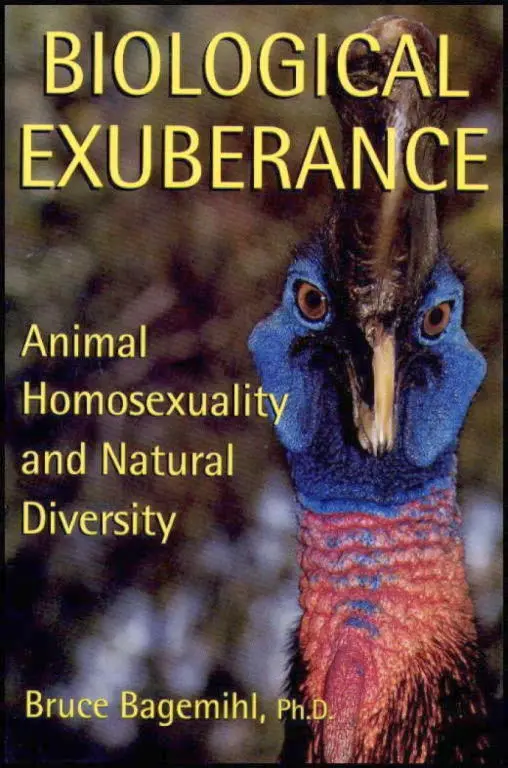
- Название:Biological Exuberance
- Автор:
- Издательство:St. Martin's Press
- Жанр:
- Год:2012
- Город:New York
- ISBN:0312192398
- Рейтинг книги:4 / 5. Голосов: 1
-
Избранное:Добавить в избранное
- Отзывы:
-
Ваша оценка:
Biological Exuberance: краткое содержание, описание и аннотация
Предлагаем к чтению аннотацию, описание, краткое содержание или предисловие (зависит от того, что написал сам автор книги «Biological Exuberance»). Если вы не нашли необходимую информацию о книге — напишите в комментариях, мы постараемся отыскать её.
Best Book One of the New York Public Library’s “25 Books to Remember” for 1999 Homosexuality in its myriad forms has been scientifically documented in more than 450 species of mammals, birds, reptiles, insects, and other animals worldwide.
is the first comprehensive account of the subject, bringing together accurate, accessible, and nonsensationalized information. Drawing upon a rich body of zoological research spanning more than two centuries, Bruce Bagemihl shows that animals engage in all types of nonreproductive sexual behavior. Sexual and gender expression in the animal world displays exuberant variety, including same-sex courtship, pair-bonding, sex, and co-parenting—even instances of lifelong homosexual bonding in species that do not have lifelong heterosexual bonding.
Part 1, “A Polysexual, Polygendered World,” begins with a survey of homosexuality, transgender, and nonreproductive heterosexuality in animals and then delves into the broader implications of these findings, including a valuable perspective on human diversity. Bagemihl also examines the hidden assumptions behind the way biologists look at natural systems and suggests a fresh perspective based on the synthesis of contemporary scientific insights with traditional knowledge from indigenous cultures.
Part 2, “A Wondrous Bestiary,” profiles more than 190 species in which scientific observers have noted homosexual or transgender behavior. Each profile is a verbal and visual “snapshot” of one or more closely related bird or mammal species, containing all the documentation required to support the author’s often controversial conclusions.
Lavishly illustrated and meticulously researched, filled with fascinating facts and astonishing descriptions of animal behavior,
is a landmark book that will change forever how we look at nature.
[May contain tables!]
Biological Exuberance — читать онлайн бесплатно полную книгу (весь текст) целиком
Ниже представлен текст книги, разбитый по страницам. Система сохранения места последней прочитанной страницы, позволяет с удобством читать онлайн бесплатно книгу «Biological Exuberance», без необходимости каждый раз заново искать на чём Вы остановились. Поставьте закладку, и сможете в любой момент перейти на страницу, на которой закончили чтение.
Интервал:
Закладка:
In Eastern Gray Kangaroos, intersexual or hermaphrodite individuals also occur: some animals, for example, have both a penis and a pouch (the latter usually found only in females), mammary glands, and testes, all combined with body proportions that are generally intermediate between male and female. Chromosomally, these individuals have a mosaic of the female type (XX), the male type (XY), and a combined XXY pattern.
Frequency: Female homosexual mounting in Eastern Gray Kangaroos occurs sporadically: in one study of a wild population, for example, homosexual behavior was recorded eight times during four months of observation. It should be noted, however, that heterosexual mating is rarely observed as well: only one male-female mating was seen during that same time, while only three heterosexual copulations were recorded during a three-year study of Red-necked Wallabies. In captivity, mounting between female Red-necked Wallabies is quite common, but male homosexual activity is much less frequent. During play-fights between males, courtship and sexual behaviors occur roughly once every five hours of activity. Homosexual mounts between males account for about 1 percent of all mounting activity in Whiptail Wallabies.
Orientation: In captive groups of Eastern Gray Kangaroos (which included both sexes), four of six females formed same-sex pairs. Male Red-necked Wallabies may be sequentially bisexual during their lifetimes: sexual interactions during play-fighting are most common among adolescent males, while adults are probably more heterosexually oriented. Male Whiptail Wallabies that court or mount other males also interact sexually with females, i.e., they are simultaneously bisexual.
Female Red-necked Wallabies are often harassed by males trying to mate with them (similar behavior also occurs in Whiptail Wallabies). As many as seven males at a time may pursue a single female, and they may injure her while mating: females have been seen limping or with cuts on their backs after heterosexual copulations. Mating attempts may also be interrupted by other males charging the pair and trying to dislodge the mounting male. In this species, only about 18 percent of the males ever mate with females. Nonbreeding females also occur in Eastern Gray Kangaroos. In addition, females who are pregnant (including late-term), not in heat, or sexually immature also occasionally participate in heterosexual activity, and males also regularly masturbate by thrusting the erect penis into the paws. DELAYED IMPLANTATION is another notable feature of the reproductive cycle in these species.
Homosexual mounting occurs in a number of other Kangaroo and Wallaby species: between females in Yellow-footed Rock Wallabies (Petrogale xanthopus), and between males in Western Gray Kangaroos (Macropus fuliginosus), Red Kangaroos (Macropus rufus), Agile Wallabies (Macropus agilis), Black-footed Rock Wallabies (Petrogale lateralis), and Swamp Wallabies (Wallabia bicolor). Transgendered or intersexual individuals of various types are also found in several species, including Red Kangaroos, Euros (Macropus robustus), Tammar Wallabies (Macropus eugenii), and Quokkas (Setonix brachyurus). Some of these individuals have female body proportions and external genitalia, female or combined male-female internal reproductive organs, a scrotum, and absence of a pouch and mammary glands. Others have male reproductive organs, intermediate or female body proportions, and a pouch and mammary glands.
*asterisked references discuss homosexuality/transgender
Coulson, G. (1997) “Repertoires of Social Behavior in Captive and Free-Ranging Gray Kangaroos, Macropus giganteus and Macropus fuliginosus (Marsupialia: Macropodidae).” Journal of Zoology, London 242:119–30.
*———(1989) “Repertoires of Social Behavior in the Macropodoidea.” In G. C. Grigg, P. J. Jarman, and I. D. Hume, eds., Kangaroos, Wallabies, and Rat-Kangaroos, pp. 457–73. Chipping Norton, NSW: Surrey Beatty and Sons.
*Grant, T. R., (1974) “Observations of Enclosed and Free-Ranging Gray Kangaroos Macropus giganteus.” Zeitschrift für Säugetierkunde 39:65–78.
*———(1973) “Dominance and Association Among Members of a Captive and a Free-Ranging Group of Gray Kangaroos (Macropus giganteus).” Animal Behavior 21:449–56.
Jarman, P. J., and C. J. Southwell (1986) “Grouping, Association, and Reproductive Strategies in Eastern Gray Kangaroos.” In D. I. Rubenstein and R. W. Wrangham, eds., Ecological Aspects of Social Evolution, pp. 399–428. Princeton: Princeton University Press.
Johnson, C. N. (1989) “Social Interactions and Reproductive Tactics in Red-necked Wallabies (Macropus rufogriseus banksianus).” Journal of Zoology, London 217:267–80.
Kaufmann, J. H. (1975) “Field Observations of the Social Behavior of the Eastern Gray Kangaroo, Macropus giganteus” Animal Behavior 23:214–21.
*———(1974) “Social Ethology of the Whiptail Wallaby, Macropus parryi, in Northeastern New South Wales.” Animal Behavior 22:281–369.
*LaFollette, R. M. (1971) “Agonistic Behavior and Dominance in Confined Wallabies, Wallabia rufogrisea frutica.” Animal Behavior 19:93–101.
Poole, W. E. (1982) “Macropus giganteus Shaw 1790, Eastern Gray Kangaroo.” Mammalian Species 187:1–8.
———(1973) “A Study of Breeding in Gray Kangaroos, Macropus giganteus Shaw and M. fuliginosus (Desmarest), in Central New South Wales.” Australian Journal of Zoology 21:183–212.
Poole, W. E., and P. C. Catling (1974) “Reproduction in the Two Species of Gray Kangaroos, Macropus giganteus Shaw and M. fuliginosus (Desmarest). I. Sexual Maturity and Oestrus.” Australian Journal of Zoology 22:277–302.
*Sharman, G. B., R. L. Hughes, and D. W. Cooper (1990) “The Chromosomal Basis of Sex Differentiation in Marsupials.” Australian Journal of Zoology 37:451–66.
*Stirrat, S. C., and M. Fuller (1997) “The Repertoire of Social Behaviors of Agile Wallabies, Macropus agilis.” Australian Mammalogy 20:71–78.
*Watson, D. M., and D. B. Croft (1993) “Playfighting in Captive Red-Necked Wallabies, Macropus rufogriseus banksianus.” Behavior 126:219–245.
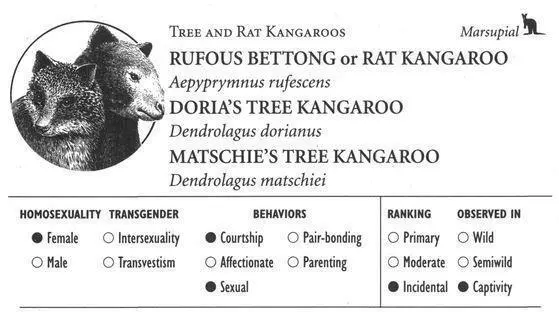
IDENTIFICATION: A small (6–7 pound), rodentlike kangaroo with reddish brown fur. DISTRIBUTION: Eastern and southern Australia. HABITAT: Grassy woodlands. STUDY AREAS: National Parks and Wildlife Service Center, Townsville, Australia; Zoological Garden of West Berlin, Germany.
IDENTIFICATION: Stocky, tree-dwelling kangaroos; chestnut or chocolate brown fur with lighter patches. DISTRIBUTION: Interior New Guinea; Doria’s is vulnerable, Matschie’s is endangered. HABITAT: Mountainous rain forests. STUDY AREAS: Karlsruhe Zoo, Germany; Woodland Park Zoological Gardens, Seattle, Washington.
Tree Kangaroos and Rufous Bettongs are largely solitary, although they sometimes associate in pairs, trios, or small groups of adults and young. About 15 percent of Bettong groups are same-sex. The mating systems of these species, though poorly understood, may involve polygamy or promiscuity, perhaps combined with monogamous pair-bonding in some populations of Rufous Bettongs. Males do not generally participate in raising their own offspring.
Читать дальшеИнтервал:
Закладка:
Похожие книги на «Biological Exuberance»
Представляем Вашему вниманию похожие книги на «Biological Exuberance» списком для выбора. Мы отобрали схожую по названию и смыслу литературу в надежде предоставить читателям больше вариантов отыскать новые, интересные, ещё непрочитанные произведения.










Обсуждение, отзывы о книге «Biological Exuberance» и просто собственные мнения читателей. Оставьте ваши комментарии, напишите, что Вы думаете о произведении, его смысле или главных героях. Укажите что конкретно понравилось, а что нет, и почему Вы так считаете.