Mary Roach - Stiff
Здесь есть возможность читать онлайн «Mary Roach - Stiff» весь текст электронной книги совершенно бесплатно (целиком полную версию без сокращений). В некоторых случаях можно слушать аудио, скачать через торрент в формате fb2 и присутствует краткое содержание. Город: New York, Год выпуска: 2003, ISBN: 2003, Издательство: Viking, Жанр: sci_popular, История, на английском языке. Описание произведения, (предисловие) а так же отзывы посетителей доступны на портале библиотеки ЛибКат.
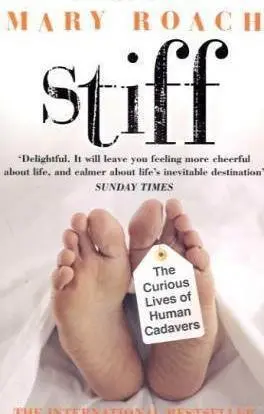
- Название:Stiff
- Автор:
- Издательство:Viking
- Жанр:
- Год:2003
- Город:New York
- ISBN:0-670-91217-4
- Рейтинг книги:4 / 5. Голосов: 2
-
Избранное:Добавить в избранное
- Отзывы:
-
Ваша оценка:
Stiff: краткое содержание, описание и аннотация
Предлагаем к чтению аннотацию, описание, краткое содержание или предисловие (зависит от того, что написал сам автор книги «Stiff»). Если вы не нашли необходимую информацию о книге — напишите в комментариях, мы постараемся отыскать её.
—
Stiff In this fascinating, ennobling account, Mary Roach visits the good deeds of cadavers over the centuries—from the anatomy labs and human-sourced pharmacies of medieval and nineteenth-century Europe to a human decay research facility in Tennessee, to a plastic surgery practice lab, to a Scandinavian funeral directors’ conference on human composting. In her droll, inimitable voice, Roach tells the engrossing story of our bodies when we are no longer with them.
Stiff — читать онлайн бесплатно полную книгу (весь текст) целиком
Ниже представлен текст книги, разбитый по страницам. Система сохранения места последней прочитанной страницы, позволяет с удобством читать онлайн бесплатно книгу «Stiff», без необходимости каждый раз заново искать на чём Вы остановились. Поставьте закладку, и сможете в любой момент перейти на страницу, на которой закончили чтение.
Интервал:
Закладка:
Glances are exchanged. A man clicks his pen.
Wiigh-Masak makes a small detour into defensive mode. “I think that if you put a camera inside a coffin we wouldn’t be very impressed with ourselves. It is a terrible result.”
Someone asks why the freeze-drying step is needed. Wiigh-Masak answers that if you don’t remove the water, the little pieces will start to decompose and smell before you can get them into the ground. But you mustn’t get rid of the water, the man counters, because this is 70 percent of this person. Wiigh-Masak tries to explain that the water inside each one of us changes day by day. It’s borrowed. It comes in, it goes out, the molecules from your water mix with someone else’s. She points to the man’s coffee cup. “The coffee you are drinking has been your neighbor’s urine.” You have to admire a woman who can toss the word “urine” into a corporate presentation.
The man who has been clicking his pen is the first to raise the subject that is surely on everyone’s mind: coffins, and the disappearing profit therefrom that an ecological funeral movement will mean. Wiigh-Masak envisions the freeze-dried, powdered remains being placed in a miniature, biodegradable cornstarch coffin. “That’s a problem,” acknowledges Wiigh-Masak. “Everyone will be angry at me.” She smiles.
“I guess there will have to be a new thinking.” (As with cremation, a standard coffin could be rented for a memorial service.)
Cremationists faced the same objections. For years, according to Stephen Prothero, undertakers were advised to tell their clients that scattering was against the law, when in fact, with few exceptions, it wasn’t. Families were pushed to buy memorial urns and niches in columbaria and even standard cemetery plots in which to bury the urns. But the families persisted in their push for a simple, meaningful ceremony of their own making, and scattering caught on. As did the use of rental caskets for pre-cremation services and the manufacturing of inexpensive cardboard “cremation containers” for the actual burning. “The only reason there are rental caskets,” Kevin McCabe once told me, “is that the public demanded it.” The tremendous attention that Promessa has received since its founding has forced the funeral industry to deal with the possibility that very soon people may be coming to them requesting to be composted. (In a Swedish newspaper poll taken last year, 40 percent of respondents said they’d like to be freeze-dried and used to grow a plant.) Mortuaries in Sweden may not be actively recommending the ecological funeral any time soon, but they may stop short of trying to derail it. As a friendly young Fonus regional director named Peter Göransson said to me earlier, “It’s pretty hard to stop something once it’s rolling.”
The last question comes from a man seated next to Ulf Helsing. He asks Wiigh-Masak whether she plans to first market the technique for dead animals. She is adamant about not letting this happen. If Promessa becomes known as a company that disposes of dead cows or pets, she tells the man, it will lose the dignity necessary for a human application. It is difficult, as it is, to attach the requisite dignity to human composting.
At least in the United States. Not long ago, I called the U.S. Conference of Catholic Bishops, the official U.S. mouthpiece of the Catholic Church, to ask its opinion on freeze-drying and composting as an alternative to burial. I was put through to a Monsignor John Strynkowski in the Doctrine office. While the monsignor allowed that composting and nourishing the earth was little different from a Trappist monk’s plain shroud burial or a church-sanctioned burial at sea, following which the body will, as he put it, provide nourishment for fish, the idea of composting struck him as disrespectful. I asked him why. “Well, when I was a kid,” he answered, “we had a hole where we put peelings from apples and such, and used it for fertilizer. That’s just my association.”
While I had him on the phone, I asked Monsignor Strynkowski about tissue digestion. He replied with minimal hesitation that the church would be opposed to “the idea of human remains going into the drain.”
He explained that the Catholic Church feels that the human body should always be given a dignified burial, whether it’s the body itself or the ashes. (Scattering remains a sin.) When I explained that the company planned to add an optional dehydrator to the system that could reduce the liquefied remains to a powder that could then be buried, just as cremains can be, the line went quiet. Finally he said, “I guess that would be okay.” You got the feeling Monsignor Strynkowski was looking forward to the end of the phone call.
The line between solid waste disposal and funerary rituals must be well maintained. Interestingly, this is one of the reasons the Environmental Protection Agency doesn’t regulate U.S. crematoria. For if it did regulate them, the rules would be promulgated under Section 129 of the Clean Air Act, which covers “Solid Waste Incinerators.” And that would mean, explained Fred Porter, of the EPA Emission Standards Division in Washington, “that what we’re incinerating at crematoria is ‘solid waste.’”
The EPA does not wish to stand accused of calling America’s dead loved ones “solid waste.”
Wiigh-Masak may succeed in taking composting mainstream because she realizes the importance of keeping respectful disposition distinct from waste disposal, of addressing the family’s need for a dignified end. To a certain extent, of course, dignity is in the packaging. When you get right down to it, there is no dignified way to go, be it decomposition, incineration, dissection, tissue digestion, or composting. They’re all, bottom line, a little disagreeable. It takes the careful application of a well-considered euphemism—burial, cremation, anatomical gift-giving, water reduction, ecological funeral—to bring it to the point of acceptance. I used to think the traditional navy burial at sea sounded nice; I pictured the sun on the ocean, the infinite expanse of blue, the nowhereness of it.
Then one day I had a conversation with Phillip Backman, during which he mentioned that one of the cleanest, quickest, and most ecologically pure things to do with a body would be to put it in a big tide-pool full of Dungeness crabs, which apparently enjoy eating people as much as people enjoy eating crabs. “It’ll do the thing in a couple of days,” he said.
“It’s all recycled, and it’s all clean and taken care of.” My affinity for burial at sea—not to mention crabmeat—was suddenly, dramatically diminished.
Wiigh-Masak finishes speaking, and the group applauds. If they think of her as the enemy, they do a good job of concealing it. On the way out, a photographer asks us to pose with Helsing and a couple of the other executives for the company Web page. We stand with one foot and shoulder forward, arranged in facing columns, like doo-wop backup singers in unusually drab costumes. While I avail myself of a Fonus lint brush, I hear Helsing say that the company plans to add a link to Promessa on its Web site. A wary friendship has been forged.
On the road between Jönköping and Wiigh-Masak’s home on Lyrön is a graveyard on a hill. If you drive all the way through to the back of this graveyard, you come to a small field where the church will one day dig more graves. Halfway up the unmown terrain, a small rhododendron bush stands among the weeds. This is the Promessa test grave. Last December, Wiigh-Masak concocted the approximate equivalent of a 150-pound human cadaver, using freeze-dried cow blood and freeze-dried, pulverized bones and meat. She placed the powder in a corn-starch box, and the box in a shallow (thirty-five centimeters down, so the compost could still get oxygen) grave. In June, she will return to dig it up and make sure the container has disintegrated and the contents have begun their metaphysical journey.
Читать дальшеИнтервал:
Закладка:
Похожие книги на «Stiff»
Представляем Вашему вниманию похожие книги на «Stiff» списком для выбора. Мы отобрали схожую по названию и смыслу литературу в надежде предоставить читателям больше вариантов отыскать новые, интересные, ещё непрочитанные произведения.








Обсуждение, отзывы о книге «Stiff» и просто собственные мнения читателей. Оставьте ваши комментарии, напишите, что Вы думаете о произведении, его смысле или главных героях. Укажите что конкретно понравилось, а что нет, и почему Вы так считаете.