Mary Roach - Stiff
Здесь есть возможность читать онлайн «Mary Roach - Stiff» весь текст электронной книги совершенно бесплатно (целиком полную версию без сокращений). В некоторых случаях можно слушать аудио, скачать через торрент в формате fb2 и присутствует краткое содержание. Город: New York, Год выпуска: 2003, ISBN: 2003, Издательство: Viking, Жанр: sci_popular, История, на английском языке. Описание произведения, (предисловие) а так же отзывы посетителей доступны на портале библиотеки ЛибКат.
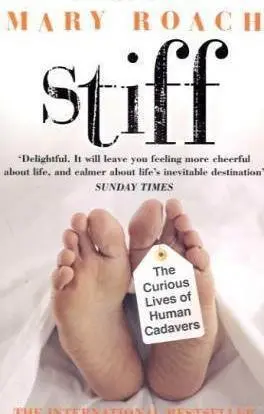
- Название:Stiff
- Автор:
- Издательство:Viking
- Жанр:
- Год:2003
- Город:New York
- ISBN:0-670-91217-4
- Рейтинг книги:4 / 5. Голосов: 2
-
Избранное:Добавить в избранное
- Отзывы:
-
Ваша оценка:
Stiff: краткое содержание, описание и аннотация
Предлагаем к чтению аннотацию, описание, краткое содержание или предисловие (зависит от того, что написал сам автор книги «Stiff»). Если вы не нашли необходимую информацию о книге — напишите в комментариях, мы постараемся отыскать её.
—
Stiff In this fascinating, ennobling account, Mary Roach visits the good deeds of cadavers over the centuries—from the anatomy labs and human-sourced pharmacies of medieval and nineteenth-century Europe to a human decay research facility in Tennessee, to a plastic surgery practice lab, to a Scandinavian funeral directors’ conference on human composting. In her droll, inimitable voice, Roach tells the engrossing story of our bodies when we are no longer with them.
Stiff — читать онлайн бесплатно полную книгу (весь текст) целиком
Ниже представлен текст книги, разбитый по страницам. Система сохранения места последней прочитанной страницы, позволяет с удобством читать онлайн бесплатно книгу «Stiff», без необходимости каждый раз заново искать на чём Вы остановились. Поставьте закладку, и сможете в любой момент перейти на страницу, на которой закончили чтение.
Интервал:
Закладка:
And because the man was buried whole, Evans had to go out with a shovel and rake to aerate him three or four times. This is why Wiigh-Masak plans to break bodies up, with either vibration or ultrasound. The tiny pieces are easily saturated with oxygen and so quickly composted and assimilated that they can be used immediately for a planting. It was also, in part, a matter of dignity and aesthetics. “The body has to be unrecognizable while it composts,” says Wiigh-Masak. “It has to be in small pieces. Can you imagine the family sitting around the dinner table and someone says, ‘Okay, Sven, it’s your turn to go out and turn Mother’?”
Indeed, Evans had something of a rough go of it, though in his case it was more the setting than the deed. “It was hard being out there,” he told me. “I used to think, ‘What am I doing here?’ I’d just put on my blinders and go to my pile.”
It took a month and a half for compost guy to complete his return to the soil. Evans was pleased with the result, which he described as “really dark, rich stuff, with good moisture-holding capacity.” He offered to send me a sample, which might or might not have been illegal. (You need a permit to ship an unembalmed cadaver across state lines, but there is nothing on the books regarding the shipping of a composted cadaver. We decided to leave it be.) Evans was pleased to note that a healthy crop of weeds had begun growing out of the top of the compost bin toward the end of the process. He had been concerned about certain fatty acids in the body, which might, if not thoroughly broken down, prove toxic to plant roots.
In the end, the government of Haiti respectfully declined Evans’s proposal. The Chinese government—in what was either a remarkable show of environmental concern or a desire to save money, manure being cheaper than coal—did express interest in human composting as an alternative to open-pit coal burnings. Evans and his adviser, Arpad Vass, prepared a white paper on the practical advantages of human composting (“…material can then be safely used in land applications as a soil amendment or fertilizer”) but received no further word. Evans has plans to work with veterinarians in southern California to make composting available to pet owners. Like Wiigh-Masak, he envisions families planting a tree or shrub, which would take up the deceased’s molecules and become a living memorial. “This is as close,” he said to me, “as science is going to get to reincarnation.”
I asked Evans if he plans to try to crack the mortuary market. There are two questions there, he answered. If I was asking whether he wanted to make composting available to people, the answer was yes. But he didn’t feel sure he wanted to make the process available through funeral homes.
“One of the things that got me interested in this is a disdain for current practices of the funeral industry,” he said. “You shouldn’t have to pay exorbitant amounts of money to die.” Ultimately, he’d like to offer it through a company of his own.
I then asked how he imagined he’d get the word out, get the ball rolling.
He said he had tried to get a celebrity interested in the cause. The hope was that someone like Paul Newman or Warren Beatty might do for composting what Timothy Leary did for space burials. As Evans was living in Lawrence, Kansas, at the time, he called fellow Kansan William S. Burroughs, who struck him as suitably eccentric and moribund to consider it. The calls were not returned. He eventually did try to contact Paul Newman. “His daughter runs a horse stable doing rehabilitation for handicapped kids. I thought we could use the manure,” Evans said.
“They were probably thinking, ‘What a freak.’” Evans isn’t a freak. He’s just a freethinker, on a topic most people would rather not think about.
Evan’s adviser, Arpad Vass, summed it up best. “Composting is a wonderful possibility. I just don’t think the mentality of this country is there yet.”
The mentality of Sweden is a good deal closer. The thought of “living on” as a willow tree or a rhododendron bush might easily appeal to a nation of gardeners and recyclers. I don’t know what percentage of Swedes have gardens, but plants seem very important to them. Business lobbies in Sweden hold tiny forests of potted trees. (In a roadside restaurant in Jönköping, I saw a ficus plant inside a revolving door.) The Swedes are a practical people, a people who appreciate simplicity and abhor frou-frou.
The stationery of the Swedish king is simply embossed with his seal; at a distance it appears to be a plain sheet of cream-colored paper. Hotel rooms are furnished with what a reasonable traveler might need and nothing more. [43] And sometimes less. My business-grade room at Gothenburg’s Landvetter Airport Hotel (“For Flying People”) had no clock, the assumption being, I suppose, that a businessman can simply consult his watch. The TV remote had no mute button. I pictured Swedish remote designers arguing quietly in their cleanly appointed conference room. “But Ingmar, why do you need a special button when you can just put down the volume?”
There is one pad of paper, not three, and the end of the toilet paper is not triangulated. To be freeze-dried and reduced to a hygienic bag of compost and incorporated into a plant, I suppose, might appeal to the Swedish ethos.
That is not the only thing that has made Sweden the right place at the right time for the human compost movement. As it happens, the crematoria in Sweden have been hit with environmental regulations regarding volatilized mercury from fillings, and many need to make costly upgrades to their equipment within the next two years. Purchasing Wiigh-Masak’s machinery would, she says, cost many of them less than would complying with government regulations. And burial hasn’t been popular here for decades. Wiigh-Masak explained that part of the Swedes’ distaste for interment can be traced to the fact that in Sweden you must share your grave. After twenty-five years, a grave is reopened, and “the men in gas masks,” as Wiigh-Masak puts it, haul you up, dig the grave deeper, and bury someone else on top of you.
This is not to say that Promessa faces no resistance. Wiigh-Masak must convince the people whose jobs will be affected should composting become a reality: the funeral directors, the coffin makers, the embalmers.
People whose apple carts stand to be upset. Yesterday she gave a talk at a conference of parish administrators in Jönköping. These are the people who would care for the person-plants in the churchyard memorial park.
While she spoke, I scanned the audience for smirks and rolling eyes, but saw none. Most of the comments seemed positive, though it was hard to tell, as the comments were in Swedish and my interpreter had never actually interpreted before. He consulted frequently with a piece of graph paper, on which he had written out a list of mortuary and composting vocabulary in Swedish and English (formultning —“moldering, decay”). At one point, a balding man in a dark gray suit raised his hand to say that he thought composting took away the specialness of being human. “In this process, we are equal to some animal that dies in the woods,” he said.
Wiigh-Masak explained that she was only concerned with the body, that the soul or spirit would be addressed, as it has always been, in a memorial service or ritual of the family’s choosing. He didn’t seem to hear this. “Do you look around this room,” he said, “and see nothing more than a hundred bags of fertilizer?” My interpreter whispered that the man was a funeral director. Apparently three or four of them had crashed the conference.
When Wiigh-Masak finished and the crowd moved to the back of the hall for coffee and pastries, I joined the man in the gray suit and his fellow undertakers. Across from me sat a man with white hair, named Curt. He wore a suit too, but his was checkered and he had an air of jollity that made it hard for me to picture him running a funeral home. He said he thought that the ecological funeral would one day, perhaps in ten years, become a reality. “It used to be that the priest told the people how to do it,” he said, referring to memorial rites and rituals and the disposition of the body. “Today the people tell the priest.” (According to Prothero, this was also the case with cremation. Part of the appeal of scattering ashes was that it took the last rites out of the hands of the undertakers and handed them over to the family and friends, freeing them to do something more personally meaningful than what the undertaker might have had in mind.)
Читать дальшеИнтервал:
Закладка:
Похожие книги на «Stiff»
Представляем Вашему вниманию похожие книги на «Stiff» списком для выбора. Мы отобрали схожую по названию и смыслу литературу в надежде предоставить читателям больше вариантов отыскать новые, интересные, ещё непрочитанные произведения.






Обсуждение, отзывы о книге «Stiff» и просто собственные мнения читателей. Оставьте ваши комментарии, напишите, что Вы думаете о произведении, его смысле или главных героях. Укажите что конкретно понравилось, а что нет, и почему Вы так считаете.