Mary Roach - Stiff
Здесь есть возможность читать онлайн «Mary Roach - Stiff» весь текст электронной книги совершенно бесплатно (целиком полную версию без сокращений). В некоторых случаях можно слушать аудио, скачать через торрент в формате fb2 и присутствует краткое содержание. Город: New York, Год выпуска: 2003, ISBN: 2003, Издательство: Viking, Жанр: sci_popular, История, на английском языке. Описание произведения, (предисловие) а так же отзывы посетителей доступны на портале библиотеки ЛибКат.
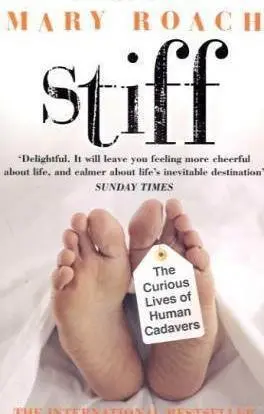
- Название:Stiff
- Автор:
- Издательство:Viking
- Жанр:
- Год:2003
- Город:New York
- ISBN:0-670-91217-4
- Рейтинг книги:4 / 5. Голосов: 2
-
Избранное:Добавить в избранное
- Отзывы:
-
Ваша оценка:
Stiff: краткое содержание, описание и аннотация
Предлагаем к чтению аннотацию, описание, краткое содержание или предисловие (зависит от того, что написал сам автор книги «Stiff»). Если вы не нашли необходимую информацию о книге — напишите в комментариях, мы постараемся отыскать её.
—
Stiff In this fascinating, ennobling account, Mary Roach visits the good deeds of cadavers over the centuries—from the anatomy labs and human-sourced pharmacies of medieval and nineteenth-century Europe to a human decay research facility in Tennessee, to a plastic surgery practice lab, to a Scandinavian funeral directors’ conference on human composting. In her droll, inimitable voice, Roach tells the engrossing story of our bodies when we are no longer with them.
Stiff — читать онлайн бесплатно полную книгу (весь текст) целиком
Ниже представлен текст книги, разбитый по страницам. Система сохранения места последней прочитанной страницы, позволяет с удобством читать онлайн бесплатно книгу «Stiff», без необходимости каждый раз заново искать на чём Вы остановились. Поставьте закладку, и сможете в любой момент перейти на страницу, на которой закончили чтение.
Интервал:
Закладка:
The machines might be so contrived as to break the bones first in pieces the size of a hen egg, next into fragments of the size of a marble, and the mangled and lacerated mass could next be reduced by means of chopping machines and steam power to mincemeat. At this stage we have a homogeneous mixture of the entire body structures in the form of a pulpous mass of raw meat and raw bones. This mass should now be dried thoroughly by means of steam heat at a temperature of 250 Fahr. …because firstly we wish to reduce the material to a condition convenient for handling and secondly we wish to disinfect it…. Once in this condition, it would command a good price for the purpose of manure.
Which brings us, ready or not, to the modern human compost movement.
Here we must travel to Sweden, to a tiny island called Lyrön, due west of Gothenburg. This is the home of a forty-seven-year-old biologist-entrepreneur named Susanne Wiigh-Masak. Two years ago, Wiigh-Masak founded a company called Promessa, which seeks to replace cremation (the choice of 70 percent of Swedes) with a technologically enhanced form of organic composting. This is no mom-and-pop undertaking of the lunatic Green fringe. Wiigh-Masak has King Carl Gustav and the Church of Sweden on her side. She has crematoria vying to be the first to compost a dead Swede. She has the dead Swede ready to go (a terminally ill man who contacted her after hearing her on the radio; he has since taken up residence in a freezer in Stockholm). She has major corporate backing, an international patent, over two hundred press clips.
Mortuary professionals and entrepreneurs from Germany, Holland, Israel, Australia, and the United States have expressed interest in representing Promessa’s technology in their own countries.
She appears to be doing, in a matter of years, what took the cremationists a century.
This is especially impressive given that what she is proposing has its closest precedent in the ideas of Dr. George Hay. Let’s say a man dies in Upsala, and that he has checked the box on the church-distributed living will that says, “I want that the new method freeze-drying ecological funeral will be used if it is available when I die.” (The equipment is still being developed; Wiigh-Masak hopes to have it ready sometime in 2003.) The man’s body will be brought to an establishment that has licensed Promessa’s technology. He will be lowered into a vat of liquid nitrogen and frozen. From here he will progress to the second chamber, where either ultrasound waves or mechanical vibration will be used to break his easily shattered self [42] Frozen humans shatter easily because they are mostly water. How much water is a matter of some debate. A Google search unearthed sixty-four Web sites with the words “body is 70 percent water,” 27 sites that say it’s 60 percent water, 43 that tell you it is either 80 or 85 percent water, 12 that say the figure is 90 percent, 3 that say it’s 98 percent, and one that says it’s 91 percent. A better consensus exists for jellyfish. They are either 98 or 99 percent water, and that is why you never see dried jellyfish snacks. Todd Astorino, director of the Exercise Science Program at Salisbury University, in Salisbury, Maryland, was able to answer the question not only with certainty, but to a decimal point: We are 73.8 percent water. The figure, he said, is calculated by giving a volunteer a measured quantity of water laced with tracers to drink. Four hours later, the subject’s blood is sampled and the dilution of the tracers is noted. From this, you, or Todd anyway, can figure out how much water is in the body. (The more water in the body, the more diluted the tracers in the blood.) Compare the water weight to body weight, and there’s the answer. Isn’t science terrific?
into small pieces, more or less the size of ground chuck. The pieces, still frozen, will then be freeze-dried and used as compost for a memorial tree or shrub, either in a churchyard memorial park or in the family’s yard.
The difference between George Hay and Susanne Wiigh-Masak is that Hay, in suggesting that we feed crops with the dead, was simply trying to be practical, to do something beneficial and useful with a dead human body. Wiigh-Masak is not a utilitarian. She is an environmentalist. And in parts of Europe, environmentalism is tantamount to its own religion. For this reason, I think, she may just succeed.
To understand Wiigh-Masak’s catechism, it helps to pay a visit to her compost pile. It lies beside the barn on the acre and a half that she and her family rent on Lyrön. Wiigh-Masak shows her compost pile to guests the way an American homeowner might show off the new entertainment center, or the youngest son’s grades. It is her pride and, it is no exaggeration to say, her joy.
She pushes a shovel into the heap and raises a loamy clod. It is complex and full of unnamable fragments, like a lasagna baked by an unsupervised child. She points out feathers from a duck that died a few weeks back, shells from the mussels that her husband, Peter, farms on the other side of the island, cabbage from last week’s coleslaw. She explains the difference between rotting and composting, that the needs of humans and the needs of compost are similar: oxygen, water, air temperature that does not stray far from 37 degrees centigrade. Her point: We are all nature, all made of the same basic materials, with the same basic needs.
We are no different, on a very basic level, from the ducks and the mussels and last week’s coleslaw. Thus we should respect Nature, and when we die, we should give ourselves back to the earth.
As though sensing that she and I might not be entirely on the same page, perhaps not even in the same general vicinity of the Dewey decimal system, Wiigh-Masak asks me if I compost. I explain that I don’t have a garden. “Ah, okay.” She considers this fact. I get the feeling that to Wiigh-Masak, this is not so much an explanation as a criminal confession. I am feeling more like last week’s coleslaw than usual.
She returns to the clod. “Compost should not be ugly,” she is saying. “It should be lovely, it should be romantic.” She feels similarly about dead bodies. “Death is a possibility for new life. The body becomes something else. I would like that that something else be as positive as possible.”
People have criticized her, she says, for lowering the dead to the level of garden waste. She doesn’t see it that way. “I say, let’s lift garden waste to as high a level as human bodies.” What’s she’s trying to say is that nothing organic should be treated as waste. It should all be recycled.
I am waiting for Wiigh-Masak to put down the shovel, but now it is coming closer. “Smell it,” she offers. I would not go so far as to say that her compost smells romantic, but it does not smell like rotting garbage.
Compared to some of the things I’ve been smelling these days, it’s a pot of posies.
Susanne Wiigh-Masak will not be the first person to compost a human body. That honor goes to an American named Tim Evans. I heard about Evans while visiting the University of Tennessee’s human decay research facility (see Chapter 3). As a graduate student, Evans had investigated human composting as an option for third-world countries where the majority of the people can’t afford coffins or cremation. In Haiti and parts of rural China, Evans told me, unclaimed bodies and bodies from poor families are often dumped in open pits. In China, the corpses are then burned using high-sulfur coal.
In 1998, Evans procured the body of a ne’er-do-well whose family had donated him to the university. “He never knew he was going to end up as compost guy,” recalled Evans, when I telephoned him. This was probably just as well. To supply the requisite bacteria to break down the tissue, Evans composted the body with manure and soiled wood shavings from stables. The dignity issue rears its delicate head. (Wiigh-Masak would not be using manure; she plans to mix a “little dose” of freeze-dried bacteria in with each box of remains.)
Читать дальшеИнтервал:
Закладка:
Похожие книги на «Stiff»
Представляем Вашему вниманию похожие книги на «Stiff» списком для выбора. Мы отобрали схожую по названию и смыслу литературу в надежде предоставить читателям больше вариантов отыскать новые, интересные, ещё непрочитанные произведения.





Обсуждение, отзывы о книге «Stiff» и просто собственные мнения читателей. Оставьте ваши комментарии, напишите, что Вы думаете о произведении, его смысле или главных героях. Укажите что конкретно понравилось, а что нет, и почему Вы так считаете.