Michael Veitch - Hell Ship
Здесь есть возможность читать онлайн «Michael Veitch - Hell Ship» весь текст электронной книги совершенно бесплатно (целиком полную версию без сокращений). В некоторых случаях можно слушать аудио, скачать через торрент в формате fb2 и присутствует краткое содержание. Город: Sydney, Год выпуска: 2018, ISBN: 2018, Издательство: Allen & Unwin, Жанр: История, на английском языке. Описание произведения, (предисловие) а так же отзывы посетителей доступны на портале библиотеки ЛибКат.
- Название:Hell Ship
- Автор:
- Издательство:Allen & Unwin
- Жанр:
- Год:2018
- Город:Sydney
- ISBN:978-1-76063-084-3
- Рейтинг книги:4 / 5. Голосов: 1
-
Избранное:Добавить в избранное
- Отзывы:
-
Ваша оценка:
Hell Ship: краткое содержание, описание и аннотация
Предлагаем к чтению аннотацию, описание, краткое содержание или предисловие (зависит от того, что написал сам автор книги «Hell Ship»). Если вы не нашли необходимую информацию о книге — напишите в комментариях, мы постараемся отыскать её.
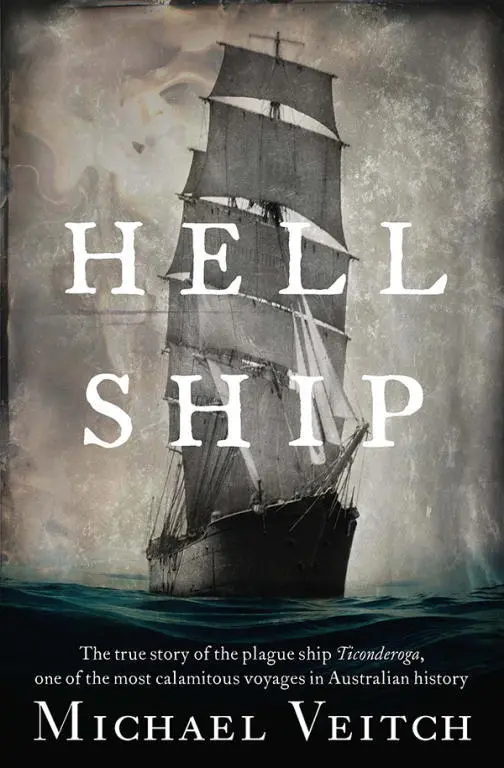
that left England for Victoria with 800 doomed emigrants on board. For more than a century and a half, a grim tale has passed down through Michael Veitch’s family: the story of the
, a clipper ship that sailed from Liverpool in August 1852, crammed with poor but hopeful emigrants—mostly Scottish victims of the Clearances and the potato famine. A better life, they believed, awaited them in Australia.
Three months later, a ghost ship crept into Port Phillip Bay flying the dreaded yellow flag of contagion. On her horrific three-month voyage, deadly typhus had erupted, killing a quarter of
’s passengers and leaving many more desperately ill. Sharks, it was said, had followed her passage as the victims were buried at sea.
Panic struck Melbourne. Forbidden to dock at the gold-boom town, the ship was directed to a lonely beach on the far tip of the Mornington Peninsula, a place now called Ticonderoga Bay.
James William Henry Veitch was the ship’s assistant surgeon, on his first appointment at sea. Among the volunteers who helped him tend to the sick and dying was a young woman from the island of Mull, Annie Morrison. What happened between them on that terrible voyage is a testament to human resilience, and to love.
Michael Veitch is their great-great-grandson, and
is his brilliantly researched narrative of one of the biggest stories of its day, now all but forgotten. Broader than his own family’s story, it brings to life the hardships and horrors endured by those who came by sea to seek a new life in Australia.
Hell Ship — читать онлайн бесплатно полную книгу (весь текст) целиком
Ниже представлен текст книги, разбитый по страницам. Система сохранения места последней прочитанной страницы, позволяет с удобством читать онлайн бесплатно книгу «Hell Ship», без необходимости каждый раз заново искать на чём Вы остановились. Поставьте закладку, и сможете в любой момент перейти на страницу, на которой закончили чтение.
Интервал:
Закладка:
Perhaps most significantly of all, Maury’s work confirmed that not only was Towson’s Great Circle the most efficient route to Australia in terms of distance, but that the winds south of 40 degrees were far more favourable to easterly bound ships than those further north.
In the end, shipowners and masters took matters into their own hands and began to follow Towson’s and Maury’s advice on their own. Only in 1854 did the Admiralty acknowledge the superiority of the Great Circle and adopt the route. The average trip from Britain to Australia was reduced from 120 days to around 80, and for his efforts, Towson was awarded £1000 and Maury became established as one of the greatest oceanographic scientists of all time.
For those on board ships heading to the Antipodes, however, the price paid for Towson and Maury’s Great Circle shortcut was high indeed. If the Ticonderoga had baked like an oven as it limped across the equator, now her passengers were to be subjected to another extremity: the wild and freezing latitudes of the Great Southern Ocean. It is here, at the end of the world, that sub-Antarctic gales howl endlessly across the dark and mountainous seas swirling around the coldest place on Earth. At this precise moment, a new and terrible epidemic—brewing now for weeks in the seams of the passengers’ clothing or even on their bodies—would burst upon the Ticonderoga ’s human cargo with unspeakable consequences.
15
Surgeons at sea
The Colonial Land and Emigration Commission (aka the Board) stipulated that all ships carrying over 50 of their assisted passengers must be accompanied by a surgeon. Laden with around 800 people, the Ticonderoga seems to have been significantly under-catered for, although this was not thought so at the time. The surgeons were well remunerated for their services, with the experienced Dr Sanger being paid £200 and his assistant, James Veitch, on his first voyage, receiving £80 pounds, though this would increase quickly with experience.
To a modern observer, the contents of the Ticonderoga ’s medical kit appear somewhat curious. Listed under ‘medical comforts’, the inventory has survived courtesy of the Public Record Office in London. What, today, are we to make of ‘Box—125 packages, patent groats’, or the ‘100 gallons, vinegar’ it was felt necessary to bring along? The list is long and includes apparently large quantities of what was otherwise banned completely on the Ticonderoga : alcohol. For strictly medicinal use, no less than three dozen cases of Hollands gin were included, as were six dozen cases of sherry and double that of port wine. There were large supplies of brandy and porter (stout) as well as 80 gallons of oil, although the type is not specified. Other supplies included ‘62 jars, 5 gallons each, lime juice’, ‘160 lbs arrow-root’, boiled beef, boiled mutton, eight barrels of raw sugar and so on. [1] British Parliamentary Papers Relative to the Australian Colonies, no. 15, 1 April 1853, Objection to Chartering Vessels of Great Burthen for the Conveyance of Emigrants
In the sailing ship era, ship’s doctors, or ‘surgeon superintendents’ as they were also known, were regarded as being just as proficient, if not more so, than their counterparts on land, despite their popularity with the passengers varying from individual to individual. Occupying a unique position on board ship, they were expected to fulfil a wide variety of roles, some of which had little to do with the practice of medicine itself. As historian Robin Haines points out in her extensive study of medicine in the Age of Sail, surgeons were the chief contact between the passengers and those in charge of their destiny on the voyage—the captain and crew—performing the role of ‘agent of the state at sea’. [2] Haines, 2005, p. 57
They soothed quarrels, passed on passenger grievances to the captain, instigated and oversaw washing and cleaning routines, and were explicitly responsible for the general health of every passenger under their care.
However, most doctors with any experience of working at sea in emigration vessels were under no illusions about just how difficult the journey facing the men, women and families under their care would be. Dr Robert Scot Skirving, surgeon superintendent on the emigrant vessel Ellora, who would go on to become a prominent medical practitioner in Sydney , observed that:
It was horrid, even indecent for decent married people to be herded like beasts, with almost no privacy to dress or undress, and where, in the close and stuffy double beds they slept in, only a thin board separated each couple… The ventilation was very poor, and in the tropics, with a temperature of 90 degrees, the air was mephitic. [3] Charlwood, 1981, p. 10
Or, as author and historian Don Charlwood put it,
Surgeon-superintendents were just as responsible as ships’ masters for bringing emigrants safely to the new land… they needed as much skill in human relations as they did in medicine… most voyages would have been intolerable without their arbitration, and losses of life would have been very much higher without their devotion. [4] Charlwood, 1981, p. 191
It had not always been so. In the early days of convict transport, the rate of deaths on board convict vessels was high, but after the infamous 1814 arrival of the transports Surry, General Hewitt and Three Bees , in which together nearly a hundred convicts, crew and even some of the guards had died of ‘a malignant fever of a very infectious nature’, [5] ‘GOVERNMENT AND GENERAL ORDERS’, Sydney Gazette Saturday 30 July 1814
it was agreed that something needed to be done. Assistant Colonial Surgeon William Redfern, who himself had arrived as a convict sentenced for mutiny (though he soon earned a full pardon from Governor Macquarie, who desperately needed his skills), was asked to submit a report on the voyage. His ground-breaking recommendations made a major contribution to colonial public health. Competent and qualified surgeons, said Redfern, should be sourced and installed on all future convict transports, and be given powers to insist that ships be kept clean, fumigated and ventilated—even to the point of overruling incompetent or drunken ships’ masters. Being a navy man himself, Redfern suggested such surgeons be selected from the ranks of the Royal Navy. In a short time, convict mortality at sea plummeted from 11.3 to 2.4 per thousand per month.
Besides preventative measures and administering treatments for everyday conditions such as indigestion, constipation, sore throats and diarrhoea, a surgeon’s practical skills were paramount. They would set broken limbs and bandage sprained ankles, sew up wounds and perform minor surgery for hernias and other ‘internal obstructions’. [6] Haines, 2005, p. 8
They would also become obstetricians for the many babies they would inevitably be called upon to deliver, treat and even bury at sea on a long sea voyage such as the Ticonderoga ’s.
As well as a daily visit to as many parts of the ship as they could manage—much like a current-day hospital doctor making the rounds—they held clinics that were enthusiastically attended by the many passengers for whom medical attention had been a previously unaffordable luxury. Once a day, too, they would report to and confer with the captain, keeping each other abreast of all that was happening on board—particularly the mood and state of the passengers—always presenting a united front of authority. Of particular importance was their task of keeping the vessel clean.
At a time in which little could be done to cure everyday diseases, the surgeon’s primary focus was prevention. Routines of health and cleanliness, it was believed, could remove the conditions where such ailments could thrive, particularly with regard to those most vulnerable on a sea voyage: children. Although the feeding of infants and newborns was the responsibility of their mothers—sometimes with tragic consequences should they be unable to do so—it was up to the surgeons to ensure that older children received adequate rations, that their berths were adequately lit and ventilated, that they could exercise, and that their clothes and bodies were washed regularly. This, of course, often came up against the physical limitations of the ship itself, but in any case involved instigating unfamiliar hygiene routines for both children and parents, and directing the sanitation of the vessel itself.
Читать дальшеИнтервал:
Закладка:
Похожие книги на «Hell Ship»
Представляем Вашему вниманию похожие книги на «Hell Ship» списком для выбора. Мы отобрали схожую по названию и смыслу литературу в надежде предоставить читателям больше вариантов отыскать новые, интересные, ещё непрочитанные произведения.










Обсуждение, отзывы о книге «Hell Ship» и просто собственные мнения читателей. Оставьте ваши комментарии, напишите, что Вы думаете о произведении, его смысле или главных героях. Укажите что конкретно понравилось, а что нет, и почему Вы так считаете.