Sofia Samatar - A Stranger in Olondria
Здесь есть возможность читать онлайн «Sofia Samatar - A Stranger in Olondria» весь текст электронной книги совершенно бесплатно (целиком полную версию без сокращений). В некоторых случаях можно слушать аудио, скачать через торрент в формате fb2 и присутствует краткое содержание. Жанр: Фэнтези, на английском языке. Описание произведения, (предисловие) а так же отзывы посетителей доступны на портале библиотеки ЛибКат.
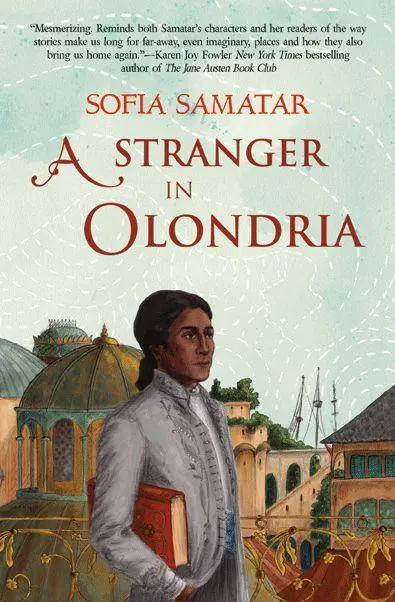
- Название:A Stranger in Olondria
- Автор:
- Жанр:
- Год:неизвестен
- ISBN:нет данных
- Рейтинг книги:5 / 5. Голосов: 1
-
Избранное:Добавить в избранное
- Отзывы:
-
Ваша оценка:
A Stranger in Olondria: краткое содержание, описание и аннотация
Предлагаем к чтению аннотацию, описание, краткое содержание или предисловие (зависит от того, что написал сам автор книги «A Stranger in Olondria»). Если вы не нашли необходимую информацию о книге — напишите в комментариях, мы постараемся отыскать её.
In desperation, Jevick seeks the aid of Olondrian priests and quickly becomes a pawn in the struggle between the empire’s two most powerful cults. Yet even as the country shimmers on the cusp of war, he must face his ghost and learn her story before he has any chance of becoming free by setting her free: an ordeal that challenges his understanding of art and life, home and exile, and the limits of that seductive necromancy, reading.
A Stranger in Olondria — читать онлайн бесплатно полную книгу (весь текст) целиком
Ниже представлен текст книги, разбитый по страницам. Система сохранения места последней прочитанной страницы, позволяет с удобством читать онлайн бесплатно книгу «A Stranger in Olondria», без необходимости каждый раз заново искать на чём Вы остановились. Поставьте закладку, и сможете в любой момент перейти на страницу, на которой закончили чтение.
Интервал:
Закладка:
“Jevick,” she said.
“Tialon.”
“Are you unwell?” she asked softly.
“Are you?” I returned.
At that her smile grew warmer and tears came into her eyes. She patted my wrist with a freezing hand. “No. I am very well. Are you still reading Olondrian Lyrics ?”
“Yes. And the Romance of the Valley .”
She nodded. Her eyes shone with the transparent light of the sky, as if the rain had washed them. “I’m reading, too. I’ve read your letters. I’m sorry I didn’t answer. I’ve come to you instead. I won’t stay long. I’ll go back to my real life. You remember I told you I’d built something… This is what I have built. This life.”
In the fractured light of the lamp her face looked young, determined, unhappy. There was a recklessness in the way she lifted her chin. “I read. I take notes for my father. I sit in the shrine of the Stone, always reading, watching, gazing into the depths of mystery. The Stone… I wish I could show it to you. Perhaps then you would understand. It is black, heavy, miraculous, covered with writing…” She raised her hands, arms wide, delineating a vague shape in the air, then shrugged her shoulders and let them fall.
“I can’t describe it. But Jevick—it is a very great thing. Our hope. My father is only the second to attempt to interpret its message. For this reason…” She paused and bit her lip, then looked at me and went on quietly: “For this reason it is easy for us to make mistakes. Do you understand? For us, for our cult, it is the beginning. We are still vulnerable—still laughed at, and still hated… We have the support of the king, but of no one close to him. Indeed, his son is one of those who seek most persistently to discredit us. And there is also Avalei’s cult. They hate us because we reject what they love: luxury, harlotry, the pursuit of angels.”
She smiled at my flushed face. “I know you’ve met the High Priestess of Avalei. I know everything. We have spies.” A tear dropped down her cheek to her lap. “Yes. Spies. We listen at doors, we follow people. My father receives reports every morning at dawn. It’s disgusting…”
Reading alarm in my face, she laughed, brushing back tears with the heel of her palm. “Don’t worry. You’re safe. You believe that, don’t you? You know I am your friend.”
I looked up into her wistful eyes, her eyes of immense candor. “Yes,” I said. “I know it. But I don’t know why.”
“That’s what I’ve come to tell you,” she said. “The reason I am your friend. The reason I won’t betray you, even though I know you’re running away. The reason for everything.” She gazed at me with a frightened smile, and swallowed. “It’s strange—now I’m here, I don’t know how to begin.”
But she did. She did know how to begin. She took a deep breath and looked down at her fingers clenched together on her dark wool dress. Then she raised her head and met my eyes. She leaned toward me like a sister, while the rain closed the Isle behind its resonant palisades.
She told me of the village of Kebreis, the village of Flint, with its roofs of broken slate and latticed windows. A village of cold water and hard rock wedged among the hills of the west, the Fiaduoron, the Dark Mountains. Kebreis: hunched in a fiercely beautiful landscape of clear streams and brilliant skies and the snow-bright pinnacles of the mountains, a landscape whose glitter hurts the eye, whose cold air stings the lungs, its people withdrawn and silent, craving isolation. Many of the men had once worked in the mines. These had tattoos under their eyes where, as they lounged in the café, one might read “Thief” or “Pirate.” Among them there was one man who was marked with the blue word “Poacher”—for he had been caught hunting boar in the Kelevain, the Telkan’s wood.
He spent six years in the mines, and when his sentence was over he came down from the mountains into the solitude of Kebreis. Like many of the men there he discovered he could live most peacefully in the hills, where his tattoo brought him not calumny but respect. So he settled there and smoked with the others in the little café, drinking sour red wine in the patch of dust under the awning, and he married the schoolteacher’s only daughter against her father’s will and took her to live in his one-roomed house among the peaks.
The schoolteacher’s daughter wore tough cotton clothes like the other women of Kebreis, and in winter a pair of boots trimmed with otter skin. And despite her father’s predictions of disaster she never longed for fine linen or servants, never complained when she had to break the ice in the buckets. She kept goats and was sunburned and caught trout and ate potatoes and refused to take even a radish from her father, and the children came one after the other, all of them wild, lanky, singing, adventurous, and strong-hearted like their parents. They were all well-suited to life in Kebreis and free from unhappy dreams. And then there were two girls who died in infancy; and then the last, a boy, whom his mother called Lunre, because he was born in the month of the purest light.
Tialon told me this. She spoke with a trembling eagerness, sometimes pulling at the collar of her dress. She held up her hand when I opened my mouth and went on telling me, hurriedly, as if rushing to catch the story before it escaped. She told me of the thin and lonely boy with the red knees who was plagued by coughs, who cried when he was ill, who lay against the wall under wool blankets with his brothers in the single room divided by a frayed curtain, who suffered in that smoky room and suffered as well outdoors, where he was pelted with snow and unable to run quickly, where his father took him on long walks to improve his constitution and forced him to wade in the furious, icy trout streams. She told me of how he suffered everywhere except in the school where his grandfather, that severe and well-dressed gentleman, who had despaired of all the boy’s brothers and sisters, was interested, hardly daring to hope, in this last one, the one with the chronic cough. Lunre. Dressed in the patched clothes of his brothers, and a wool scarf. Lunre who sometimes could not go to school but lay in the corner, pale and languid, watching the frost that formed along the edge of the door when the fire had gone out. It was his grandfather who came to him, leaning on his cane, still muffled in a fur cloak although it was spring, and the streams were rushing bright and cold, and here and there the first of the crocuses peeped through the muddy traces of melting snow. It was his grandfather who came and sat on a stool by the hearth, looking too large and princely for the small room, and offered to pay for the boy to go to school in the capital where the milder climate would give him a chance at survival. Yes, he would go to stay there with a merchant, his grandfather’s brother, in the house where his mother had lived for two years long ago, where she had learned to paint and sew but never to speak Olondrian without peppering it with phrases of mountain slang. Lunre’s parents agreed, not for the gain, the future prestige, but because Kebreis was killing their last child. And his mother wept over him as though he, the difficult one, the one who was the least like her, was the dearest of them all.
“So Lunre went to Bain,” Tialon said. “He was ten years old. Do I need to tell you what happened to him after that? Do I need to tell you of the house of his great-uncle the glass merchant, where they slept outside on the balcony in summer? And his schools—the private boys’ school, the University of Bain—do you need to hear of them, of his passion for reading? You have read Firdred of Bain, On the Nine Textures of Light , the Lyrics of Karanis—and so you know. Is it not enough for you to know that at the age of twenty-one he went to a poorly attended evening lecture and saw my father’s elderly predecessor, emaciated and fierce, exhorting young students to join the work of the Stone? And to know, also, that he felt distaste at the sight of that gaunt figure and joined him not because he believed in the dream, but because he could not resist the temptation to go to the Blessed Isle and to walk the halls of the library drenched in myth… It was only later that he became intrigued by the work of the Stone, through the debates held by the scholars who had gathered to serve the old priest. They used to meet in a roof garden full of lavender, at dusk. It was their passion that drew him. And later it was his friendship with my father.
Читать дальшеИнтервал:
Закладка:
Похожие книги на «A Stranger in Olondria»
Представляем Вашему вниманию похожие книги на «A Stranger in Olondria» списком для выбора. Мы отобрали схожую по названию и смыслу литературу в надежде предоставить читателям больше вариантов отыскать новые, интересные, ещё непрочитанные произведения.






Обсуждение, отзывы о книге «A Stranger in Olondria» и просто собственные мнения читателей. Оставьте ваши комментарии, напишите, что Вы думаете о произведении, его смысле или главных героях. Укажите что конкретно понравилось, а что нет, и почему Вы так считаете.