Sofia Samatar - A Stranger in Olondria
Здесь есть возможность читать онлайн «Sofia Samatar - A Stranger in Olondria» весь текст электронной книги совершенно бесплатно (целиком полную версию без сокращений). В некоторых случаях можно слушать аудио, скачать через торрент в формате fb2 и присутствует краткое содержание. Жанр: Фэнтези, на английском языке. Описание произведения, (предисловие) а так же отзывы посетителей доступны на портале библиотеки ЛибКат.
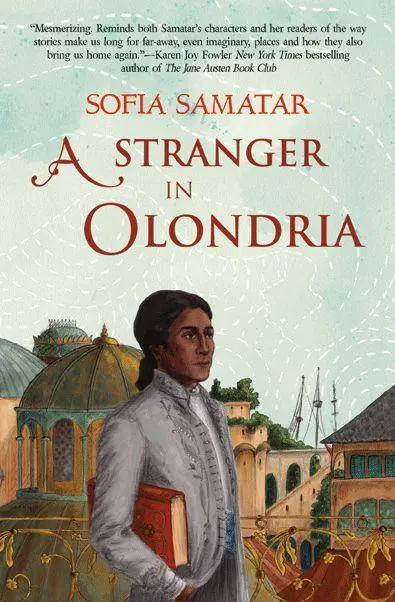
- Название:A Stranger in Olondria
- Автор:
- Жанр:
- Год:неизвестен
- ISBN:нет данных
- Рейтинг книги:5 / 5. Голосов: 1
-
Избранное:Добавить в избранное
- Отзывы:
-
Ваша оценка:
A Stranger in Olondria: краткое содержание, описание и аннотация
Предлагаем к чтению аннотацию, описание, краткое содержание или предисловие (зависит от того, что написал сам автор книги «A Stranger in Olondria»). Если вы не нашли необходимую информацию о книге — напишите в комментариях, мы постараемся отыскать её.
In desperation, Jevick seeks the aid of Olondrian priests and quickly becomes a pawn in the struggle between the empire’s two most powerful cults. Yet even as the country shimmers on the cusp of war, he must face his ghost and learn her story before he has any chance of becoming free by setting her free: an ordeal that challenges his understanding of art and life, home and exile, and the limits of that seductive necromancy, reading.
A Stranger in Olondria — читать онлайн бесплатно полную книгу (весь текст) целиком
Ниже представлен текст книги, разбитый по страницам. Система сохранения места последней прочитанной страницы, позволяет с удобством читать онлайн бесплатно книгу «A Stranger in Olondria», без необходимости каждый раз заново искать на чём Вы остановились. Поставьте закладку, и сможете в любой момент перейти на страницу, на которой закончили чтение.
Интервал:
Закладка:
“He was our only friend,” she said, touching her hand to her throat. “He was our friend, my father’s only friend. Do you understand what that means? He could make my father laugh. He could even make him play the violin. He was the only one who could ever persuade my father to sing—even I couldn’t do that, although I loved it. He used to come to our rooms when I was small. He had a special knock, so that we would recognize him and let him in. He would bring a fish or beef heart and cook it over the coals on the balcony. He could make my father eat anything, even drink wine… When he—when Lunre was there my father would sigh and say, ‘Why not?’—you see, he would lose his stiffness and become generous. He pretended that it annoyed him, but I could see how happy he was, that it was happiness that made him give in to pleasure… Sometimes when Lunre was there, when I was too little to understand, I would grow so filled with joy I had to scream; I would leap around the house, too drunk with relief to contain myself, and have to be sent to bed early or even punished. You see, our house was so solemn. There was so little room for play. And so during Lunre’s visits I would grow wild: I pushed everything too far, I laughed too loudly, I wanted each joke to continue forever. Later I always felt so ashamed…”
She smiled, glancing down at her hands, tracing the lines in her palm, the smudges of old ink. Then she looked up and said: “That friendship was inexplicable. Here was this man, my father—so dour, so shy, so easily insulted—who had recently lost his wife, who had only me. He was in his own type of mourning, which involved a strained sensitivity, an anger which erupted on any pretext, yet somehow he invited this young man to visit him, this student sixteen years younger than himself. How did it happen? I imagine it began in the garden outside the shrine, that high garden with its statues, its narrow parapet, where the followers of the Priest of the Stone used to meet and look down on the battlements of this city in the hour after sunset… The student must have said something, or followed some line of reasoning, which hinted at his solitary nature, his love of classical poetry or his ability to suffer silently, all traits my father admired in him. In him: this youth of twenty-one with the thin veneer of city cultivation over the sadness of Kebreis, with the anxious, slightly affected way of carrying himself which he used to cover his villager’s awkwardness. Perhaps that was part of it: they were both awkward, although in Lunre, who was good-natured, this quality was endearing. In my father the awkwardness was cruel. But when they were together it disappeared: they were both completely at ease…
“In those days, Jevick, I truly believe there were more stars in the sky. They used to come out all at once, like a field of snow. And we would sit on the balcony, the three of us, looking at them, and I would listen to my father and Lunre talking. Sometimes they told old stories or Lunre recited part of the Vanathul, which he had learned from his father in Kebreis, or my father brought out the limike and sang in his clear voice one of the sacred songs, or old lullabies from the country.
Long is the journey homeward,
Weary and worn are we.
Oh, if I fall behind, my love,
Will you look back for me?
That was the saddest song he sang, the one with the simplest words. It was composed long ago on the road called the Trail of Wolves. I remember hearing that song, lying half-asleep on the balcony with my cheek on the tiles in the warmth of the summer night… I could smell so many flowers and also the coals, still red from our supper. We stacked the plates in a corner of the balcony. And later, when I sat there alone, when I was nineteen years old, I could see that there were fewer stars in the sky.
“I have heard that there are people who live happily alone. But I myself have not found it to be possible. I told you that I have built something, and since you came I have realized that what I have built is the shadow of happiness. But true happiness: that is what we had when we were together, my father and Lunre and I, sometimes with my nurse, when I was old enough not to scream with the wild sensation of joy but to sit, ecstatic, to let it wash over me… We cooked, sometimes we went for a drive in one of the palace carriages and picnicked in the woods or walked in the hills, we went to plays organized for the king, and sometimes we wrote plays ourselves and performed them for my nurse on the balcony. By this time Lunre had come to believe in the message of the Stone, and he too had woven and sewn his own robe, although he did not change his name as my father had, which was good, his name suited him: he was with light, and I hope that he has always remained with light. But he had changed in himself. He had developed an intense gaze and the melancholy of hours immured in mystery. Once, from the balcony, I saw him far below in the rain, and I think that he had not realized it was raining.”
Tialon paused. She looked wan and remote, as if carved on a fountain. Her eyes were lowered; the lashes cast a shadow. She said: “I used to lie awake at night out of pure happiness, because of an apple, because we had seen butterflies, because he had laughed at my jokes and for a thousand other foolish reasons, while slowly, inexorably, our lives were breaking. They had begun to quarrel, you see—Lunre and my father. They had disagreed on certain interpretations, and my father, who could not bear contradiction even then, had forced Lunre to burn some of his notes. Yes—you do well to look shocked. But worse things happened afterward. One of my father’s enemies perished in the Telkan’s dungeons—not murdered outright, but imprisoned until his death. And there was—”
She stopped, then went on with an effort, her lips barely moving: “There was a school burned in the Valley.”
A breath. Then she went on in the same flat tone: “They were teaching banned books. None of the children could read. Avalei’s eunuchs were teaching them by recitation. They were teaching the autobiography of Leiya Tevorova, who claimed to have been haunted by an angel. My father sent them three warnings, and then the Guard, the Telkan’s Guard. He told us later that he did not know they were going to burn the school. Lunre called him a liar—my father, a liar. Three children died when the school was burned. Two of them were my age.
“Perhaps it was then that the stars began to disappear from the sky: for I believe whole constellations have been extinguished. They slipped away from us as we were lying awake or sleeping, and they have never come back, not even for a moment. Perhaps they were fading even as I walked back from the library with Lunre, the two of us arm in arm in the dark, in our somber clothes that made us call ourselves ‘the two ravens,’ laughing in the dim hallways and under the trees. I felt a surge of that wild joy which I had known as a child, and he saw it in me, my excited voice and laughter, and in the turning of one of the halls he suddenly grew still and said to me: ‘You should not laugh so; it is too much.’ He had never said such a thing to me and I took my arm away from him and we walked in silence back to the Tower of Myrrh. And as we passed through a garden I saw his face in the light of a lamp and it was grim and pained, and unlike the face of my friend.
“The quarrels between my father and Lunre continued and grew worse. My father discovered that Lunre kept secret notes, and as for Lunre, his matchless ability to suffer quietly, which he had developed in the small house in Kebreis, which my father had so admired in him, proved to have its own limits. They shouted at one another, stormed out of the shrine. My father was afraid that Lunre would take his notes to the Telkan, or publish them on the mainland, destroying my father’s own work. And Lunre was tormented by his betrayal of his friend, by the burned school, and by the other, unspeakable thing.
Читать дальшеИнтервал:
Закладка:
Похожие книги на «A Stranger in Olondria»
Представляем Вашему вниманию похожие книги на «A Stranger in Olondria» списком для выбора. Мы отобрали схожую по названию и смыслу литературу в надежде предоставить читателям больше вариантов отыскать новые, интересные, ещё непрочитанные произведения.






Обсуждение, отзывы о книге «A Stranger in Olondria» и просто собственные мнения читателей. Оставьте ваши комментарии, напишите, что Вы думаете о произведении, его смысле или главных героях. Укажите что конкретно понравилось, а что нет, и почему Вы так считаете.