Sofia Samatar - A Stranger in Olondria
Здесь есть возможность читать онлайн «Sofia Samatar - A Stranger in Olondria» весь текст электронной книги совершенно бесплатно (целиком полную версию без сокращений). В некоторых случаях можно слушать аудио, скачать через торрент в формате fb2 и присутствует краткое содержание. Жанр: Фэнтези, на английском языке. Описание произведения, (предисловие) а так же отзывы посетителей доступны на портале библиотеки ЛибКат.
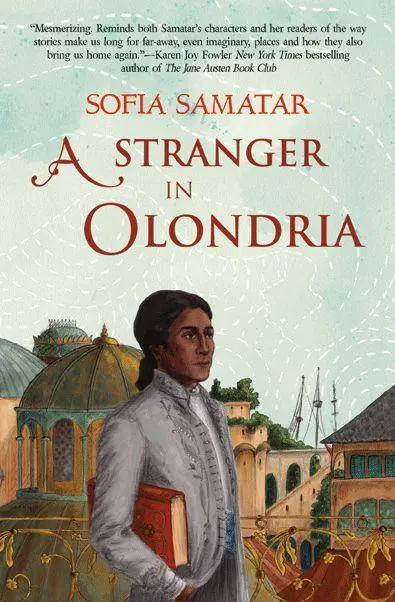
- Название:A Stranger in Olondria
- Автор:
- Жанр:
- Год:неизвестен
- ISBN:нет данных
- Рейтинг книги:5 / 5. Голосов: 1
-
Избранное:Добавить в избранное
- Отзывы:
-
Ваша оценка:
A Stranger in Olondria: краткое содержание, описание и аннотация
Предлагаем к чтению аннотацию, описание, краткое содержание или предисловие (зависит от того, что написал сам автор книги «A Stranger in Olondria»). Если вы не нашли необходимую информацию о книге — напишите в комментариях, мы постараемся отыскать её.
In desperation, Jevick seeks the aid of Olondrian priests and quickly becomes a pawn in the struggle between the empire’s two most powerful cults. Yet even as the country shimmers on the cusp of war, he must face his ghost and learn her story before he has any chance of becoming free by setting her free: an ordeal that challenges his understanding of art and life, home and exile, and the limits of that seductive necromancy, reading.
A Stranger in Olondria — читать онлайн бесплатно полную книгу (весь текст) целиком
Ниже представлен текст книги, разбитый по страницам. Система сохранения места последней прочитанной страницы, позволяет с удобством читать онлайн бесплатно книгу «A Stranger in Olondria», без необходимости каждый раз заново искать на чём Вы остановились. Поставьте закладку, и сможете в любой момент перейти на страницу, на которой закончили чтение.
Интервал:
Закладка:
“Yes,” Tialon whispered, “by the other, unspeakable thing, which I did not discover until he had gone, though I must have sensed its presence without admitting it to myself and without even understanding what it was. I only knew that something, some threat, was hovering over us on that night in the hall when he had told me not to laugh, and again in one of the gardens when I caught my hair in the thorns of the hedge and he, releasing it, stroked my cheek. That was how it appeared: first like that and then on the hill overlooking the sea when we fell silent for no reason, afraid in the light of that threatening sky with the storm coming over the sea; and then at night on the balcony; and then everywhere. Yes, soon this fear, this desolation was everywhere, and I could not look at him without feeling my face grow hot, and he looked at me searchingly and submissively and without hope, and then one day, after eighteen years, he was gone.
“He left my father a letter,” Tialon said quietly, “and my father, in his rage, forced me to read it. And so I read how Lunre was going away, was leaving Olondria, but did not know whether he would flee to the north or south of the world. And I also read of his reasons: that he was not worthy to study the words of the gods, as he had betrayed both them and himself. And that, he wrote, he was in the grip of a dishonorable passion. Those were his words: ‘a dishonorable passion.’”
The sighing echo of those words hung in the air of the room, the echo not just of what Tialon had said, but of what she had read in the letter on that remote afternoon under the quivering and furious eye of her father. There was a burnt smell from the hills. In the evening she sat on the balcony with her back against the wall, staring into the dark, and when her nurse came out and asked her why she wept she told her that she had only now seen that some of the stars were missing.
“He was twenty years older than I,” she said to me in that stone cell in the Gray Houses, seated on the edge of my low bed. “He was—but why am I telling you how he was? You must know.” She looked at me, her gaze penetrating, direct.
“Yes,” I whispered.
I had thought that she would weep, but she did not. She was like a queen, sitting very straight, her hands quiet in her lap. Only her voice wavered, and a shudder crossed her throat when she said: “Yes. I knew. And how could I not? I did not spend those years, the years of my childhood, listening to him read in the evening light, only to forget the books he loved, the books we loved together. I knew when I saw you with his Olondrian Lyrics .”
She nodded as if to herself and looked around the room, the rickety shelf with its useless volumes, the bareness and the squalor. The room had grown colder. Her face, turned away from me, was cast in shadow so that I could not see her expression when she said: “And how is he?”
“He is well,” I said.
Tialon nodded again. She had the flawless dignity of one sentenced to death. Her story seemed to have drained everything out of her, her terror and wildness and even the resolution that had forced her to tell it. I knew she had told it because she could not give up the chance to say his name, aloud, in the hearing of another, of one who had known him. I sensed this in the way her lips curved to form the word, lingered over it—that it was a forbidden sound in her house. Lunre : the call of a water bird, and then the fall of water. A name that means “with light,” the last month of the year. She said it now with the sigh of the closing year and then she stood and faced me, her face pale and severe in the cold lamplight.
“I have something for you.”
She went to the door and picked up her writing box. She carried it back to the mattress and sat beside me, the box in her lap. Then she sprang the catch and the box yawned open, and she took from it two oily-looking packages tied with string.
“News from the past.”
A shrill note in her voice. She set the packages on the sheet. Each was as solid and dense as a cheese. They were bundles of paper covered with a closely written script, discolored with the passage of the years.
“Take them with you,” Tialon said. I looked up at her, speechless. Her smile trembled; her eyes were very bright. She clasped her hands in front of her face and looked down, hiding her mouth behind them. “I wrote him over a thousand letters, I think.”
“I’ll take them.”
She swallowed. “Thank you. I’ll try to make it easy for you to get out of the Houses.”
“And if you want to know more about him,” I murmured, “I can tell you—”
She shook her head, closed her writing box, and stood, not looking at me as she whispered: “I have built my life without knowing where he was.”
I often think of her like that: with her head half turned away, the curls gleaming at the nape of her thin neck, one hand already reaching down to pick up her umbrella, the other gripping the writing box like an anchor. She seems to hang before me, wavering like the light of a candle, suspended in that breathless, fragile instant. Then the candle is blown out and she is gone, the room is empty, she leaves only a fleeting warmth and a trace of smoke.
After she had gone I remained staring at the door, thinking of the young figure of my master: dark-haired, but with the same steady, piercing, quartz-green eyes, in a black robe that would make his skin seem paler. I thought of him standing among the trees with the rain falling through his cloak in the oblivion of religious contemplation, and cringed with the feeling that I had wronged him by picturing him thus, in his other life which he did not want me to know. But now it was too late: my master, Lunre of Bain, had been irrevocably replaced by Lunre of Kebreis. And the small boy who lay in the corner and watched frost form on the door had replaced all the fantasies of my master’s childhood.
There is a courtyard where I imagine my master and Tialon, the tortured man and the adolescent girl: an illusory place with flowers of mother-of-pearl in the swaying almond trees whose leaves are spangled with drops of a recent rain. It is a place of tears. And yet their laughter echoes against the stones, this tall man with the slightly abstracted air, with the solitary smile, in the unseasonable dark wool, and the girl in the short, straight frock of the same material. They are talking under the trees. The girl has hair of dark honey, bound into four fuzzy plaits harassed by the leaves. She is knock-kneed, with the lighted eyes of an evening after a rainstorm and the shapely, fluted ankles of a deer. Again they laugh. Her eyes are quick and lively under thick lashes, and his eyes, answering, wrinkle at the corners. This girl speaks excitedly and precociously about the classics, but she still sleeps in the same room as her old nurse… And he watches her, watches the dazzling light slide on and off of her shoulder, changing as she moves beneath the trees, turning her skin from the color of pale sand to the color of autumn and in the shadows to the color of old silver. Her resplendent skin, which is still the skin of a child. He notices that it is almost the same color as her hair. The difference is infinitesimal: yet in that difference of hue there are desert armies, cities of marble in conflagration. The air is rarefied by the sound of her laugh and the smell of the trees, and then by the sleep and meadows which her arms smell of, as she puts them around his neck and prostrates him with a chaste kiss. A burning memory crackles in his hair. Later, while they are walking, she will wonder why they are suddenly sad, and he will not be able to explain; he will say: “We should not have eaten the mussels. They smell of death…” And they will both want to weep in the dark air.
Читать дальшеИнтервал:
Закладка:
Похожие книги на «A Stranger in Olondria»
Представляем Вашему вниманию похожие книги на «A Stranger in Olondria» списком для выбора. Мы отобрали схожую по названию и смыслу литературу в надежде предоставить читателям больше вариантов отыскать новые, интересные, ещё непрочитанные произведения.








Обсуждение, отзывы о книге «A Stranger in Olondria» и просто собственные мнения читателей. Оставьте ваши комментарии, напишите, что Вы думаете о произведении, его смысле или главных героях. Укажите что конкретно понравилось, а что нет, и почему Вы так считаете.