Sofia Samatar - A Stranger in Olondria
Здесь есть возможность читать онлайн «Sofia Samatar - A Stranger in Olondria» весь текст электронной книги совершенно бесплатно (целиком полную версию без сокращений). В некоторых случаях можно слушать аудио, скачать через торрент в формате fb2 и присутствует краткое содержание. Жанр: Фэнтези, на английском языке. Описание произведения, (предисловие) а так же отзывы посетителей доступны на портале библиотеки ЛибКат.
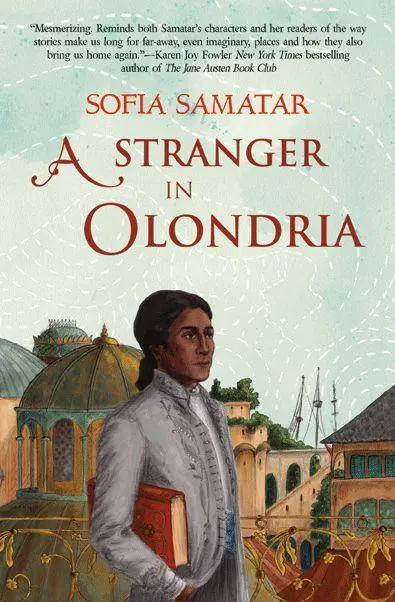
- Название:A Stranger in Olondria
- Автор:
- Жанр:
- Год:неизвестен
- ISBN:нет данных
- Рейтинг книги:5 / 5. Голосов: 1
-
Избранное:Добавить в избранное
- Отзывы:
-
Ваша оценка:
A Stranger in Olondria: краткое содержание, описание и аннотация
Предлагаем к чтению аннотацию, описание, краткое содержание или предисловие (зависит от того, что написал сам автор книги «A Stranger in Olondria»). Если вы не нашли необходимую информацию о книге — напишите в комментариях, мы постараемся отыскать её.
In desperation, Jevick seeks the aid of Olondrian priests and quickly becomes a pawn in the struggle between the empire’s two most powerful cults. Yet even as the country shimmers on the cusp of war, he must face his ghost and learn her story before he has any chance of becoming free by setting her free: an ordeal that challenges his understanding of art and life, home and exile, and the limits of that seductive necromancy, reading.
A Stranger in Olondria — читать онлайн бесплатно полную книгу (весь текст) целиком
Ниже представлен текст книги, разбитый по страницам. Система сохранения места последней прочитанной страницы, позволяет с удобством читать онлайн бесплатно книгу «A Stranger in Olondria», без необходимости каждый раз заново искать на чём Вы остановились. Поставьте закладку, и сможете в любой момент перейти на страницу, на которой закончили чтение.
Интервал:
Закладка:
The girls dragged in a wineskin, and Kovyan offered us cups of a powerful, spicy vintage called “The Wine of the White Bees.” As we drank, there came a sound of hurried commotion out in the court, and four young men rushed in with an anxious, expectant air. These were Kovyan’s sons and the sons of his sister: evidently a child had been dispatched to fetch them from the fields. They had washed hastily in the court, and their beards and long hair dripped with water that ran down to darken the shoulders of their robes. With the knives at their belts and the tin jewelry which reminded me of galley slaves, they presented a rough and even feral appearance; but all of their vigor went into making us welcome. Bows were exchanged and more chairs fetched from the recesses of the radhu . The “boys,” as Kovyan called them, made themselves comfortable on the squeaking iron beds, drinking straight from the wineskin because there were no more cups. Into this active, convivial atmosphere walked a pair of proud adolescents bearing a colossal bowl on their shoulders.
Miros, enlivened by wine, cheered and tapped his cup with his ring. He winked at me and whispered: “I told you they’d give us something!” The bearers of the bowl, a boy and girl, trembled under its weight as they lowered it to the stool in the middle of the room. Inside it steamed a splendid stew of pork, mulberries, and chestnuts. Eager children materialized from the darkness of the walls. Last of all came Kovyan’s sister, the matriarch of the household: a heavy woman with mocking eyes in a sun-weathered face.
Conversation flared in every corner of the large room, all the men, women, and children talking at once, but only Kovyan made no attempt to lower his excited voice, and so his talk rang out above that of the others. He urged us to visit Huluethu, the country estate to the north of the road, where the “young princes” enjoyed music and hunting. Huluethu was a hunter’s palace: venison smoked there every day, and the young men practiced swordplay on the flat roof. “Near the White River,” he said, and I asked him if it was the same White River mentioned in the Romance of the Valley .
“Is it in the Romance ?” he asked, wide-eyed, and the family gathered around me as I took out my book and read:
“‘ A river is there, which is paved with stars. Its surface is covered with almond blossom; it runs through the fields of my dream like a river of snow. The White River, it is called. It is upon the redness of poppy fields, upon the blueness of fields of lavender. Its water is sweet, and the nymphs who dwell in it are the friends of men. All day they sit on its banks, carding wool… ” When I looked up, Kovyan tapped his cup in approval. His sister smiled over her coffee, licking her teeth to clean away the grounds.
The light grew etiolated, worn to threads. Kovyan stood and put a match to the little oil lamp on the cabinet. Only when it was dark and stars shone faintly through the skylight did the High Priest of Avalei walk into the room. He strode in without question, without deference, pushing back his hood, his eyes shining, and the huvyalhi went to him and kissed his hands, and the life that had begun to enter my veins died out like sap in a fallen tree, and I recalled the presence of death.
The priest sat, refusing wine and stew, taking only a glass of water, a piece of cheese. His terrible, loving gaze beamed about Kovyan’s house. “Why not a tale?” he said. “We have a stranger with us, an islander. Let us give him a Valley entertainment.”
“Grandmother, Grandmother,” the children cried.
Kovyan’s sister folded her hands, her eyes amused in the light of the oil lamp. “Very well,” she said. “Since our guest admires the Romance of the Valley , I will give him a tale from it.”
She shifted, her chair creaking. She cleared her throat. A child whimpered somewhere at the back of the room and was hushed back into silence. Then the woman told her tale in a voice both throaty and smooth, like new tussore, while a cat wailed at intervals from behind the wall.
People of the House, People of the House! This tale cannot turn anyone’s blood to water.
It is told of Finya the Sorcerer that, sick with illicit love, he journeyed into Evmeni to battle the pirates of the Sea-King; for the people of the archipelago were strong in those days, and proud in their strength, and harassed our people as far as the plains of Madh. So Finya rode to the Salt Coast, where the sea is as white as milk, and the land as poor as ash, and the winds enervate the body. There he destroyed many evil men by the power of sword and magic, and won renown. And this adventure befell him during those days.
It happened that he encamped in an abandoned part of the coast; and with him were Draud, and Rovholon, and Maldar, and Keth of the Spring. When they had passed the night, Finya was the first to see the dawn, and he saw also a white dolphin which had washed up onto the sand. Beautiful was this dolphin as a pearl and well-shaped as a lily, and as it yet lived the youth went down to the shore to rescue it. But as he approached it, the sun, rising over the Duoronwei, struck the dolphin, and it disappeared as if it had been sea foam.
Now Finya was saddened by the fading of such a noble beast, and he hid what he had seen from his companions. Nevertheless, when they wished to press on he expressed the desire to camp in that place a second night: for he said that his wound pained him. At dawn he awoke, and saw the dolphin who seemed at the point of death, and rushed down the stinging sands littered with shells; and a second time the sun rose as he reached the dolphin’s side, and the creature, fixing its eye on him, dissolved into the sea.
Then Finya was saddened more than before and would not leave that place, though his companions all were eager to move on. And Draud said, “Surely the wound of the sorcerer is healed; can it be cowardice that holds him back?” Then Rovholon and Maldar and Keth feared that their fellowship would be split, and that Finya would challenge Draud for the insult; but Finya said only: “The payment shall be deferred, Son of the Horse.” And they camped a third night in that place, in great unease.
But Finya had resolved not to sleep, and he went down to the empty shore and knelt in the place where he had seen the dolphin. All night he watched, and as the sky grew pale the beast washed up on the shore, and Finya grasped hold of it in mighty joy. Then the dolphin spoke to him, saying: “What have I done to you, Child of Woman, that you repay me with such a grave insult?” And Finya asked: “Pray, where is the insult? I saw your noble beauty and wished to save you from perishing with the light.” “Is it no insult then,” said the dolphin, “to seize a king’s daughter?” “Forgive me,” said Finya, “I acted in ignorance.” “Nevertheless,” said the dolphin, “you shall repay me.” “Willingly,” said the youth. “Since you have touched,” said the dolphin, “do not let go.”
Then the dolphin dove into the waves and swam toward the west, and Finya clung to it about the neck. It swam until they reached a beautiful city on a rock, which the sorcerer had never seen nor heard of. Glorious was that city; it covered all of that island of rock, and it was full of good wells, palaces, and gardens, but it was silent: not a soul came out from among its walls, and the chains of the abandoned wells moaned sadly in the wind. “Go up,” said the dolphin, “and pass into the central palace. There you shall find a great hall of stone, in the floor of which there is a small hole plugged with a stopper of vine leaves. Pull out this stopper and see what you shall find.”
“Willingly,” said the youth and clambered from the dolphin’s back onto the white steps which led up toward the city. And she stayed in the water, balancing on her tail, and watched him. So many a hero has gone forth into grief.
Читать дальшеИнтервал:
Закладка:
Похожие книги на «A Stranger in Olondria»
Представляем Вашему вниманию похожие книги на «A Stranger in Olondria» списком для выбора. Мы отобрали схожую по названию и смыслу литературу в надежде предоставить читателям больше вариантов отыскать новые, интересные, ещё непрочитанные произведения.









Обсуждение, отзывы о книге «A Stranger in Olondria» и просто собственные мнения читателей. Оставьте ваши комментарии, напишите, что Вы думаете о произведении, его смысле или главных героях. Укажите что конкретно понравилось, а что нет, и почему Вы так считаете.