Sofia Samatar - A Stranger in Olondria
Здесь есть возможность читать онлайн «Sofia Samatar - A Stranger in Olondria» весь текст электронной книги совершенно бесплатно (целиком полную версию без сокращений). В некоторых случаях можно слушать аудио, скачать через торрент в формате fb2 и присутствует краткое содержание. Жанр: Фэнтези, на английском языке. Описание произведения, (предисловие) а так же отзывы посетителей доступны на портале библиотеки ЛибКат.
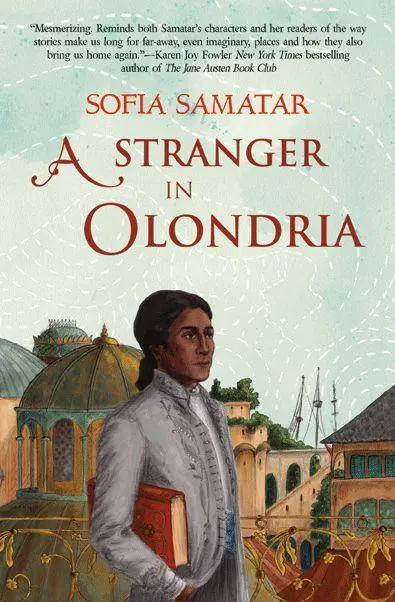
- Название:A Stranger in Olondria
- Автор:
- Жанр:
- Год:неизвестен
- ISBN:нет данных
- Рейтинг книги:5 / 5. Голосов: 1
-
Избранное:Добавить в избранное
- Отзывы:
-
Ваша оценка:
A Stranger in Olondria: краткое содержание, описание и аннотация
Предлагаем к чтению аннотацию, описание, краткое содержание или предисловие (зависит от того, что написал сам автор книги «A Stranger in Olondria»). Если вы не нашли необходимую информацию о книге — напишите в комментариях, мы постараемся отыскать её.
In desperation, Jevick seeks the aid of Olondrian priests and quickly becomes a pawn in the struggle between the empire’s two most powerful cults. Yet even as the country shimmers on the cusp of war, he must face his ghost and learn her story before he has any chance of becoming free by setting her free: an ordeal that challenges his understanding of art and life, home and exile, and the limits of that seductive necromancy, reading.
A Stranger in Olondria — читать онлайн бесплатно полную книгу (весь текст) целиком
Ниже представлен текст книги, разбитый по страницам. Система сохранения места последней прочитанной страницы, позволяет с удобством читать онлайн бесплатно книгу «A Stranger in Olondria», без необходимости каждый раз заново искать на чём Вы остановились. Поставьте закладку, и сможете в любой момент перейти на страницу, на которой закончили чтение.
Интервал:
Закладка:
Finya, wild with grief, ran down the white steps to the sea. “Who art thou?” he cried. “Who art thou?”
“Alas,” said she, “I am the ninth wonder of the City of Nine Wonders.”
And she swam with her children out to sea, and was lost.
An owl gave a low, flute-like call from somewhere in the garden. For a moment I thought the High Priest was looking at me, but the light of the oil lamp writhed like a sea worm, casting wayward shadows, and his pensive gaze was impossible to trace. Miros and the others applauded, congratulating Kovyan’s sister, exchanging remarks on the poignancy of the tale. Auram leaned and clasped my arm. “From memory!” he hissed in triumph. “All that from memory. She cannot read a word.”
I rose, pleading exhaustion, and one of the young men led me into a dark bedchamber. The only light seeped in from the other room. Don’t worry, I told myself. Only survive, survive until they bring the body to you and it crumbles on the fire. Flames grew in my mind, great bonfires, suns. The young man slapped the bed, checking it for stability or snakes. He left me, and as I sat down and pulled off my boots I heard the priest’s voice clearly from the other room: “Yes, a Night Market.”
A Night Market. I lay down and covered myself with the coarse blanket. The others talked late into the night, exchanging laughter. In the morning a watery sun showed me the scrubbed walls of the room patterned with shadows by the ivy over the window. Once again the angel had not come. A painting of the goddess Elueth regarded me from one wall, kneeling, her arms about a white calf. The expression on her dusky face was sad, and underneath her ran the legend: “ For I have loved thee without respite .”
Chapter Fourteen
The Night Market
The next day we traveled farther into the Valley. And a message ran out from Kovyan’s radhu in every direction, announcing the Night Market. It would be held outside the village of Nuillen, almost on the eastern edge of the Fayaleith. The news traveled to Terbris, Hanauri, Livallo, Narhavlin, tiny villages in the shadow of towers overgrown with moss. We followed in a carriage, jouncing along the graveled roads. Miros drove, and I sat beside him on the coachman’s seat. Sometimes we stopped by the roadside and drank milk from heavy clay bowls, waving our hands to drive away flies in the shade of a chestnut tree, and the young girls who sold milk spoke to us with the glottal accent of the country, clicking their tongues when Miros teased them. They urged us to buy their pots of honey and curd, or strings of dried fish. One of them tried to sell us the skin of an otter. They had lively eyes and raggedly braided hair, always in four plaits, sometimes with tin or glass beads at the tips.
At the crest of a hill, we passed beneath the famous arch of Vanadias, the great architect of the Tombs of Hadfa. The pink stone glowed against the sky, carved with images of the harvest, of dancers, children, and animals entwined with bristling leaves. The intricacy of the carving filled me with awe and a kind of heartache, such as one feels in the presence of mystery. In the center of the arch were the proud words “ This Happy Land ,” and beyond it the very shadows seemed impregnated with radiance.
At night those shadows were deep and blue, the radhui immense and silent, and the whole world had the quality of an engraving. The carriage trundled past temples and country villas, their white shapes standing out against the darkness, each one spellbound, arrested in torrents of light. A healing light, cool as dew. We passed the famous palace of Feilinhu, standing in nacreous grandeur against the dark lace of its woods: that triumph of Vanadias with its roof of astounding lightness, its molded, tapering pillars of white marble. Miros stopped the horses and swore gently under his breath. The palace, nocturnal, resplendent, stood among palisades of moonlight. Even the crickets were silent. Miros’s voice seemed to rend the air as he spoke the immortal first line of Tamundein’s poem:
“Weil, weil tovo manyi falaren, falarenre Feilinhu.”
Far, far on the hills now are the summers of Feilinhu,
the winds calling, the blue horses,
the balconies of the sky.
Far now are the horses of smoke:
the rain goes chasing them.
Oh my love,
if you would place on one leaf of this book
your kiss.
We watch the lightning over the hills
and imagine it is a city,
and the others dream of its lighted halls
smoking with wild cypress.
Feilinhu, they say,
and they weep.
And I weep with them, love, banquet,
sea of catalpas,
lamp I saw only in a mirror.
The moon is escaping over the land
and only the hills are alight.
There, only there can one be reminded of Feilinhu.
Where we saw the stars broken under the fountain
and saddled the horses of dawn.
And you, empress of sighs:
with your foot on the dark stair.
And she, my empress of sighs. Where was she waiting now with her ravaged hair, her deathless eyes, her perfect desolation? Waiting for me. I knew she was waiting, because she did not come. My nights were silent, but too taut to be called peaceful. Jissavet waited just beyond the dark. The night sky was distended in my dreams, sinking to earth with the weight of destructive glory behind it. In one of those dreams I reached up and touched it gently with a fingertip, and it burst like a yolk, releasing a deluge of light.
People traveled together in little groups along the roadsides, talking and laughing softly, on their way to the Night Market. There was no sign of the Telkan’s Guard. I blessed Tialon privately: she must be doing all she could to keep me safe. Fireflies spangled the grass, and a festival air filled the countryside, as if the whole Valley were stirring, coming to life. At the inn in the village of Nuillen, in the old bedrooms divided with screens, the sheets held a coolness as if they had just been brought in from the fields.
We spent two days in Nuillien. During that time the inn filled up until, the landlord told us panting, people were sleeping under the tables. From the window of my room I could see little fires scattered over the square at night, where peasant families slept wrapped in their shawls. On the evening of the Market, music burst out suddenly in the streets, the rattling of drums and the shouting of merry songs, and Auram came into my room bearing a white robe over his arm, his eyes alight. “Come, avneanyi ,” he said. “It’s time.”
He was splendidly dressed in a surcoat embroidered in gold, its ornamental stiffness softened by the fluid lace at his wrists. Above the glow of the coat, rich bronze in the firelight, the flat white triangle of his face floated, crowned with dead-black hair. He looked at me with delight, as if I were something he had created himself: a beautiful portrait or gem-encrusted ring. His exaltation left no room for the human. I saw in his shining, ecstatic, ruthless eyes that he would not be moved no matter how I suffered.
“Come,” he said with a little laugh that drove a chill into my heart. “You must dress.” I undressed in silence and put on the robe he had brought for me. The silk whispered over my body, smooth and cold like a river of milk. Afterward he made me sit down and tied my hair back with a silver thread.
The mirror reflected the firelight and my face like a burnt arrow. Under the window a voice sang: “ Gallop, my little black mare .”
“Have you been studying?” Auram asked.
“Yes.”
“Have you committed it to memory?”
“Yes.”
My glance strayed to the ragged little book on the table. The Handbook of Mercies , by Leiya Tevorova. Auram had brought it to me wrapped in old silks the color of a fallen tooth. “One of the few copies we were able to save,” he said, and he pressed it into my hands and urged me to memorize the opening pages. This was the book Leiya had written in Aleilin, in the tower where she was locked away, in the days Auram called the Era of Misfortune. A handbook for the haunted. I turned away from it and met Auram’s eyes in the glass.
Читать дальшеИнтервал:
Закладка:
Похожие книги на «A Stranger in Olondria»
Представляем Вашему вниманию похожие книги на «A Stranger in Olondria» списком для выбора. Мы отобрали схожую по названию и смыслу литературу в надежде предоставить читателям больше вариантов отыскать новые, интересные, ещё непрочитанные произведения.





Обсуждение, отзывы о книге «A Stranger in Olondria» и просто собственные мнения читателей. Оставьте ваши комментарии, напишите, что Вы думаете о произведении, его смысле или главных героях. Укажите что конкретно понравилось, а что нет, и почему Вы так считаете.