Sofia Samatar - A Stranger in Olondria
Здесь есть возможность читать онлайн «Sofia Samatar - A Stranger in Olondria» весь текст электронной книги совершенно бесплатно (целиком полную версию без сокращений). В некоторых случаях можно слушать аудио, скачать через торрент в формате fb2 и присутствует краткое содержание. Жанр: Фэнтези, на английском языке. Описание произведения, (предисловие) а так же отзывы посетителей доступны на портале библиотеки ЛибКат.
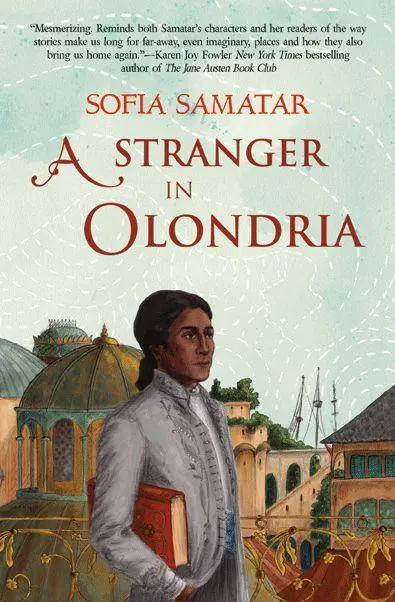
- Название:A Stranger in Olondria
- Автор:
- Жанр:
- Год:неизвестен
- ISBN:нет данных
- Рейтинг книги:5 / 5. Голосов: 1
-
Избранное:Добавить в избранное
- Отзывы:
-
Ваша оценка:
A Stranger in Olondria: краткое содержание, описание и аннотация
Предлагаем к чтению аннотацию, описание, краткое содержание или предисловие (зависит от того, что написал сам автор книги «A Stranger in Olondria»). Если вы не нашли необходимую информацию о книге — напишите в комментариях, мы постараемся отыскать её.
In desperation, Jevick seeks the aid of Olondrian priests and quickly becomes a pawn in the struggle between the empire’s two most powerful cults. Yet even as the country shimmers on the cusp of war, he must face his ghost and learn her story before he has any chance of becoming free by setting her free: an ordeal that challenges his understanding of art and life, home and exile, and the limits of that seductive necromancy, reading.
A Stranger in Olondria — читать онлайн бесплатно полную книгу (весь текст) целиком
Ниже представлен текст книги, разбитый по страницам. Система сохранения места последней прочитанной страницы, позволяет с удобством читать онлайн бесплатно книгу «A Stranger in Olondria», без необходимости каждый раз заново искать на чём Вы остановились. Поставьте закладку, и сможете в любой момент перейти на страницу, на которой закончили чтение.
Интервал:
Закладка:
I see him with the sweat on his brow which has turned the color of tallow and imagine how he will flee to the ends of the earth, putting the fathomless sea between himself and this sweet, incautious girl, interring himself in a country of alien flowers. And never, not even in the delirium of his island fevers, will he allow himself to pronounce the lost child’s name. And as for her, she will say his name only in solitude, hugging herself in her small bed, her tears shining in the moonlight.
Tonight the house is quiet. The old nurse sits by the hearth, muttering to herself, half-asleep. The young girl is collecting their soiled plates from the table and carrying them away to the dark kitchen. Suddenly she looks outside. The balcony doors are open, the night soft and humming with the insects of summer. Then there is her startled cry, and the crash of a plate on the floor. She has noticed the disappearance of the stars.
Midnight. The door creaked open and I was instantly awake, fearing as always the witchlight of the ghost. But there was only the dull glow of a lantern, and a hand like an iron scepter prodding me urgently in the neck. “Rise. Rise.” It was Auram, High Priest of Avalei, cloaked and hooded. His sleeve was damp and carried an odor of salt. He had already crept down to the shore where a boat rocked on the waves, hushed and lightless, awaiting its cargo: a fugitive saint.
Book Four
The Breath of Angels
Chapter Thirteen
Into the Valley
The boat slid swiftly through water and night to Ethendria, a city named for the “Lovely Palace” overlooking the sea. We arrived too early to land without drawing undue attention, and dropped anchor within sight of the city’s lights to await the dawn. The air was cold, the sea restless; the boat danced at the end of her tether like a foal. I breathed in great gulps of salt and darkness, and remembered buying a ticket to Ethendria long ago, in Bain. The memory lightened my heart: I was moving eastward at last, toward the angel’s body. My path was a knot, full of loops and barriers, but freedom lay at the end of it, I was sure. As if to confirm my choice, the angel had withdrawn. She was not far off—I felt her in my heart like a grain of poison—but she had not torn my nights apart since we had spoken in the Girdle of Avalei.
Auram appeared at my shoulder; the spark of my new confidence wavered and grew dim. “ Avneanyi ,” he said.
“I told you not to call me that.”
“Why not? It is what you are. But never mind now,” he went on smoothly, his voice smiling, his face a hollow in his cloak. The starlight caught his teeth.
“Tell me: are you well?” he asked.
“Yes.”
“Excellent, excellent! You have a formidable constitution; or, like me, you are a cricket.”
“A cricket, veimaro ?”
“A midnight creature; the foxes’ bard. All night he makes music, but by day he is oh! so tired!”
His hood tilted to one side; he might have been resting his cheek on his hand. I smiled without pleasure, thinking that he was extraordinarily like a cricket: his liveliness and neatness, his black eyes, the extreme fineness of his limbs, even the chirring of his voice.
“As it happens, I prefer the day,” I said.
“A pity. But you may change your mind before long—the night belongs to Avalei.”
“The night, perhaps. But not me.”
“Come, avneanyi .” A soft note of warning crept into his voice. “We must be friends if we are to succeed.”
He put his hand on my arm, each finger precise and delicate as a physician’s lance. His breath smelled faintly of rotting strawberries. “We shall travel light and swiftly. I have but a single trunk, and Miros, my nephew and valet, has been ordered to leave it behind if we are pursued.”
I recognized the name of the careless, engaging young man who had first brought me out of the Houses.
“Miros is here?”
“Yes, but it doesn’t matter. Listen. We’ll avoid inns where we can, at least until the village of Nuillen, at the eastern edge of the Valley, where we shall hold the Market. Is this clear?”
“Yes.”
“It may not keep the Telkan’s Guard from us. We are a rather conspicuous party—at least, you and I are easily marked. I say this without either humility or conceit, without wishing to flatter or condemn you. We must prepare to face dangers. We must expect to be found.”
The boat swayed under me, treacherous.
“What about your lady’s friends? What about her power? You said it would be easy.”
“And no doubt it will, it will,” he soothed me, stroking my arm, the edges of his nails catching in the embroidered jacket he’d given me.
I pulled my arm away. “Speak plainly. Will we be found or not?”
“I cast no bones,” he said, laughing. “The Oracle God has no reason to love me. I say that it will be easy, because I believe it. And I say we must expect to be found, because I believe this also.”
The sky had grown subtly lighter while we spoke; his hood was black against it. His hands showed white when he moved to fold his arms.
“And what happens if we are found?” I asked sharply.
“For you: the Gray Houses. Indefinitely. For me…”
He shrugged, his bright laughter a string of pearls. “I fear no dark place.”
Before dawn was full Auram disappeared under the deck, and like day trading places with night, Miros came up yawning and rubbing his eyes. He smiled when he saw me. “Good morning, avneanyi ,” he said, awkward with the word, rubbing his hands on the sides of his plain linen tunic.
“Please call me by name.”
“Much better!” he said, visibly relieved. “What was it? Shevas?”
I laughed in spite of myself— shevas is Olondrian for “turnip.”
“Jevick of Tyom.”
“Right! I’ll leave your place name alone, if you don’t mind—too fine a note for my heavy tongue. But Jevick will do very well.”
He pronounced it “Shevick,” as my master had—as all Olondrians did, save Tialon, who had a musician’s ear. He took my arm and pulled me out of the way of the turning sail, and we leaned on the rails at the edge of the boat together and watched the city take shape. Miros did not resemble his uncle: where the priest was pale and black-haired, Miros had the brown curls and golden skin of the Laths, the people of the Valley. He had only recently joined his uncle’s service—to escape some trouble, I understood from his evasions and nervous fumbling with the pearl in his earlobe.
“I don’t know a thing about being a valet,” he added gloomily. “I only hope we get some hunting in the highlands. If I were home I could hunt in the Kelevain with my other uncles… But it’s my own fault. It’s always a mistake to leave one’s home.”
Recalling my own situation, he stammered: “I mean for me, for people like me, uneducated, suited for nothing but idleness…”
I laughed and told him he was right. “I ought to have stayed home myself,” I said. At the end of the sentence sorrow clenched my throat.
After a moment I managed: “But you’re with your uncle the priest, at any rate. You must admire him.”
Miros stared at me, half laughing and half aghast. He glanced about him, then bent to my ear and said in a heightened, roguish whisper like that of a stage villain: “Admire him! I hate him like the cramp.”
“Evmeni is Evmeni, Kestenya is Kestenya: but the Valley is Olondria.” Thus wrote Firdred of Bain, of the Fayaleith, or “Valley”; and his words seemed to breathe in the air that rushed to meet us at the whitewashed steps of the town. My skin tingled at its touch; my spirits rose. It was too great an effort to be unhappy that transparent morning, thrust from the Gray Houses into Ethendria, a town poised between the Valley and the sea, devoted to the manufacture of sweets, where the very plaster gives off a fragrance of almond paste. Miros dashed off to hire a carriage, leaving me under a tamarind tree with the priest, who sat silent on his traveling trunk with his hood pulled down to his lips; apparently unmoved by the glorious morning, he got into the carriage as soon as Miros returned, and closed the door with a bang.
Читать дальшеИнтервал:
Закладка:
Похожие книги на «A Stranger in Olondria»
Представляем Вашему вниманию похожие книги на «A Stranger in Olondria» списком для выбора. Мы отобрали схожую по названию и смыслу литературу в надежде предоставить читателям больше вариантов отыскать новые, интересные, ещё непрочитанные произведения.







Обсуждение, отзывы о книге «A Stranger in Olondria» и просто собственные мнения читателей. Оставьте ваши комментарии, напишите, что Вы думаете о произведении, его смысле или главных героях. Укажите что конкретно понравилось, а что нет, и почему Вы так считаете.