Sofia Samatar - A Stranger in Olondria
Здесь есть возможность читать онлайн «Sofia Samatar - A Stranger in Olondria» весь текст электронной книги совершенно бесплатно (целиком полную версию без сокращений). В некоторых случаях можно слушать аудио, скачать через торрент в формате fb2 и присутствует краткое содержание. Жанр: Фэнтези, на английском языке. Описание произведения, (предисловие) а так же отзывы посетителей доступны на портале библиотеки ЛибКат.
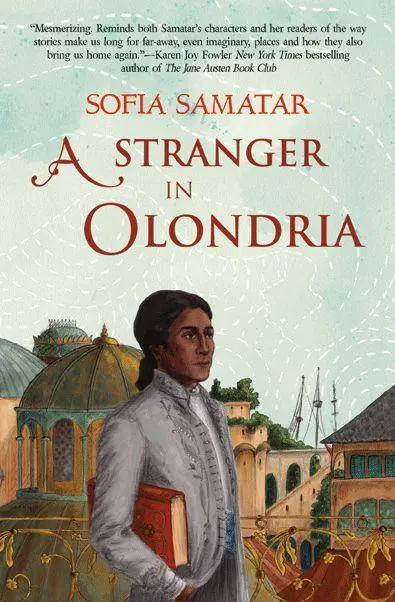
- Название:A Stranger in Olondria
- Автор:
- Жанр:
- Год:неизвестен
- ISBN:нет данных
- Рейтинг книги:5 / 5. Голосов: 1
-
Избранное:Добавить в избранное
- Отзывы:
-
Ваша оценка:
A Stranger in Olondria: краткое содержание, описание и аннотация
Предлагаем к чтению аннотацию, описание, краткое содержание или предисловие (зависит от того, что написал сам автор книги «A Stranger in Olondria»). Если вы не нашли необходимую информацию о книге — напишите в комментариях, мы постараемся отыскать её.
In desperation, Jevick seeks the aid of Olondrian priests and quickly becomes a pawn in the struggle between the empire’s two most powerful cults. Yet even as the country shimmers on the cusp of war, he must face his ghost and learn her story before he has any chance of becoming free by setting her free: an ordeal that challenges his understanding of art and life, home and exile, and the limits of that seductive necromancy, reading.
A Stranger in Olondria — читать онлайн бесплатно полную книгу (весь текст) целиком
Ниже представлен текст книги, разбитый по страницам. Система сохранения места последней прочитанной страницы, позволяет с удобством читать онлайн бесплатно книгу «A Stranger in Olondria», без необходимости каждый раз заново искать на чём Вы остановились. Поставьте закладку, и сможете в любой момент перейти на страницу, на которой закончили чтение.
Интервал:
Закладка:
“ And wilt thou never return? ” she says, entreating me with her eyes, stretching out her hands, which shine darkly in the torchlight. “ Nay, say the snows; for the earth which spills the delights of her lap for thee is but a shade unto thy love, and the shadow of a closed door. Could my love not keep thee, Anavyalhi, body of water… the way of the sword, or the path of the deadly unguents. …”
In a moment of pure lucidity I know that the liquid I have drunk is affecting my mind. Everything is clear in that moment. My vision is sharpened: I see the small hairs in the rigid mask of a priest, imagine how the hide would feel, hard and buckled, dried fruit. I see the bodies under the dark red dresses of the girls, secretive bodies, the ribs shuddering as they jangle their bells. I see more than it is given to the human eye to see, the sweat on their stomachs, their fear of the dark cistern, their fear of the dark. I see them washing their faces, becoming childish, pink, defenseless, crawling into their beds and speaking in code by touching fingers, passing gossip down the long row of beds, these girls called Feilar, Kialin, Kerelis, these young girls far from home. I can count the glimmering beryls scattered across the robe of the priestess, like copses in a field of tawny wheat. I think I can even catch the scent of them: they smell of mint. But the chalcedony smells like the bark of trees. I see her, Taimorya, the Queen of the Witches. I know that every night she eats a plate of snails, for eloquence. I see her sitting up by the lamp, painting a china apple. The prince is asleep in the shadow of her bed.
Then, as suddenly as it arrived, this clarity vanishes. My mouth goes slack; it is hard to keep my eyes from fluttering closed. The monotonous music, which never flags, which is now like a great company on horseback jingling and pounding through a gap between mountains, confuses me like a mist. It is the dust raised by the hooves. And far away, the echo of falling stones. I see the high priestess: only her face, beautiful, heartless, exalted. Her long black eyes reflecting the sparks of the torches. “My love,” she says. Her voice is deep inside my ear, so deep that I do not know if it is she who has spoken or I.
“Where are you?”
Now I am sure that I am the one who has spoken. But it is also she; I feel her speaking through me. I struggle weakly against her, suddenly terrified, trying to rise, lifting my heavy eyelids to see the dove’s body on the altar. I fight against the darkness but only think to myself, stupidly: They have put something on the torches. The smoke is strange… Then it becomes too easy to sink, to abandon myself to oblivion. The slide to the bottom is effortless, enchanting. There, at the bottom, I see unimagined valleys of white fish. There are deserts too, dotted with blackened rose trees.
“Where are you?” I ask, or the priestess asks with my voice. “Why don’t you come to me? Can’t you hear me? I’ve been looking for you for so long. I’m lost…”
Silence. A ripple of water which might be, far away, the bells of the girls in the cave.
Then I see her. And for the first time and the last, I know that I am seeing her when she is alone, before she knows I am there. She walks uncertainly, sometimes pausing as though she has dropped something. She is far away, and her progress is very slow. She wears the same short, colorless shift, and her hair lies on her thin shoulders. She turns her head, bewildered, filling me with the desire to weep.
“I’m here,” I say.
She looks up sharply and sees me. Her gaze burns. In the air, the insistent ringing, like flashes of light. “Jevick,” she says.
“Yes.”
She comes close to me, almost blinding me with her ocean of light, making me cry out, my eyes on fire; then she grows dim and looks at me anxiously and hungrily through the whirling cloud. “Jevick, you’re here. You’ve come to find me…”
“Yes,” I whisper.
She frowns. “But you’re strange. There are two of you.”
“Yes. I have asked the aid of a northern priestess. Together we have come to find what it is that you desire. We have—I have done this for love of you—”
A blaze of scorn makes me scream again. My eyes are bleeding. “You do not love me,” the angel says.
“Forgive me. It was the love which all of the living must have, for those who come from beyond the narrow grave, of which I spoke.”
“Beyond the grave,” the angel says. “That is northern talk.”
“Yes,” I whisper. I feel the words echo inside me. I am listening, and speaking, in two languages at once, translating. The mouth and ears of the Priestess of Avalei.
“Very well,” says the angel. She looks at me in bitter disdain, and I grovel, writhing before the flame of her face. “This boy is weak,” she says contemptuously. “He will not last long. You have asked what I desire, and I will tell you.” She pauses, her indrawn breath a conflagration. Then she says: “Write me a vallon . Put my voice inside it. Let me live.”
She draws close to me. “Write me a vallon , Jevick. Like what you read to me on the ship that day. You said they last forever.”
Her voice is suddenly fragmented, broken with tears. She weeps like one who is dying of grief, and yet she cannot die; she weeps like one who has lost her dearest possession, her only love. “Jevick, my mother left me alone. Do you hear me? They buried me there, in the north. She was weak. She let them put me into the earth. In the graveyard—faugh!—in the huge graveyard on the hill. She let them put me there, to have my bones sink into the earth, and—oh, Jevick! I am one of the Rotted Dead.”
Her face is transformed by the horror she feels—the horror that grips us both. In its clutches and for one moment she looks devastatingly human. Her face is close to mine, the eyes wide, the mouth aghast. I think I can see the pores in her skin, the beads of sweat, the terror… But of course it is an illusion, a wraith: her body is underground, sinking and putrefying, her youth and beauty mere bubbles of gas. As if she has read my thought, she shrieks, begins to wail, whipping her red hair to and fro, in mourning for herself.
“Jissavet,” she cries. “Jissavet.”
The priestess plucks the translation from my mind. Island of the White Flowers.
But I am falling now. I cannot speak for her, to answer the foolish question: “Yes, angel? What do you mean?” I know what she means, I think to myself, and the priestess does not hear me because I am already too far away, my body shivering, slick with sweat, riding the river of pain which bears me away to a new depth where I will not hear the grief-maddened shrieking of the angel. It is as if she moves away from me, weeping over the valleys. “Jissavet, Jissavet.” Then silence. Then I know nothing, until I wake again in the holy cave and see the face of Auram bending over me.
“Don’t sit up,” he said. I looked up at him, at the thick locks of his hair in disarray against the craggy ceiling. His face was shadowed, but I could see that it did not have its usual chalky pallor: the skin was mottled, tense, excited. There was a sour odor: I guessed it came from his short leather skirt. An odor of ancient cabinets, ancient sweat. His mask was slung around his neck, and it looked at me too, leering downward, its hide in the torchlight criss-crossed with fine wrinkles.
“Brave one!” he said ecstatically. He caressed my hair; his palm was damp and heavily scented with musk. I lay motionless on the bare floor of the cave, close to his crossed legs, his plucked-looking, almost hairless shins, the brief flap of his skirt. Voices resounded in the air, the murmuring of the girls, and huge shadows moved to and fro on the walls. “ Avneanyi, ” Auram whispered. His fingernail snagged my skin as he traced a circle on my brow with his index finger.
Читать дальшеИнтервал:
Закладка:
Похожие книги на «A Stranger in Olondria»
Представляем Вашему вниманию похожие книги на «A Stranger in Olondria» списком для выбора. Мы отобрали схожую по названию и смыслу литературу в надежде предоставить читателям больше вариантов отыскать новые, интересные, ещё непрочитанные произведения.








Обсуждение, отзывы о книге «A Stranger in Olondria» и просто собственные мнения читателей. Оставьте ваши комментарии, напишите, что Вы думаете о произведении, его смысле или главных героях. Укажите что конкретно понравилось, а что нет, и почему Вы так считаете.