Algis Budrys - Who?
Здесь есть возможность читать онлайн «Algis Budrys - Who?» весь текст электронной книги совершенно бесплатно (целиком полную версию без сокращений). В некоторых случаях можно слушать аудио, скачать через торрент в формате fb2 и присутствует краткое содержание. Год выпуска: 1958, Издательство: Pyramid Books, Жанр: Фантастика и фэнтези, на английском языке. Описание произведения, (предисловие) а так же отзывы посетителей доступны на портале библиотеки ЛибКат.
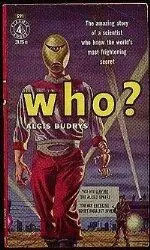
- Название:Who?
- Автор:
- Издательство:Pyramid Books
- Жанр:
- Год:1958
- ISBN:нет данных
- Рейтинг книги:4 / 5. Голосов: 1
-
Избранное:Добавить в избранное
- Отзывы:
-
Ваша оценка:
Who?: краткое содержание, описание и аннотация
Предлагаем к чтению аннотацию, описание, краткое содержание или предисловие (зависит от того, что написал сам автор книги «Who?»). Если вы не нашли необходимую информацию о книге — напишите в комментариях, мы постараемся отыскать её.
Nominated for Hugo Award for Best Novel in 1958.
Who? — читать онлайн бесплатно полную книгу (весь текст) целиком
Ниже представлен текст книги, разбитый по страницам. Система сохранения места последней прочитанной страницы, позволяет с удобством читать онлайн бесплатно книгу «Who?», без необходимости каждый раз заново искать на чём Вы остановились. Поставьте закладку, и сможете в любой момент перейти на страницу, на которой закончили чтение.
Интервал:
Закладка:
“Jesus, Jesus, Jesus!” Finchley muttered urgently, “He’ll kill himself.”
The driver jammed speed into the car, flinging them over the truck-broken street. The man was already well past the next corner. Now he turned his head back for an instant and saw them. He threw himself forward even faster, came to a cross street, and flailed around the corner, running toward Sixth Avenue now.
“That’s a one-way street against us!” the driver yelled.
“Take it anyway, you idiot!” Finchley shouted back, and the car plunged west with the driver working frantically at the wheel. “Now, catch him!” Finchley raged. “We can’t let him run to death!”
The street was lined with cars parked at the crowded curbs. The clear space was just wide enough for a single car to squeeze through, and somewhere a few blocks ahead of them another set of headlights was coming toward them, growing closer.
The man was running desperately now. As the car began to catch him, Rogers could see his head turning from side to side, looking for some narrow alleyway between buildings, or some escape of any kind.
When they pulled even with him, Finchley cranked his window down. “Martino! Stop! It’s all right. Stop!”
The man turned his head, looked, and suddenly reversed his stride, squeezing between two parked cars with a rip of his coat and running across the street behind them.
The driver locked his brakes and threw the gear lever into reverse. The transmission broke up, but it held the driveshaft rigid. The car slid on motionless wheels, leaving a plume of smoke upon the street, the tires bursting into flame. Rogers’ face snapped forward into the seat back, and his teeth clicked together. Finchley tore his door open and jumped out.
“Martino!”
The man had reached the opposite sidewalk. Still running west, he did not stop or look behind. Finchley began to run along the street.
As Rogers cleared the doorway on his side, he saw the oncoming car just on the other side of the next street, no more than sixty feet away.
“Finch! Get off the street!”
Their man had reached the corner. Finchley was almost there, still in the street, not daring to waste time and fight his way between the bumper-to-bumper parked cars.
“Martino! Stop! You can’t keep it up — Martino-you’ll die!”
The oncoming car saw them and twisted frantically into the cross street. But another car came around the corner from MacDougal and caught Finchley with its pointed fender. It spun him violently away, his chest already crumpled, and threw him against the side of a parked car.
For one second, everything stopped. The car with the crushed fender stood rocking at the mouth of the street. Rogers kept one hand on the side of the FBI car, the stench of burnt rubber swirling around him.
Then Rogers heard the man, far down a street, still running, and wondered if the man had really understood anything he’d heard since the girl screamed at him.
“Call in,” he snapped to the FBI driver. “Tell your headquarters to get in touch with my people. Tell them which way he’s going, and to pick up the tail on him.” Then he ran across the street to Finchley, who was dead.
7
The hotel on Bleecker Street had a desk on the ground floor and narrow stairs going up to the rooms. The entrance was a narrow doorway between two stores. The clerk sat behind his desk, his chair tipped back against the stairs, and sleepily drooped his chin on his chest. He was an old, worn-out man with gray stubble on his face, and he was waiting for morning so he could go to bed.
The front door opened. The clerk did not look up. If somebody wanted a room, they’d come to him. When he heard the shuffling footsteps come to a stop in front of him, he opened his eyes.
The clerk was used to seeing cripples. The rooms upstairs were full of one kind or another. And the clerk was used to seeing new things all the time. When he was younger, he’d followed things in the paper. It had been no surprise to him when the Third Avenue El was torn down, or cars came out with four headlights. But now that he was older, things just drifted by him. So he never was surprised at anything he hadn’t seen before. If doctors were putting metal heads on people, it wasn’t much different from the aluminum artificial legs that often stumped up and down the stairs behind him.
The man in front of the desk was trying to talk to him. But for a long while, the only sound he made was a series of long, hollow, sucking sounds as air rushed into his mouth. He held onto the front edge of the desk for a moment. He touched the left side of his chest. Finally he said, laboring over the words, “How much for a room?”
“Five bucks,” the clerk said, reaching behind him for a key. “Cash in advance.”
The man fumbled with a wallet, took out a bill, and dropped it on the desk. He did not look directly at the clerk, and seemed to be trying to hide his face.
“Room number’s on the key,” the clerk said, putting the money in the slot of a steel box bolted through the floor.
The man nodded quickly. “All right.” He gestured self-consciously toward his face. “I had an accident,” he said. “An industrial accident. An explosion.”
“Buddy,” the clerk said, “I don’t give a damn. No drinking in your room and be out by eight o’clock, or it’s another five bucks.”
8
It was almost nine o’clock in the morning. Rogers sat in his cold, blank office, listening to the telephone ring. After a time, he picked it up.
“Rogers.”
“This is Avery, sir. The subject is still in the hotel on Bleecker. He came down a little before eight, paid another day’s rent, and went back to his room.”
“Thank you. Stay on it.”
He pushed the receiver back on the cradle and bent until his face was almost touching the desk. He clasped his hands behind his neck.
The interoffice buzzer made him straighten up again. He moved the switch over. “Yes?”
“We have Miss DiFillipo here, sir.”
“Would you send her in, please.”
He waited until the girl came in, and then let his hand fall away from the switch. “Come in, please. Here’s — here’s a chair for you.”
Angela DiFillipo was an attractive young brunette, a trifle on the thin side. Rogers judged her to be about eighteen. She came in confidently, and sat down without any trace of nervousness. Rogers imagined that in ordinary circumstances, she was a calm, self-assured type, largely lacking in the little guilts that made even the most harmless people turn a bit nervous in this building.
“I’m Shawn Rogers,” he said, putting on a smile and holding out his hand.
She shook it firmly, almost mannishly, and smiled back without giving him the feeling that she was trying to make an impression on him. “Hello.”
“I know you have to get to work, so I won’t keep you here long.” He turned the recorder on. “I’d just like to ask you a few questions about last night.”
“I’ll be glad to help out.”
“Thank you. Now — your name is Angela DiFillipo, and you live at thirty-three MacDougal Street, here in New York, is that right?”
“Yes.”
“Last night — that would be the twelfth — at about ten-thirty p.m., you were at the corner of MacDougal and an alley between Bleecker and Houston Streets. Is that correct?”
“Yes.”
“Would you tell me how you got there and what happened?”
“Well, I’d just left the house to go to the delicatessen for some milk. The alley’s right next to the door. I didn’t particularly notice anybody, but I did know somebody was coming up MacDougal, because I could hear his footsteps.”
“Coming toward Bleecker? On the west side of the street?”
Читать дальшеИнтервал:
Закладка:
Похожие книги на «Who?»
Представляем Вашему вниманию похожие книги на «Who?» списком для выбора. Мы отобрали схожую по названию и смыслу литературу в надежде предоставить читателям больше вариантов отыскать новые, интересные, ещё непрочитанные произведения.






Обсуждение, отзывы о книге «Who?» и просто собственные мнения читателей. Оставьте ваши комментарии, напишите, что Вы думаете о произведении, его смысле или главных героях. Укажите что конкретно понравилось, а что нет, и почему Вы так считаете.