Donald Moffitt - Second Genesis
Здесь есть возможность читать онлайн «Donald Moffitt - Second Genesis» весь текст электронной книги совершенно бесплатно (целиком полную версию без сокращений). В некоторых случаях можно слушать аудио, скачать через торрент в формате fb2 и присутствует краткое содержание. Год выпуска: 1986, ISBN: 1986, Издательство: Del Rey / Ballantine, Жанр: Фантастика и фэнтези, на английском языке. Описание произведения, (предисловие) а так же отзывы посетителей доступны на портале библиотеки ЛибКат.
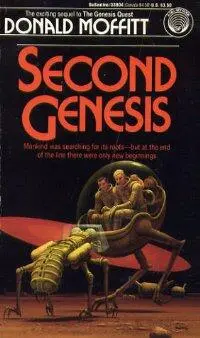
- Название:Second Genesis
- Автор:
- Издательство:Del Rey / Ballantine
- Жанр:
- Год:1986
- ISBN:0-345-33804-9
- Рейтинг книги:4 / 5. Голосов: 1
-
Избранное:Добавить в избранное
- Отзывы:
-
Ваша оценка:
Second Genesis: краткое содержание, описание и аннотация
Предлагаем к чтению аннотацию, описание, краткое содержание или предисловие (зависит от того, что написал сам автор книги «Second Genesis»). Если вы не нашли необходимую информацию о книге — напишите в комментариях, мы постараемся отыскать её.
Second Genesis — читать онлайн бесплатно полную книгу (весь текст) целиком
Ниже представлен текст книги, разбитый по страницам. Система сохранения места последней прочитанной страницы, позволяет с удобством читать онлайн бесплатно книгу «Second Genesis», без необходимости каждый раз заново искать на чём Вы остановились. Поставьте закладку, и сможете в любой момент перейти на страницу, на которой закончили чтение.
Интервал:
Закладка:
“We’re filling in all the blank places in human culture,” Ame said. “Books of art reproductions—shelves of them. And thousands of actual paintings and pieces of sculpture from the later centuries. And holos of opera, dance, and dramatic performances. And in my field, a complete survey of terrestrial paleontology going back four and a half billion years.”
“Biology, too,” Bram said. “We have a complete DNA library of thousands and thousands of plant and animal species.” Those had been among the first treasures to be moved; they now were in storage aboard Yggdrasil.
Edard hardly listened; he was carried away by his own enthusiasms. “And musical scores! More than nine hundred compositions by someone named Schubert—songs, symphonies, quartets! He must have lived after the discovery of immortality to have written so much! And thirty-two piano sonatas by Beethoven, all of them strikingly different. I never knew he’d written so many! And operas by Mozart! Oratorios by Handel! They all belong to us again!”
“We’ll look forward to your next concerts,” Jun Davd murmured.
The super made a few last notations on a tablet with a vacuum stylus, scribbled his initials, and tacked the sheet to the pallet frame. “All set,” he said.
Edard climbed to a perch atop his possessions, got a firm grip on the cargo net, and waved. A Cuddly rode his shoulder. Bram, Ame, and Jun Davd stood well back with the caravan master and line of walkers. Flame bloomed behind the splash skirt, and the heavily laden platform lifted ponderously, seemed to hang poised for several seconds, then rose with increasing speed into the black sky.
Around Bram the tethered walkers pawed the ground in response to the vibrations. Their attendants calmed them by stroking the affected pseudoganglions. Bram followed the yellow square of flame with his eyes as it climbed toward the hovering tree.
Bram’s eyes were still turned upward when Jun Davd grabbed his sleeve and said, “Look!”
Somewhere past Yggdrasil a new star bloomed. It was a bright blue spark, moving rapidly across the field of stars. It lost its proper motion and turned brighter.
“I believe it’s a fusion flame,” Jun Davd said calmly.
The caravan master and drovers, following their gaze, gaped skyward. On the surrounding plain, activity slowed and stopped as other people noticed.
The blue spark was the brightest star in the sky. It moved not at all against the constellations now.
“They made their course correction,” Jun Davd said. “It appears that this is the disk they’ve chosen.”
“Where…” began a stunned Ame.
Jun Davd squinted at the strange new constellations that had taken shape after seventy-four million years. By now he knew them by heart. “They seem to have come from the general direction of Sol,” he said. “Of course, it was inevitable that they’d get around to Delta Pavonis sooner or later.”
“All those clicking stars…” Bram said.
Jun Davd nodded. “They had to be some manifestation of their message traffic, whether we could extract a pattern out of it or not. And they spread like a tide—not by exercising choice. Inhospitable places like red giants and the burnt-out cinders of white dwarfs, whose planets have no future. You’d think they would have skipped to a few of the more congenial stars first. And now their wave front’s arriving here, like clockwork.”
Bram drew a sharp breath. “But why now?” he said. “Why not sooner? Or later? No one’s visited the disk-worlds for over fifty million years. And just as we get here…”
Ame’s face was flushed behind the sparkling curve of her helmet. “Because it’s their turn, don’t you see, Bram- tsu !”
“Your extinction timetable?”
She nodded vigorously. “The figures work out about right, don’t they, Jun Davd?”
Jun Davd spoke without removing his eyes from the distant fusion flame. “ We came back here in a multiple of thirty-seven million years—just as fast as we could after the Message reached the Father World, not counting the few insignificant millennia that fell through the cracks while the Nar remade us, and so forth. They got here in a rough multiple of twenty-six million years after the Message stopped.” He pursed his lips. “They seem to have arrived about four million years early. That’s within the limits of your timetable, isn’t it, Ame?”
“Divided by three, yes,” she said.
Around them on the booty-littered plain, people were gathering into groups, pointing excitedly at the sky. Bram knew that if he switched to the general frequency he would hear a babble of voices. A delegation of about a dozen people, spotting Jun Davd’s tall space-suited figure and his own well-worn tabard, were bouncing across the fiat ribbonscape toward them.
“Who?” Bram said. “Relatives of the Cuddlies? The collateral branch you postulated that might have evolved from the same root stock after the longfoots carried the Cuddlies here?”
“No,” Ame said. “That would have been the last cycle—twenty-six million years ago. The proto-Cuddlies missed their chance. They never traveled to the stars.”
Bram stared at the blue spark that was heading toward them. “Who then?” he said.
“We’ll know very soon,” Jun Davd said.
CHAPTER 9
The alien ship resembled a long jointed stick studded with budlike structures and a cluster of bubbles like white foam at one end. It was very large, as starships must be. It was not worldlike in Yggdrasil’s sense, but the segmented shaft was many miles long, and each individual bubble was easily a half mile in diameter.
“It’s a fusion vessel, all right, but not a ramjet,” said Jun Davd’s deep, composed voice from the screen. “They carried their fuel with them. They’re using a deuterium-helium three reaction. But there are traces of tritium from previous burns.”
Bram saw the implications immediately. “They started their trip with a deuterium-tritium reaction. And they’ve been at it long enough to have to switch fuels because of the decay of their tritium.”
He turned his eyes from the sticklike image on the portable viewscreen long enough to exchange glances with Jao. Jun Davd had returned to the tree in order to have the full resources of the observatory at his disposal, but the burly physicist had left Trist to hold the fort and returned to the diskworld, where, he said, “the action’s going to be.”
The strangers’ starship had been decelerating steadily for six days now at half a g. It had covered more than two hundred million miles since it had first been spotted approaching from the outer system. It would rendezvous with the diskworld in only a few hours—still with too much velocity, according to Trist.
Bram, waiting with Jao, had set up shop in the great sports arena, which was mostly cleared out now. A few people in casual dress moved through the empty spaces, picking over the remaining exhibits. Ame was among them, a distant figure working with a male associate to pack and label pods. Bram had sent all the junketing tourists—and everybody else who could be spared—back to the tree. He didn’t want half the population milling around where they could not easily be rounded up. Not with this new development unfolding. But Ame had refused to go. “Not on your life,” she’d said. “I wouldn’t miss this for anything. Besides, you’re going to need me, and Jorv, and all the other experts on terrestrial life.” She was right, Bram knew. Only a few hundred people remained on the diskworld, but he had seen to it that a sprinkling of specialists in the once-abstract disciplines was included.
“Yes,” Jun Davd’s voice agreed. “If they came from Sol, they’ve been traveling at nonrelativistic speeds. Tritium’s half-life is only twelve years and a bit. At the end of their first fifty or sixty years, most of it would have turned into helium three, their secondary fuel. And what does that suggest?”
Читать дальшеИнтервал:
Закладка:
Похожие книги на «Second Genesis»
Представляем Вашему вниманию похожие книги на «Second Genesis» списком для выбора. Мы отобрали схожую по названию и смыслу литературу в надежде предоставить читателям больше вариантов отыскать новые, интересные, ещё непрочитанные произведения.





Обсуждение, отзывы о книге «Second Genesis» и просто собственные мнения читателей. Оставьте ваши комментарии, напишите, что Вы думаете о произведении, его смысле или главных героях. Укажите что конкретно понравилось, а что нет, и почему Вы так считаете.