Donald Moffitt - Second Genesis
Здесь есть возможность читать онлайн «Donald Moffitt - Second Genesis» весь текст электронной книги совершенно бесплатно (целиком полную версию без сокращений). В некоторых случаях можно слушать аудио, скачать через торрент в формате fb2 и присутствует краткое содержание. Год выпуска: 1986, ISBN: 1986, Издательство: Del Rey / Ballantine, Жанр: Фантастика и фэнтези, на английском языке. Описание произведения, (предисловие) а так же отзывы посетителей доступны на портале библиотеки ЛибКат.
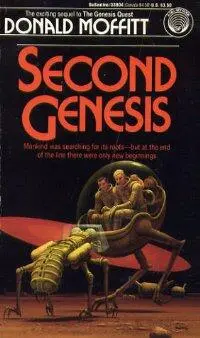
- Название:Second Genesis
- Автор:
- Издательство:Del Rey / Ballantine
- Жанр:
- Год:1986
- ISBN:0-345-33804-9
- Рейтинг книги:4 / 5. Голосов: 1
-
Избранное:Добавить в избранное
- Отзывы:
-
Ваша оценка:
Second Genesis: краткое содержание, описание и аннотация
Предлагаем к чтению аннотацию, описание, краткое содержание или предисловие (зависит от того, что написал сам автор книги «Second Genesis»). Если вы не нашли необходимую информацию о книге — напишите в комментариях, мы постараемся отыскать её.
Second Genesis — читать онлайн бесплатно полную книгу (весь текст) целиком
Ниже представлен текст книги, разбитый по страницам. Система сохранения места последней прочитанной страницы, позволяет с удобством читать онлайн бесплатно книгу «Second Genesis», без необходимости каждый раз заново искать на чём Вы остановились. Поставьте закладку, и сможете в любой момент перейти на страницу, на которой закончили чтение.
Интервал:
Закладка:
“What was this place?”
“The longfoots had some of their own storehouses here. And living areas close by. We gleaned some insight into their social habits. There was some limited pair bonding in our sense, but mostly they lived in aggregates of fifty to a hundred members in which females were available to males on some kind of schedule of dominance. The living arrangements pointed to that, anyway. The females raised their young separately and cooperated in keeping males at bay for a period after parturition.”
“They don’t sound like a very pleasant people.”
“Rats don’t make very pleasant ancestors.”
Bram shuddered, remembering the fragment of film Ame had been able to show him. It had been part of an exhibit associated with the mounted rat skeleton and had shown a bedraggled brown animal with beady eyes and a naked tail greedily eating its way thorugh a store of corn, excreting as it went. Bram had been ashamed of his instant and automatic revulsion, telling himself that the rat was a life form like any other, with a right to existence. But Ame had told him that his reaction wasn’t unique—that rats seemed to raise the hackles of most humans.
“You’re being narrow-minded, Ame,” Jorv protested. “Seeing it from a human point of view. Different species, different biological imperatives. They might have been a perfectly decent folk. They acted cooperatively, after all.”
“Come here, I want to show you something,” Ame said.
She led Bram to a cache where specimens had been arranged with preliminary labels. There were bins of a dessicated, unfamiliar grain, shovel-size scoops, a broken ceramic jug.
But what caught Bram’s attention was a small animal skeleton on a slab of wood. The skull was crushed, pinned to the slab by a copper bar that was attached to a large spring. But enough could be seen of the jaw to show that it was still clenched around something that looked like a fossil nut, which was attached by a wire to a sort of pivoting tray.
“A trap,” Ame said. “The animal in it was a Cuddly.”
Shira tossed her lank hair back within the bowl of her helmet. “They poisoned them, too,” she said. “We’ve found piles of Cuddly bones around a feast of that same bait that one of them would have brought back to the burrow for the females and young ones.”
Bram was appalled. “But what a terrible thing to do.”
“No more terrible than what Original Man did to rats,” Jorv said.
“The longfoots carried their own vermin into space with them, just as man once carried rats and mice,” Ame said. “That’s what the vermin were. Cuddlies.”
“The Cuddlies’ ancestral form, actually,” Shira said. “They hadn’t evolved for airlessness yet. You can see that the rib cage isn’t enlarged for accessory lungs. And the toe of the rear foot is not fully opposable.”
“But I think that if we were to see one of these creatures in its fur,” Ame said, “we’d see it as a Cuddly.”
Bram studied the trap with distaste. “Ingenious and cruel,” he said. “The victim had to tug at the bait to pull it loose, and that released this strut that kept the spring armed. The animal’s head would be in position for the copper bar. Even if its reflexes were good and it drew back, it would still get its neck broken.”
“These little animals were pests,” Jorv said. “They got into the longfoots’ food supply. They were probably unsanitary. And they probably bit.”
“The longfoots tried diligently to exterminate them back on Earth. We found a sort of children’s picture book with a story about it. But the creatures must have been too clever, or too prolific, to be stamped out entirely. The longfoots must have been horrified to find that they’d transported them here.”
“Well, the Cuddlies outlasted the longfoots here, at any rate,” Bram said grimly. “Long after these … rat-people packed up and went back to Earth, The Cuddlies were able to survive on the diskworld long enough to adapt for vacuum. To adapt for space travel, when you stop to think about it—when you see the way they scamper around Yggdrasil’s branches and seem to enjoy it.”
“Their root stock must have adapted back on Earth, too,” said Shira.
“Yes,” Ame said “If the human race was never able to exterminate rats, and the rats developed into an intelligent species after man was gone, the same might be true for the proto-Cuddlies. They might be the longfoots’ successors back on earth by now. After all, they occupied a similar ecological niche.”
“What a delicious thought, Ame!” Shira exclaimed. “A world ruled by cousins of the Cuddlies! But would a six-foot intelligent Cuddly be as huggable ?”
Ame laughed. “I can hardly wait to get to Sol and see. But Bram -tsu, we mustn’t leave till we finish our work here.”
“That won’t be for a while,” Bram said. “We had an all-tree meeting before I left. You’ve been voted an extra year.”
The long plain was dotted with depots of crated material, each with a little band of partisans gathered around it vying for priority. Processions of cargo walkers, roped together in long caravans led by space-suited drovers, plodded across the starlit diskscape toward the staging areas where the rocket-assisted pallets were being loaded. All the wheeled vehicles had been pressed into service, too, and they could be seen bumping lazily across the flat vista, some of them achieving temporary flight.
Bram, helping Jun Davd to cinch a saddlebag full of astronomical data in place on a kneeling walker, paused in his work to watch a shower of sparks lift above the horizon and rise toward the blob of silver light that was Yggdrasil, hovering just to the right of the pendant moon.
“That’s the third in an hour from the other side,” he said. “The museum’s launchpad, it looks like. They must be working overtime.”
“They’re overloading their pallets,” Jun Davd said. “I’m surprised some of ’em got off the ground. I was over there yesterday helping the dispatcher to figure weights and balances, and we had to make them take off a big statue of three naked men wrestling a snake. Would have spoiled the trim—had the platform tumbling end over end. Had one of those art fellows almost in tears.”
“I’m sure they got it off later.”
“They’ve had a year and a half to loot that museum. I thought the idea was to take a small representative sample and leave the rest for the ages—or for whenever we can get back this way.”
“You know how it is. All of a sudden we’re about to leave, and they start having second thoughts. There’s this last-minute rush. Everybody’s suddenly discovered that there are things they just can’t bear to leave behind—the historians, the archaeologists, the agronomists, everybody.” He laid a hand on the saddlebags. “You, too, it looks like.”
Jun Davd grunted. “It just occurred to me that it might be a good idea to abscond with part of the backlog of original plates—do you know, their astronomers were still recording images on light-sensitive paper for centuries after they had more advanced methods available? Oh, I’ve got all the electronically stored data I need, but it’ll take years—decades—to go through it all, and I started worrying about accumulated signal errors.”
“Have you made any more progress in locating Sol?”
“There are four candidates in the immediate stellar neighborhood. I’ve all but ruled out three of them—but I want to refine my mass estimates a bit further before I set a course out of this system.”
“Waiting until the last minute, are you?”
Jun Davd hooked a thumb over his shoulder in the direction of the red-rimmed world-edge that overlooked the masked sun.
Читать дальшеИнтервал:
Закладка:
Похожие книги на «Second Genesis»
Представляем Вашему вниманию похожие книги на «Second Genesis» списком для выбора. Мы отобрали схожую по названию и смыслу литературу в надежде предоставить читателям больше вариантов отыскать новые, интересные, ещё непрочитанные произведения.





Обсуждение, отзывы о книге «Second Genesis» и просто собственные мнения читателей. Оставьте ваши комментарии, напишите, что Вы думаете о произведении, его смысле или главных героях. Укажите что конкретно понравилось, а что нет, и почему Вы так считаете.