Donald Moffitt - Second Genesis
Здесь есть возможность читать онлайн «Donald Moffitt - Second Genesis» весь текст электронной книги совершенно бесплатно (целиком полную версию без сокращений). В некоторых случаях можно слушать аудио, скачать через торрент в формате fb2 и присутствует краткое содержание. Год выпуска: 1986, ISBN: 1986, Издательство: Del Rey / Ballantine, Жанр: Фантастика и фэнтези, на английском языке. Описание произведения, (предисловие) а так же отзывы посетителей доступны на портале библиотеки ЛибКат.
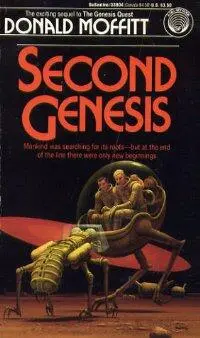
- Название:Second Genesis
- Автор:
- Издательство:Del Rey / Ballantine
- Жанр:
- Год:1986
- ISBN:0-345-33804-9
- Рейтинг книги:4 / 5. Голосов: 1
-
Избранное:Добавить в избранное
- Отзывы:
-
Ваша оценка:
Second Genesis: краткое содержание, описание и аннотация
Предлагаем к чтению аннотацию, описание, краткое содержание или предисловие (зависит от того, что написал сам автор книги «Second Genesis»). Если вы не нашли необходимую информацию о книге — напишите в комментариях, мы постараемся отыскать её.
Second Genesis — читать онлайн бесплатно полную книгу (весь текст) целиком
Ниже представлен текст книги, разбитый по страницам. Система сохранения места последней прочитанной страницы, позволяет с удобством читать онлайн бесплатно книгу «Second Genesis», без необходимости каждый раз заново искать на чём Вы остановились. Поставьте закладку, и сможете в любой момент перейти на страницу, на которой закончили чтение.
Интервал:
Закладка:
Jao’s eyes glinted. “Deuterium-tritium fusion is easy. But tritium’s hard to come by. They would’ve made it back home as a by-product of their fusion reactors. Deuterium-helium three fusion’s easy, too—but first you have to accumulate enough helium three. Deuterium’s more plentiful. But I guess they’re not capable of deuterium-deuterium fusion yet. Nor of the boron fusion-fission reaction the Nar used in their early starships.”
He glanced at the bubble-and-stick image that was being transmitted from Yggdrasil’s telescopes. “So this is a very early model starship. They’re in the first stages of exploration.”
“It isn’t an exploration ship. It’s a colony ship. They don’t have enough reaction mass for a return trip.”
“But the bubbles…”
“If they ever were fuel tanks, they’re empty now. Our radar shows they’re hollow. And they haven’t collapsed, as a sensible membrane envelope would, nor have they been cast off. I suspect that they’ve been converted into environmental pods for a very rapidly expanding population.”
“They could have planned to set up reactors here to manufacture tritium,” Bram suggested. “Or mine a gas giant for helium three.”
“Except that there are no gas giants in this system. Nor oceans to extract deuterium from. All they could have known about this system is that there was mass here. And energy.”
Jao was agape, and Bram didn’t blame him. “You mean they sent a shipload of colonists out—to travel for generations and breed aboard ship—without knowing for sure what they’d find here? They must hold their lives cheap!”
“And it must follow that they hold other lives cheap, as well,” Jun Davd said hollowly.
“Jun David, what are you driving at?” Bram demanded.
“They’re closing with the disk very rapidly, and they still haven’t turned off their fusion drive. They must have seen Yggdrasil. And felt our radar probing them. They know there’s life here.”
Trist’s voice cut in, sounding harsh. “They’re going to overshoot, Bram. They’ll have to cut right across the rim of the diskworld.”
Bram was aghast. “They’d have to assume there must be intelligent life on the surface even if they didn’t care about the artifacts they’d be destroying. And they have no way of knowing exactly where on the rim we might be.”
“We’re sending them radio messages,” Trist said. “Just intelligent noises on every wavelength—number patterns and so forth. They don’t respond. It’s as if we don’t exist for them.”
“I can evacuate,” Bram said, thinking frantically. “No, that would take too long,’ wouldn’t it, with everybody spread out? It wouldn’t matter, anyway. Yggdrasil’s less than twenty thousand miles away, right in the path of destruction if the drive exhaust comes anywhere near here.”
“Yggdrasil’s safe, and so are you, we think,” Jun Davd said. “These careless strangers will intersect the rim between moons—at least five or ten million miles from your position.”
“You think,” Jao growled.
A scattered crowd had gathered on the plain, facing the point where the long straight ribbon of land vanished into infinity. About three hundred people were left on the diskworld, and virtually all of them were here in their space suits. They stood in small, chatting groups or lounged against the landing legs of the waiting shuttles. A few enterprising souls had even climbed to perches atop the spaces vehicles for a better view.
Bram was still uneasy about everybody being out in the open. His first instinct had been to keep people as far underground as possible. But Jun Davd had assured him that the alien ship was holding its course. For all practical purposes, the enormous curvature of the rim was a straight line, and even if that dreadful inferno of fusing deuterium and hydrogen three passed only marginally below the theoretical horizon, millions of miles of diskworld would be interposed between Bram’s people and death.
Not so for the Cuddlies inhabiting that distant latitude. Bram’s mouth tightened into a grim line as he thought of the slaughter that would take place in a few minutes.
The Cuddlies here certainly had no premonition of what was about to happen to their faraway cousins. Attracted by the festive atmosphere, they hung around the people, popping in and out of crevices and sometimes pulling at space-suit legs to be picked up.
“You could see it now if you were hanging in a bosun’s chair over the outside rim,” Jun Davd’s voice sounded in his ear. “It’s cutting upward from below a chord drawn between you and its point of intersection. It will rise above your sunward horizon after transit.”
“How soon?” Bram asked.
“Four minutes. If you sight along the outer edge, you ought to be able to see some lightening of the limb.”
Bram strained his eyes. Beside him, Jao, fussing with the tripod of a theodolite, straightened for a look.
Yes, the precipice edge that faced the interstellar night had gained a silvery hairline illumination. It projected a short distance as a faint straight scratch against the darkness. Where the scratch ended would be the theoretical horizon.
“Got it?” he asked Jao.
Jao struggled with the theodolite. “Just a second. Yah. Here we go.”
“One minute.”
All across the pebbled plain, space-suited figures showed that they were listening in on the circuit by ceasing their activities and becoming still. The Cuddlies, sensing the humans’ absorption, froze.
“Now,” Jun Davd said.
Where the threadlike horizon narrowed to invisibility, there was a great flare. Garish light spilled over the plain, casting long black shadows. Human figures, their reflexes slower than their helmet filters, raised arms in a delayed reaction to ward off the light.
Bram saw streaks of movement through the awful glare: startled Cuddlies popping back into their holes. When his eyes adjusted, not a Cuddly was to be seen anywhere.
The light dwindled to a point and disappeared. Moments later, a bright star rose against the inward horizon.
Except that it couldn’t be a star, because it was in front of one of the great, dully visible faces of a disk.
Jun Davd’s voice in Bram’s ear was tinged with sorrow. “The exhaust swept across one of the regions we never had a chance to send a survey team to. The one with the great elliptical bowl and the pyramidal objects rising tens of miles high on stilts. Radar echoes appeared to show a small city in the vicinity to service it, whatever it was. We thought it might be a research center of some sort.”
“I remember,” Bram said.
“There’s nothing there now but thousands of square miles of melted slag.”
Bram thought of all the Cuddly warrens that must have lain under the complex and about all the Cuddlies outside the zone of direct destruction that would be dying of radiation sickness in the days and Tendays ahead.
Beside him, Jao swore. “I was going to come back. Maybe in a couple of hundred years when we got ourselves established and could afford to lay off a little. The pyramid installation was the first place I wanted to look at.”
In the disk-filled inner sky, the artificial star seemed to slow as if it were on a rubber band. Slowly, slowly, the rim of the diskworld pulled it back.
“They’re not going to bother to go into an orbit,” Jun Davd’s voice said. “They’re just going to hang there.”
“Disposable ship,” Jao said. “Or disposable colonists.”
“A life form that just sets blindly out and goes anywhere,” Jun Davd mused, “and takes root if it can. And now, I’m afraid, they’re making their second pass to bring them to a halt over the rim. They don’t bother to think things out in advance. They’re empirical.”
Читать дальшеИнтервал:
Закладка:
Похожие книги на «Second Genesis»
Представляем Вашему вниманию похожие книги на «Second Genesis» списком для выбора. Мы отобрали схожую по названию и смыслу литературу в надежде предоставить читателям больше вариантов отыскать новые, интересные, ещё непрочитанные произведения.





Обсуждение, отзывы о книге «Second Genesis» и просто собственные мнения читателей. Оставьте ваши комментарии, напишите, что Вы думаете о произведении, его смысле или главных героях. Укажите что конкретно понравилось, а что нет, и почему Вы так считаете.