Donald Moffitt - Second Genesis
Здесь есть возможность читать онлайн «Donald Moffitt - Second Genesis» весь текст электронной книги совершенно бесплатно (целиком полную версию без сокращений). В некоторых случаях можно слушать аудио, скачать через торрент в формате fb2 и присутствует краткое содержание. Год выпуска: 1986, ISBN: 1986, Издательство: Del Rey / Ballantine, Жанр: Фантастика и фэнтези, на английском языке. Описание произведения, (предисловие) а так же отзывы посетителей доступны на портале библиотеки ЛибКат.
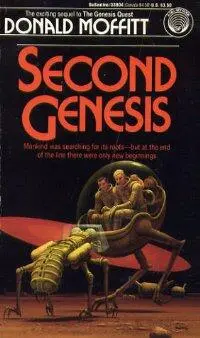
- Название:Second Genesis
- Автор:
- Издательство:Del Rey / Ballantine
- Жанр:
- Год:1986
- ISBN:0-345-33804-9
- Рейтинг книги:4 / 5. Голосов: 1
-
Избранное:Добавить в избранное
- Отзывы:
-
Ваша оценка:
Second Genesis: краткое содержание, описание и аннотация
Предлагаем к чтению аннотацию, описание, краткое содержание или предисловие (зависит от того, что написал сам автор книги «Second Genesis»). Если вы не нашли необходимую информацию о книге — напишите в комментариях, мы постараемся отыскать её.
Second Genesis — читать онлайн бесплатно полную книгу (весь текст) целиком
Ниже представлен текст книги, разбитый по страницам. Система сохранения места последней прочитанной страницы, позволяет с удобством читать онлайн бесплатно книгу «Second Genesis», без необходимости каждый раз заново искать на чём Вы остановились. Поставьте закладку, и сможете в любой момент перейти на страницу, на которой закончили чтение.
Интервал:
Закладка:
“I think I’ve identified our hidden friend, though. It must have been the star they called Delta Pavonis.”
Bram tried not to show his disappointment. “Well, it’s a possible reference point, I suppose. Though the relative positions of the stars in the neighborhood will have changed a lot in seventy-four million years.”
“Delta Pavonis was almost Sol’s twin,” Jun Davd went on serenely. “It was a G-type star with ninety-eight percent of Sol’s mass. It was about nineteen light-years distant. The other nearby G stars had masses of eighty or ninety percent of Sol, except for one called Beta Hydri—that was about one and a quarter solar masses—and one other exception. So the invisible star we’re circling almost has to be either Sol or Delta Pavonis—and I think we’ve already agreed that Original Man would hardly have dismantled his own system for a radio station.”
“Or it could be an interloper. A wanderer they used.”
“In that case, the proper motion of all the nearby stars would be much greater than we’ve observed during our stay.”
“Oh, right.” Bram blushed like an apprentice. After more than five centuries of subjective time, Jun Davd could still make him feel like the little boy whom Voth had sent to the observatory to take astronomy lessons.
“The interesting thing is that the other exception is also almost a twin of Sol—a G-4 of one point oh eight solar masses.”
“So we still can’t tell which—”
“Except for the fact that it was part of a triple star system that went by the name of Alpha Centauri. Which also happened to be Sol’s closest neighbor—just a shade over four light-years away.”
With mounting excitement, Bram began, “That means—”
Jun Davd nodded. “On the assumption that stars that close might have been gravitationally bound—however tenuously—I searched for matching G stars about that distance apart, one of which was part of a triple system.” A grin spread slowly across his dark face. “They’re still there, drifting hand in hand through the spiral arms, and they haven’t changed position much with respect to Delta Pavonis, either.”
“Jun Davd, you’re incorrigible! I’ll never forgive you for keeping me in suspense like that. How far?”
“Less than twenty light-years. Boosting at one gravity, we can be home in seven subjective years.”
Home. The word had a strange ring to it. Bram slapped Jun Davd on the back. “Let’s hurry and get started, then.”
The walker, misinterpreting the slap, rose to its full height. The drover came over and said, “Are you ready to go?”
“In a minute,” Jun Davd told him. He turned back to Bram. “There’s one more datum.”
“What’s that?”
“The G star that seems to be Sol happens to be at the exact center of the sphere of radio clicks that’s growing our way. As if it were the focal point.”
“Original Man!” Bram whispered. “He has come back!”
Jum Davd shook his, head. “That doesn’t seem likely. We’ve had the longfoots in between. We may be about to meet the next contender on the evolutionary treadmill. Or Smeth may be right. It may be a natural phenomenon. In any case, we’d better go. see.”
He picked up the remaining pair of saddlebags and slung them over his own shoulder. The other walkers in the caravan, feeling the tug of the rope, struggled to their feet. In a few minutes, Bram and Jun Davd were following the swaying line of biotransports down the well-scuffed trail to the staging area.
There were plenty of willing hands at the other end to help the caravan unload. Ame was there, supervising the lashing of some bulky crates to an enormous wooden frame whose booster rockets, bolted to the corners and along the sides, must have added up to a hundred thousand pounds of thrust. Bram also spotted his son, Edard, clambering around at the top of a mountain of freight, unfurling a cargo net. Edard saw him and took a nicely calculated leap that brought him floating down to within a foot of where Bram and Jun Davd were standing.
“Hello, Father. Hello, Jun Davd. What have you got there? Documents mostly? If you have anything fragile, I’ve got room for it with my stuff. I’m riding with the supercargo this load, and I can keep an eye on it for you at the other end.”
Edard was fair and slender, with a suggestion of epicanthic folds at the corners of his eyes that must have come from mama-mu Dlors after skipping a generation. Bram was sorry that Edard had never met his partial gene grandmother; Dlors had elected to remain on the Father World. As a dancer, she had been part of the musical world, and she would have been as proud of Edard as if she had been any latter-day grandmother contributing a full complement of grandmotherly genes.
“You’re going to ride that thing?” Bram asked, casting a dubious eye at the rickety pile. “In nothing but a space suit?”
“It’s only a few hours to Yggie now, and the super’s got an extra bottle of air he’s willing to share,” Edard said cheerfully.
Ame sauntered over. “Everybody’s hitching rides now,” she said. “I’m going to ride up with my last load, too. I’m saving the delicate stuff for then.”
Edard cast a glance upward to where the silver shape of the space tree hung overhead. “Got to take advantage of Yggie’s favorable position while it lasts. Look at these mountains of souvenirs around us. It’ll be half a Tenday before we load it all, and then we’ve got to get the walkers and heavy equipment up there, not to mention packing up our own personal odds and ends.”
Bram conceded the point with a nod. Before coming down to the surface on this final trip, he had given the order for Yggdrasil’s rotation to be stopped. The tree’s inhabitants could put up with weightlessness for the few days it took to make the final transfer of goods. The swarms of cargo pallets were landing all over the branches. The limited docking facilities at the hub were being reserved for passenger vehicles.
“I’ll accept your offer with thanks,” Jun Davd said to Edard. “Here, give me a hand with these boxes of instruments. Be careful—there’s a lot of glass.”
Edard pitched in, and he and Jun Davd made a number of soaring trips in tandem to the top of the heap with boxes slung between them, while Bram unloaded the walker. Fifteen minutes later it was done. The cargo net was tied down securely over the mound of bales and crates, and the supercargo, after inspecting all the fastenings, walked all the way around the wooden platform, checking the weight distribution at intervals with a jack arrangement that lifted the whole thing off the ground.
While they waited, Bram said to Edard, “What have you got there?”
Edard’s face lit up. “Musical instruments. Hundreds of them, all gathered into one place by the longfoot archaeologists. We would never have been able to collect them all ourselves in twenty years of digging! This is my fourth load. Bramfather, the violin—and the other stringed instruments—are entirely different from the way we’ve conceived them! They had only four strings, and they were played with an ordinary manual bow, not motorized disks or powered friction wands. And the instruments themselves are beautiful, curved, complex shapes sculpted of wood. We’ll have to learn how to copy them! We’ll hear music we never heard before! But learning to play such devices well will take a lot of practice!”
“Your mother will be pleased.” Bram could not help thinking of Olan Byr, who had devoted his life to reinventing the old instruments.
“I’ve already given her one of the cellos,” Edard said. “On my last trip a few days ago. She was practicing on it when I left.”
Читать дальшеИнтервал:
Закладка:
Похожие книги на «Second Genesis»
Представляем Вашему вниманию похожие книги на «Second Genesis» списком для выбора. Мы отобрали схожую по названию и смыслу литературу в надежде предоставить читателям больше вариантов отыскать новые, интересные, ещё непрочитанные произведения.





Обсуждение, отзывы о книге «Second Genesis» и просто собственные мнения читателей. Оставьте ваши комментарии, напишите, что Вы думаете о произведении, его смысле или главных героях. Укажите что конкретно понравилось, а что нет, и почему Вы так считаете.