Donald Moffitt - Second Genesis
Здесь есть возможность читать онлайн «Donald Moffitt - Second Genesis» весь текст электронной книги совершенно бесплатно (целиком полную версию без сокращений). В некоторых случаях можно слушать аудио, скачать через торрент в формате fb2 и присутствует краткое содержание. Год выпуска: 1986, ISBN: 1986, Издательство: Del Rey / Ballantine, Жанр: Фантастика и фэнтези, на английском языке. Описание произведения, (предисловие) а так же отзывы посетителей доступны на портале библиотеки ЛибКат.
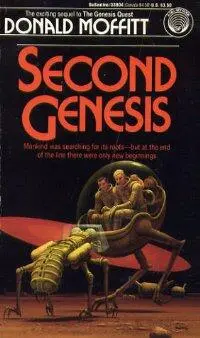
- Название:Second Genesis
- Автор:
- Издательство:Del Rey / Ballantine
- Жанр:
- Год:1986
- ISBN:0-345-33804-9
- Рейтинг книги:4 / 5. Голосов: 1
-
Избранное:Добавить в избранное
- Отзывы:
-
Ваша оценка:
Second Genesis: краткое содержание, описание и аннотация
Предлагаем к чтению аннотацию, описание, краткое содержание или предисловие (зависит от того, что написал сам автор книги «Second Genesis»). Если вы не нашли необходимую информацию о книге — напишите в комментариях, мы постараемся отыскать её.
Second Genesis — читать онлайн бесплатно полную книгу (весь текст) целиком
Ниже представлен текст книги, разбитый по страницам. Система сохранения места последней прочитанной страницы, позволяет с удобством читать онлайн бесплатно книгу «Second Genesis», без необходимости каждый раз заново искать на чём Вы остановились. Поставьте закладку, и сможете в любой момент перейти на страницу, на которой закончили чтение.
Интервал:
Закладка:
He scuffed cautiously closer. He hadn’t had time to readjust to diskworld gravity yet, and he was still stiff and tired from the ferry trip to the surface, though it was down to five days now.
“ Rattus norvegicus to be exact,” Ame said. “The most successful member of the family and the one that would have been in the best position to succeed Original Man after man’s activities had changed the environment. They were highly adaptable, they were omnivores as humankind’s ancestors were, and in fact they resembled some of the primitive specimens on our own family tree.”
The computer-generated hologram showed three skeletons in the same scale. The center one was a life-size projection of Ame’s most complete longfoot skeleton—the one Bram had noticed when he first entered the work-bay. He recognized the skeleton on the right, too. It was Doc Pol’s familiar ultrasound figurine, the textbook example that Doc had learned his own trade from and that he now required his apprentices to memorize.
The third skeleton was something else entirely. Though the computer had made the bones stand in an upright position, the proportions were grotesque. The torso was absurdly long, with tiny little hands and feet and a head that was much too large for it. The bones would have been too spindly to support the creature in normal gravity. Bram saw immediately that the creature must have been a very small animal that the computer had brought up to the size of the other two skeletons for purposes of comparison.
Ame touched a button, and lines flashed from the center skeleton to the other two, showing correspondences. Though the longfoot skeleton and the human skeleton were superficially similar, it was immediately apparent that the disproportioned skeleton on the left had more in common with the longfoot specimen.
“You can see that what appears to be a backward-bending knee is actually what became a heel,” Ame said. “The creature would have walked on its toes. The shaft of the leg bone became a long, narrow foot. And of course, the tail is there, bone for bone.”
“Ame, this is marvelous,” Bram said. “I’m enormously impressed. How did you do all this?”
She looked pleased. “We had a breakthrough. Literally. One of the digging machines broke through to a layer where the stratigraphy had been disturbed. The longfoots had been busy there. They had a—a sort of museum of their own there. And a library. And biosample vaults. They had brought up and catalogued a whole biological cornucopia preserved by Original Man. It must have come as a wonderful revelation to the longfoots. They were interested in their own ancestry, you see. Original Man’s records predated their own fossil records.”
Jorv’s plump face beamed complacency. “Original Man did all the work for them,” he said, “and they did all the work for us. ”
“We don’t have enough archaeologists to go around,” Ame said, “but all the amateurs are well trained by now. As soon as the digging machine operator saw what he was bringing up, he stopped, roped off the place, and notified the proper people.”
“As soon as they saw they were bringing up biological specimens, they got us,” Jorv bubbled. “You wouldn’t believe it! There were mounted skeletons. Arranged in classifications. And metal plaques to explain them. And supplementary materials—actual books preserved in nitrogen. And tapes and holochips. In Inglex and Chin-pin-yin. The longfoots probably couldn’t read them, but we could—right away!”
The attenuated paleobiologist, Shira, ran nervous fingers through stringy brown hair. “And there were actual tissue samples, too, still in a remarkable state of preservation. The rat-people—longfoots—had broken some of the seals, but others were intact. We were able to extract enough DNA and protein for sequential analysis.”
“There’ll be more,” Jorv interrupted. “We’ve only scratched the surface with this find. We’re trenching now, looking for the rest of it. And they thought zoology was a theoretical science! Bram-companion, when we get to our world, we’ll be able to recreate species! Stock our streams with trout, our forests with trees other than poplar! Did you know that Original Man had his own bio-vehicles—a sort of walker called a horse!”
“Well, that’s certainly a program for the future,” Bram said noncommittally.
Shira continued serenely, as if used to interruptions. “Until now, we’ve lacked the capacity to do molecular taxonomy in any meaningful way. Oh, we’ve been able to use cytochrome c sequencing to demonstrate that human beings are very far removed indeed from yeast—forty-five amino acid differences—not quite as far removed from cabbages, and closer still to heterochronic eggs. But now, of course, we have all those lovely tissue samples.”
“Horses,” Jorv said dreamily. “Zebras. Giraffes. Rhesus monkeys. Wolves. Original Man preserved them all.”
“And of course we’ve brought up scads of mouse bones from our deeper excavations. Man inadvertently carried mice and other vermin to the diskworld with him—just as, I suppose, he carried them with him everywhere he went. The mice didn’t manage to survive for long after humans departed the diskworld. They never adapted for airlessness, they weren’t able to burrow deep enough, and they quickly exhausted the more easily available sources of food. We found no mouse bones more recent than seventy million years old. But they still contained traces of cytochrome c .”
“And we had ourselves and Cuddlies available as a source of hemoglobin and serum albumin,” Jorv said. “Oh, there was no doubt at all!”
Shira brushed her hair back. “The longfoots were at several removes from us and Cuddlies—well beyond the limits of family or genus, let alone species. Farther still from Jorv’s giraffes, though we were able to do only DNA sequencing in that case. But the molecular differences between longfoots and mice—”
“ Mus musculus,” Jorv interjected. “Same family as rats. If you remember your childhood Chin-pin-yin, it’s the same word. Big-mouse.”
Shira spared a tolerant glance for Jorv and finished what she had been saying. “…but the molecular differences between longfoots and mice were practically nil.”
Bram nodded at the longfoot skeleton. “That seems to settle it, then. Man did become extinct. And the next dominant species was that.”
Ame said, “We found something else.”
“What’s that?”
“We know how the Cuddlies got here.”
Bram picked his way down the tunnel, following Jorv’s bobbing yellow light. Loose gravel under his feet started slow-motion cascades as he proceeded, coming to rest long after he had passed. The lanky paleobiologist was right behind him, shedding enough light of her own for him to see by, and Ame brought up the rear. Bram, as an escorted guest, went unburdened; the other three wore many-pocketed tabards over their space suits and lugged an assortment of picks, hammers, and other small tools.
After what seemed like an endless trek, the tunnel opened out into a wide, low-ceiling space shored up by timbers. Other tunnels branched off the space, glimmers of light from a couple of them showing the presence of other work parties.
The thick timbers were ordinary vacuum-poplar. Seeing them brought a lump of homesickness to Bram’s throat till he remembered that vacuum-poplar had originated here, in the Milky Way, not in the Whirlpool galaxy.
Ame saw him looking. “The longfoots dug up a human lumberyard near here and took advantage of it. The wood must have been in vacuum and still good. Before that—” She indicated the branching tunnels where archaeological work was in progress. “—the longfoots used columns of native stone as well as steel griders that they brought with them. Evidently they didn’t have much of a structural plastics industry. It bears out your theory that they were a young civilization, newly come to star travel, Bram -tsu.”
Читать дальшеИнтервал:
Закладка:
Похожие книги на «Second Genesis»
Представляем Вашему вниманию похожие книги на «Second Genesis» списком для выбора. Мы отобрали схожую по названию и смыслу литературу в надежде предоставить читателям больше вариантов отыскать новые, интересные, ещё непрочитанные произведения.





Обсуждение, отзывы о книге «Second Genesis» и просто собственные мнения читателей. Оставьте ваши комментарии, напишите, что Вы думаете о произведении, его смысле или главных героях. Укажите что конкретно понравилось, а что нет, и почему Вы так считаете.