Donald Moffitt - Second Genesis
Здесь есть возможность читать онлайн «Donald Moffitt - Second Genesis» весь текст электронной книги совершенно бесплатно (целиком полную версию без сокращений). В некоторых случаях можно слушать аудио, скачать через торрент в формате fb2 и присутствует краткое содержание. Год выпуска: 1986, ISBN: 1986, Издательство: Del Rey / Ballantine, Жанр: Фантастика и фэнтези, на английском языке. Описание произведения, (предисловие) а так же отзывы посетителей доступны на портале библиотеки ЛибКат.
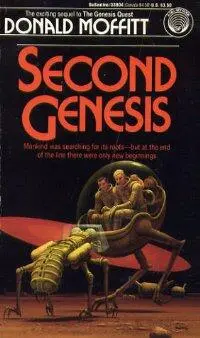
- Название:Second Genesis
- Автор:
- Издательство:Del Rey / Ballantine
- Жанр:
- Год:1986
- ISBN:0-345-33804-9
- Рейтинг книги:4 / 5. Голосов: 1
-
Избранное:Добавить в избранное
- Отзывы:
-
Ваша оценка:
Second Genesis: краткое содержание, описание и аннотация
Предлагаем к чтению аннотацию, описание, краткое содержание или предисловие (зависит от того, что написал сам автор книги «Second Genesis»). Если вы не нашли необходимую информацию о книге — напишите в комментариях, мы постараемся отыскать её.
Second Genesis — читать онлайн бесплатно полную книгу (весь текст) целиком
Ниже представлен текст книги, разбитый по страницам. Система сохранения места последней прочитанной страницы, позволяет с удобством читать онлайн бесплатно книгу «Second Genesis», без необходимости каждый раз заново искать на чём Вы остановились. Поставьте закладку, и сможете в любой момент перейти на страницу, на которой закончили чтение.
Интервал:
Закладка:
Bram pointed upward. “You can see where we patched the roof to pressurize the place—and we only had to do that because we broke through it ourselves. Otherwise, we only had to put in a few minor seals to make the place airtight again. They built well, these former humans. The supporting walls were fused stone and carbon, yards thick.”
“What kind of games did they play here?”
“We’ve found clues to that in some bas-reliefs we dug up. One game was played with a ball and paddles. You struck the ball with a paddle or kicked it with a foot while flapping the paddles to try to stay aloft as long as possible. There was a variation played only with a stick—the players dropped faster, and the plays were shorter. If you’ll look way up toward the ceiling past the lights, you’ll see the remnants of the drop grid. At the beginning of each play the teams were released simultaneously at a signal, in their starting positions.”
They continued threading their way between the tables across the wide floor. Progress was tricky because the floor was not smooth enough for a low-gravity scuff, and there was a tendency to bounce too high when surmounting some block of rubble—but they couldn’t sail over the obstacles, either, because they had to be careful of the tables.
“They drank out of strange cups,” Mim said, pausing at a table spread with shards of plastic ware.
Bram examined one of the more complete cups, a two-handled affair whose top tapered into a sort of spout that one could put into one’s mouth, almost like a nipple.
“Actually, that’s not such a bad design for a low-gravity environment. Prevents sloshing. Better than our own lidded cups,” Bram observed.
“That’s not what I meant. It’s the handles. They don’t seem to fit the hand very well. I’d find it very awkward to drink from one.”
Instead of being designed for one or two fingers and an opposing thumb, the handles were fat knobs with five vertical grooves. Bram could see what Mim meant. If one were going to hold a cup with two hands as if it were a bowl, the natural tendency would be to cradle it laterally, in the direction the wrists faced. If handles were needed at all, the grooves ought to have been horizontal—and there ought to have been only four of them, with a depression for the thumb on the opposite side.
“Maybe their wrists were more supple than ours,” he said. He smiled at a sudden comic image. “Or maybe they had no elbow room at their tables.”
“I’m serious.”
“So am I. About the wrist joints, anyway. Mim, what if Original Man didn’t become extinct seventy-odd million years ago, as we’ve always thought? What if he evolved past us—past the image of himself that he transmitted to the Virgo cluster?”
“Have you talked to Edard about the musical instruments?”
“What? No, Edard leads his own life these days. I haven’t seen him for a ten of Tendays.”
“They put him on one of the evaluation committees. Asked for his thoughts on fragments that seemed to belong to musical instruments. There’s a sort of pottery … flute, I’d guess you’d call it, in the shape of a tapered ovoid. It has finger grooves like the cups. And Edard says that the finger holes are placed in a peculiar way. It would make it almost impossible to play.”
“Well, perhaps Ame has an answer. Here we are. This is her bailiwick over here.”
He steered Mim toward one of the open bays on the perimeter of the floor, under the overhang of the first balcony. The bay was perhaps a quarter acre in extent. The bones didn’t take up as much room as the artifacts.
Ame came over to greet them. Her handful of assistants were working at tables with brushes and scrapers and buckets of plaster. One bushy-headed fellow was glued to a computer screen that showed animated images comparing the ways hip joints rotated.
“Bram -tsu-fu, Mim -tsu-mu !” she said, her face radiant with pleasure. “I’m so glad you could come!”
“How are the twins?” Mim asked, giving her a matriarchal kiss.
“Jabbering. And getting into things. Smeth’s watching them now. We have rooms at the guest house across the moon plaza. But I think I’m going to ask him to take them back to the tree. The low gravity isn’t good for their bones while they’re growing.” She laughed. “Besides, they’re enough trouble in two dimensions without having them flying through the air as well.”
Bram looked across at the row of skeletons wired upright to metal stands. “It looks as if you’ve put together some fairly complete specimens since I was here last.”
“Yes,” Ame said, looking pleased. “We were lucky enough to stumble across a burial ground. They seem to have interred their dead with much ceremony. That was a bonus. We’re learning quite a lot about their technology from the grave-objects. Don’t be deceived, though. The skeletons aren’t quite as complete as they look. We’ve filled in a few missing parts with plaster and resin by mirror-imaging, inference, trading bones, and so forth.”
Bram stopped the eager flow of words with a raised eyebrow. “Burial ground?” he repeated. “What did they die of?”
“Accidents, some of them. Degenerative diseases. Old age.”
“Old age!” Mim exclaimed. “But human beings are immortal!”
“Not always, Mim,” Bram reminded her. “The immortality virus was an addition to Original Man’s message. It came somewhere between the cycles of the transmission.” He turned expectantly to Ame. “The burial ground must have dated from the earlier epoch of the diskworld, then?”
“No,” Ame said. “That’s the problem. We haven’t dug down that far yet. Though the levels are mixed in ways they ought not to be—they’ve been disturbed.”
“How recent, then?”
“From everything we can surmise from the skeleton remains, the grave objects, the kitchen middens, and all the rest—the most recent habitation of this city was only about twenty-eight to thirty million years ago.”
“Original Man’s heyday was more than twice as long ago as that. Could you be mistaken?”
“Radiometric dating confirms that figure pretty much.”
“Original Man’s civilization fell,” Mim offered. “They lost their immortality. Forgot everything. Struggled up from barbarism. Then a new civilization emerged. Went star traveling again. Found humanity’s old beacon and began digging through the ruins—same as we’re doing.”
“That might fit,” Bram said. “The mixed levels. And some of the artifacts. They’re more primitive than the diskworld itself would suggest. That eight-wheeled jointed machine with the armored portholes and those crude metal-spring tires to absorb bounce in low gravity, for instance. Even we’re beyond that, with our Nar technology. Doesn’t it suggest a race with reborn self-confidence in the first flush of star travel?”
“Come over here,” Ame said. “I want to show you something.”
They followed her to the row of skeletons. A young assistant looked up from her work, smiled, and went back to wiring vertebrae together on a half-completed specimen.
“I’ve never seen a human skeleton, of course,” Ame said. “Just Doc Pol’s ultrasonic hologram of one. But you don’t have to be an expert to see that these skeletons aren’t right.”
She switched on the hologram, which appeared in a tinted plastic booth at the end of the row of skeletons, like one more skeleton frozen in a block of ice. Bram glanced at it for comparison, then turned his attention to the others.
The long-footed skeletons were approximately human size and shape and looked remarkably similar to Doc Pol’s study model if you discounted the long tail. But even without recourse to the hologram, Bram could spot the anomalies.
Читать дальшеИнтервал:
Закладка:
Похожие книги на «Second Genesis»
Представляем Вашему вниманию похожие книги на «Second Genesis» списком для выбора. Мы отобрали схожую по названию и смыслу литературу в надежде предоставить читателям больше вариантов отыскать новые, интересные, ещё непрочитанные произведения.





Обсуждение, отзывы о книге «Second Genesis» и просто собственные мнения читателей. Оставьте ваши комментарии, напишите, что Вы думаете о произведении, его смысле или главных героях. Укажите что конкретно понравилось, а что нет, и почему Вы так считаете.