Donald Moffitt - Second Genesis
Здесь есть возможность читать онлайн «Donald Moffitt - Second Genesis» весь текст электронной книги совершенно бесплатно (целиком полную версию без сокращений). В некоторых случаях можно слушать аудио, скачать через торрент в формате fb2 и присутствует краткое содержание. Год выпуска: 1986, ISBN: 1986, Издательство: Del Rey / Ballantine, Жанр: Фантастика и фэнтези, на английском языке. Описание произведения, (предисловие) а так же отзывы посетителей доступны на портале библиотеки ЛибКат.
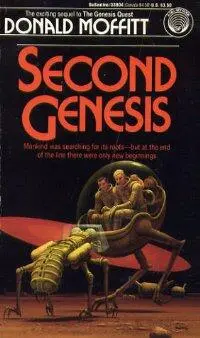
- Название:Second Genesis
- Автор:
- Издательство:Del Rey / Ballantine
- Жанр:
- Год:1986
- ISBN:0-345-33804-9
- Рейтинг книги:4 / 5. Голосов: 1
-
Избранное:Добавить в избранное
- Отзывы:
-
Ваша оценка:
Second Genesis: краткое содержание, описание и аннотация
Предлагаем к чтению аннотацию, описание, краткое содержание или предисловие (зависит от того, что написал сам автор книги «Second Genesis»). Если вы не нашли необходимую информацию о книге — напишите в комментариях, мы постараемся отыскать её.
Second Genesis — читать онлайн бесплатно полную книгу (весь текст) целиком
Ниже представлен текст книги, разбитый по страницам. Система сохранения места последней прочитанной страницы, позволяет с удобством читать онлайн бесплатно книгу «Second Genesis», без необходимости каждый раз заново искать на чём Вы остановились. Поставьте закладку, и сможете в любой момент перейти на страницу, на которой закончили чтение.
Интервал:
Закладка:
“They have the same general body plan as we do,” Ame said, “and the same major bones in the same places. But the arms are too short. The upper and lower leg bones are in the wrong proportion. The thumb opposes, but it’s the same length as the fingers. The cranial structures are wrong—the skull has about the same volume as ours, but it’s long rather than domed. And the dentition is very different.”
“And then there’s the tail,” Mim put in.
“Yes,” Ame said. “Evolution might have made many changes in man over a forty-million-year period, but surely it would not have given him back his tail.”
Bram chewed his lip. “It is possible, you know. There’s such a thing as back mutation or reversion. The mechanism isn’t well understood. But in this case you might envision it as the loss of a ‘switch-off’ gene that was an earlier mutation causing taillessness in some hominoid ancestor of man. The loss would leave the redundant tail genes that were still part of the DNA free to express themselves again.”
“You mean we could all grow tails again?” Mim said, wide-eyed. “I don’t think I’d like that!”
She cast a distinctly worried look at the short-armed, long-footed skeletons with their long whiplashes of added vertebrae.
Bram laughed. “It must have complicated their space-suit design, I’ll say that.”
“Oh, we’ve found an almost intact space suit,” Ame said. “The tail sheath was quite ingenious, with a whole series of little bleeder valves that allowed the tail to curl all the way around in a prehensile grip. Even in moderate gravity, they could have hung from their tails, leaving both hands free. We turned the suit over to one of the technology evaluation committees. You can see it on the upper balcony if you like.”
“Ame, how large a population of them was there?”
“It’s too early to answer that, but it must have been in the tens of thousands.”
“Too few to have filled this city, too many to have been just a scientific expedition. Ame, what were they doing here?”
“I can’t tell you that, either. We know that one of the things they were doing was exploring these ruins—just as we are. In fact, they’ve made our work a little easier. We’ve found at least one of their digs and its repository. They seem to have brought things up from a lower level one where the artifacts definitely were made for hands like ours—and they’ve arranged and cataloged their finds most conveniently.”
“Longfoot archaeologists.”
“Yes. They seem to have been just as interested in Original Man as we are. But the level of archaeological activity wasn’t high enough to explain their numbers. Otherwise, the whole place would have been dug up.”
“And yet they lived and died here.”
“For several generations, at least. We’ve found parts of children’s skeletons, too, and fetal bones along with the skeleton of one pregnant female. Bram -tsu, they gave birth to a dozen young at a time.”
“That doesn’t sound like human beings,” Mim said.
“No, not even after thirty million more years of evolution. But on the other hand, thirty million years before our line diverged from the hominids, our most probable direct ancestor was a small tree-dwelling animal called Aegyptopithecus. It was about the size of a Cuddly and looked something like a cat.” She halted. “Do you know what a cat was?”
“Yes. The little furry animals in the Goya painting.”
Ame nodded. “So you see, a lot can happen in thirty million years, even in the human line. Tail aside, the longfoots don’t seem that different from us.”
Bram said, “Ame, what were they?”
“We’re going to do some DNA studies and protein sequencing as soon as we can scrape together enough material. I’ll let you know.”
He got the answer to one of his questions a couple of Tendays later.
He was sitting in the cubbyhole he used as an office, going over Yggdrasil’s accounts—one of the more onerous chores he had to do as year-captain. Enyd had sent him an enormous stack of tally sheets—glucose balance; starch reserves; projected production of fats, oils, alcohol, and glycine over the next kiloday; currently available hydrogen and oxygen—and he was expected to okay the allocations today, if not yesterday.
The rasp of the intercom made him wince.
“I’ll get it!” Mim called. He heard her speak to someone, then she poked her head in and said, “That was Smeth from the trunk. The expedition’s just docked. Trist is on his way down now.”
“What’s his hurry? You’d think he’d want a little time to collapse first and get reacquainted with Nen. Or at least allow himself to be lionized for a few hours.”
Bram had been back on board Yggdrasil for only a few days himself; he’d left the disk city with the question of longfoot ancestry still unresolved. He’d had to plunge immediately into his accumulated paperwork and other duties, with no time to think about the matter further.
“Nen’s in surgery with Doc Pol,” Mim said. “Somebody managed to fall down a tracheid and smash an ankle. Trist prepared a preliminary report on the trip back. But he said he thought you’d want to know right away.”
“Know what?”
“That,” she said, “is what he’s on his way down to tell you.”
Trist arrived twenty minutes later; he must have been in free fall all the way. His yellow hair was disheveled, and he had a ripe space suit aroma—Lydis was still making her passengers suit up for drops and dockings—but he was full of unleashed energy, and his blue eyes, though rimmed with fatigue, sparkled.
He refused Mim’s offer of tea—a new custom instituted by Marg after she had read about it in some of the library material that had been brought up from the diskworld, subsequently experimenting with infusions brewed from Yggdrasil’s bark—and got right to the point.
“We did a thorough survey from space, of course,” he said. “Went as close to the hub as Lydis dared. Spotted over a hundred of the sites over a nine-hundred-billion-square-mile area. Some of the structures were still inflated after all this time; others were flat as corncakes. It was pretty obvious what they’d been up to. But we couldn’t be absolutely certain till we made a landing and deployed the climbers. We managed to visit four locations—brought back some goodies for the archaeologists, too.”
“And,” Bram said, knowing the answer, “what were they?”
“Camps,” Trist said promptly. “Work camps. They must have lived there deciyears at a time, repairing antenna elements, installing their own equipment to fill in the breaks.”
“They were trying to make the system operational again?”
“That’s the only conclusion that can be drawn.”
Bram leaned back and stared into space for a moment. “That would have been a tremendous undertaking, even with a work force of tens of thousands—or many times more than that, it may turn out. It would have meant committing themselves for generations.”
“They were willing to do that, apparently. Bram, can you imagine the conditions they must have endured in those inflatable camps? The ones closer to the horizontal gravity sectors were built out on scaffolding—with no place even to stand for kilodays, except for the tents and stringers. Dangling over eternity all that time while they worked. It wasn’t much better closer to the hub. Trying to adjust to the crazy angles, under heavy gravity with your weight tearing sideways at you. With the danger of falling with every step and an awareness of the penalties if you did. We didn’t set foot within ten million miles of some of the farther camps, and I can tell you, I still didn’t like it!”
Читать дальшеИнтервал:
Закладка:
Похожие книги на «Second Genesis»
Представляем Вашему вниманию похожие книги на «Second Genesis» списком для выбора. Мы отобрали схожую по названию и смыслу литературу в надежде предоставить читателям больше вариантов отыскать новые, интересные, ещё непрочитанные произведения.






Обсуждение, отзывы о книге «Second Genesis» и просто собственные мнения читателей. Оставьте ваши комментарии, напишите, что Вы думаете о произведении, его смысле или главных героях. Укажите что конкретно понравилось, а что нет, и почему Вы так считаете.