Donald Moffitt - Second Genesis
Здесь есть возможность читать онлайн «Donald Moffitt - Second Genesis» весь текст электронной книги совершенно бесплатно (целиком полную версию без сокращений). В некоторых случаях можно слушать аудио, скачать через торрент в формате fb2 и присутствует краткое содержание. Год выпуска: 1986, ISBN: 1986, Издательство: Del Rey / Ballantine, Жанр: Фантастика и фэнтези, на английском языке. Описание произведения, (предисловие) а так же отзывы посетителей доступны на портале библиотеки ЛибКат.
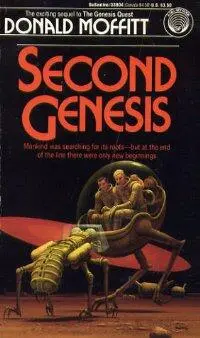
- Название:Second Genesis
- Автор:
- Издательство:Del Rey / Ballantine
- Жанр:
- Год:1986
- ISBN:0-345-33804-9
- Рейтинг книги:4 / 5. Голосов: 1
-
Избранное:Добавить в избранное
- Отзывы:
-
Ваша оценка:
Second Genesis: краткое содержание, описание и аннотация
Предлагаем к чтению аннотацию, описание, краткое содержание или предисловие (зависит от того, что написал сам автор книги «Second Genesis»). Если вы не нашли необходимую информацию о книге — напишите в комментариях, мы постараемся отыскать её.
Second Genesis — читать онлайн бесплатно полную книгу (весь текст) целиком
Ниже представлен текст книги, разбитый по страницам. Система сохранения места последней прочитанной страницы, позволяет с удобством читать онлайн бесплатно книгу «Second Genesis», без необходимости каждый раз заново искать на чём Вы остановились. Поставьте закладку, и сможете в любой момент перейти на страницу, на которой закончили чтение.
Интервал:
Закладка:
The star hung over the point of the horizon and winked out. Across the narrow plain, space-suited people eddied about, and groups began to break up. A few cautious Cuddlies popped up out of their holes.
“Show’s over,” Bram said.
Back inside a sports arena that buzzed and echoed with excited conversation, Bram and Jao conferred with Jun Davd and watched on their portable screen the images from Yggdrasil’s remote sensors.
“We were lucky,” Jun Davd’s distant voice said. “One of our orbiting cameras happened to be no more than a quarter million miles from where our visitor decided to park. We’ve moved it closer in the last hour, and we’re still closing.”
People kept poking their heads into the alcove where Bram and Jao had installed themselves. It would have been hard to jam more people into the area where people were crowding around for a look at the screen. Outside, on the rocky floor of the arena, a number of people had been foresighted enough to fetch their own personal viewscreens from their quarters and slave them to Bram’s circuit, and each of these had growing knots of watchers around it.
“They’re continuing to ignore us,” Jun Davd said. “Not a peep on any wavelength.”
Bram studied the fuzzy image. The lack of definition took away the regularities that would have labeled the ship an artificial shape and made it look like a life form. A life form with a long lumpy stem whose segments swelled where they fit into each other and a living jelly of bubbles to cap it. The nodules along the shaft fostered the notion.
For a moment Bram toyed with the idea. Yggdrasil was a living spaceship, after all. Why not this? What kind of life form would look like a budding stick, and what function would be served by the gob of bubbles at one end?
Then he dismissed the thought. The thing was a machine, after all—a relatively primitive machine that generated a howling storm of hydrogen-helium fusion and probably poisoned’ its inhabitants.
“We make it at approximately twenty miles long,” Jun Davd said. “It could alight in Yggdrasil’s branches and never be noticed, but it’s still an impressive achievement for a manufactured article.”
“What are they doing?” Bram said.
“Nothing, as far as we can tell. No extravehicle activity, no electromagnetic emissions. No attempt to reorient the axis of the ship as a preliminary to achieving some sort of rational orbit. They just appear to be waiting.”
“Waiting for what?” Jao rumbled. “They sit there like that, and eventually they’re going to drift off the rim and get sucked down the side. Then they’re going to have to turn on that torch of theirs and burn some more landscape.”
“Perhaps they don’t care,” Jun Davd said.
Bram was staring at the glob of bubbles. Overmagnification had blended them into an undifferentiated mass, but despite the bleared focus there was enough mottled shadowing for the eye to appreciate them as a clump of hundreds of separate spherules.
They were hollow, according to Jun Davd’s radar echoes. Empty fuel tanks, each a couple of thousand feet in diameter—big enough to hold millions of tons of frozen hydrogen in its different isotopic forms. And there would be a complex maze of piping to skim off the helium three as it became available and store that separately, too.
Tritium was biologically hazardous. It was hard to believe that the empty bubbles had been converted into environmental pods. Jun Davd’s imagination must have run away with him. Surely no people would be that reckless with their generations.
The vague mottling seemed to shift, showing one of the globules more distinctly.
“Do I see movement?” Bram said. “Or is that just image shimmer?”
Jao grabbed Bram’s arm. “No, it’s movement.”
As they watched, one of the bubbles detached itself from the foamlike cluster and drifted free. A fine mist spouted from it.
“Chemical jets,” Jun Davd said. “They’re matching velocity with the rim.”
A hum of voices rose in the surrounding bay. “Hold it down,” Jao thundered.
“You were right,” Bram told Jun Davd. “They moved into their empty fuel tanks. If that one held tritium, there must still be residual radiation. They’d have to be desperate for expansion room.”
“The original life-support system must have been confined to the budlike structures on the stem,” Jun Davd said. “But with the fuel tanks, they’d have a hundredfold the living space in reserve, becoming available as they spilled over.”
“What kind of intelligent race,” Bram said in dismay, “would breed that unrestrainedly, with no sureties at their destination?”
Ame pushed through the surrounding press of bodies. “The longfoots,” she said. “The females had a dozen young to a litter, remember? They’ve come back.”
“Or their successors have,” Bram said. “Whatever else the longfoots were, they were a thoughtful people. That ship doesn’t look like their technology.”
“Rise and fall, Bram -tsu, ” Ame said defensively. “Devolution and reradiation of species.”
On the screen, the separated globule fell with alarming speed toward the narrow rimscape. “That’s awfully big to be using as a lander, even on a low-gravity world,” Jun Davd said. “But that’s what they’re doing with it.”
“One mistake and they’ll be scattered all over the landscape,” Jao grunted.
Bram calculated spherical volume in his head. “There could be a population of thousands in that bubble. If all of the bubbles are inhabited…”
“These strangers must like to travel in large crowds and take their environment with them,” Jun Davd said. “That detachable habitat of theirs is big enough to qualify as a self-contained colony. The ship could drop more of them off here and there around the rim and leave them to fend for themselves. Then flit around the system and seed the other disks.”
“You talk as if that ship were a living organism.”
Jun Davd laughed. “If the surviving colonies grow up to build more ships like it, then it fits the definition.”
Trist’s voice cut in. “We’re getting message traffic now between the ship and the lander.”
“Radio? Laser?” Jao’s voice was impatient.
“Neither. They communicate by modulating polarized light—switching rapidly back and forth to different planes of polarization. We can’t read the signal, but it’s a signal, all right.”
“What kind of pattern? Binary, or what?”
“No, it’s positional. It codes for some kind of grid. And now that you know that, you know as little as I do.”
“Why would they modulate polarized light?” Bram asked. “If you’re going to communicate by light, there are easier ways to modulate it for a signal.”
It was Ame, unexpectedly, who answered. “Perhaps because it corresponds to their natural sensory input.”
“Now, Ame, we use radio mostly,” Jao said condescendingly. “But we don’t see by radio waves.”
“No,” she said, “but we use it the way we use visible light—by modulating its frequency. Or we use it by mimicking sound—by modulating the amplitude.”
Bram pondered Ame’s startling supposition. “But where does a positional grid come into it?”
“I don’t know, Bram -tsu. We use radio waves to build up pictures or sound. And when we use laser, we use it more or less as if it were just an improved kind of radio. It has something to do with the way they think or perceive things.”
“Trist, can you rig up something that’ll modulate polarized light?” Bram asked.
“Sure, nothing to it,” came Trist’s cheerful voice.
“Can you beam some of their own patterns back at them—just as a recognition signal? Just to get them to notice us.”
Читать дальшеИнтервал:
Закладка:
Похожие книги на «Second Genesis»
Представляем Вашему вниманию похожие книги на «Second Genesis» списком для выбора. Мы отобрали схожую по названию и смыслу литературу в надежде предоставить читателям больше вариантов отыскать новые, интересные, ещё непрочитанные произведения.








Обсуждение, отзывы о книге «Second Genesis» и просто собственные мнения читателей. Оставьте ваши комментарии, напишите, что Вы думаете о произведении, его смысле или главных героях. Укажите что конкретно понравилось, а что нет, и почему Вы так считаете.