Donald Moffitt - Second Genesis
Здесь есть возможность читать онлайн «Donald Moffitt - Second Genesis» весь текст электронной книги совершенно бесплатно (целиком полную версию без сокращений). В некоторых случаях можно слушать аудио, скачать через торрент в формате fb2 и присутствует краткое содержание. Год выпуска: 1986, ISBN: 1986, Издательство: Del Rey / Ballantine, Жанр: Фантастика и фэнтези, на английском языке. Описание произведения, (предисловие) а так же отзывы посетителей доступны на портале библиотеки ЛибКат.
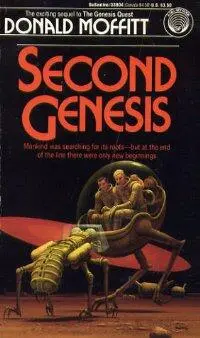
- Название:Second Genesis
- Автор:
- Издательство:Del Rey / Ballantine
- Жанр:
- Год:1986
- ISBN:0-345-33804-9
- Рейтинг книги:4 / 5. Голосов: 1
-
Избранное:Добавить в избранное
- Отзывы:
-
Ваша оценка:
Second Genesis: краткое содержание, описание и аннотация
Предлагаем к чтению аннотацию, описание, краткое содержание или предисловие (зависит от того, что написал сам автор книги «Second Genesis»). Если вы не нашли необходимую информацию о книге — напишите в комментариях, мы постараемся отыскать её.
Second Genesis — читать онлайн бесплатно полную книгу (весь текст) целиком
Ниже представлен текст книги, разбитый по страницам. Система сохранения места последней прочитанной страницы, позволяет с удобством читать онлайн бесплатно книгу «Second Genesis», без необходимости каждый раз заново искать на чём Вы остановились. Поставьте закладку, и сможете в любой момент перейти на страницу, на которой закончили чтение.
Интервал:
Закладка:
“I’ll get on it right away.”
“And get somebody working on that grid.”
“The chess club’s already taken it on as a project. So have the linguists.”
“Get them together.”
On the screen, the stick ship had moved out of the frame as Jun Davd’s remote camera followed the life-support module. It showed as a pale blob against a rim-scape that whizzed by at blurring speed.
“Looking for a spot to light,” Jun Davd said. “They had a choice of two directions. They chose yours.”
“How long before they get here?”
“At their present velocity? About two days.”
Two days later,’ the thing passed overhead, looking very large. Everybody was outside again for the passage. As it sailed by, everybody waved. A few energetic jumping jacks leaped straight up fifty feet or more, wigwagging with both hands. But the bubble took no notice. It receded into the distance, blank as an egg.
“They almost nicked one of the moonropes,” Jao said. “They’re flying much too close to the rim’s edge. And too low. The pilot’s a bit impetuous, isn’t he?”
Bram, sweating inside his helmet, hand-cranked the flywheel—mounted telescope to follow the enormous spheroid. The others crowded close to look at the photoplastic image in the visored plate at the end of the barrel.
“They’re losing speed and altitude fast,” Bram said. “They’re going to come down about two hundred miles farther on, it looks like. We’ll have them for neighbors.”
“The pilot’s braking too fast,” Jao said, squinting at the shaded image. “As if he made up his mind on the spur of the moment. Whoops! He changed his mind. He’s lifting up over that escarpment! Almost grazed it. He must be shaking up his passengers.”
Jao’s commentary may have been unjust. The huge globular object went into a long graceful glide, riding the plume of its jet, and set down with abrupt gentleness in the exact center of a flat circular feature where the plain was smooth.
“A seat-of-the-pants natural,” Bram said. “Like Lydis.”
“If he wears pants,” Jao said. “Or has a seat.”
Ame was looking thoughtful. “What do we do now, great-great-great-grandfather?”
Bram sighed. “I suppose we’d better pay them a visit.”
Everybody wanted to go. Bram fended them off as diplomatically as possible when they came barging into the bay where he was trying to work out a plan with Ame and Jao.
“The first meeting is going to be very important,” he told them over and over. “We’ll have just a few specialists, each with a job to do. We can’t take a crowd along.”
And then, of course, everybody tried to convince Bram that he or she was a specialist.
“As a sociometrician,” Silv Jaks said, getting strident, “my insight into the interrelationships of individuals will be invaluable.”
“We don’t even know if they’re human, Silv,” Bram said. “What we’re really after is a paleobiologlst.”
After she stalked out, Jao said, “That was nothing. One of the archaeologists insisted on being included because, he said, he could tell us a lot about them by studying their pottery.”
Ame wrinkled her nose. “It might not be a bad idea to take along someone from the Theoretical Anthropology group, though. It would give us some kind of benchmark for behaviors.”
“Who do you suggest?” Bram said.
“Heln Dunl-mak,” Ame said promptly. “She’s a sociobiologist. She worked with us to try to analyze longfoot society from physical clues. She’s even been studying the behavior of social insects from the old books and holos.”
“All right,” Bram said.
“And we’d better have Jorv.”
Bram hesitated. “He’s an awfully impulsive fellow. Establishing contact could be a delicate business.”
“He knows more about terrestrial life forms and their development than anybody we’ve got,” Ame said. “There’s his assistant, Harld, but…”
“I’ll keep an eye on him,” Jao said, twisting around from his console. He winked. “With a steady hand like me to keep him in line, there won’t be any trouble.”
Bram said, “I thought you’d stay here and—”
“What?” Jao gave a roar of outrage. “Who’s going to operate the equipment? I’ve rigged up a computer signboard. I’ve programmed it with an image library and everything.”
“All right, all right,” Bram said hastily. “I wish we had a linguist.”
“They’ve all gone back to the tree with their tons of books and micromedia in their own pet languages. What do we need a linguist for, anyway? Languages all either have a grammar more or less like Inglex, or they don’t, like Chin-pin-yin. And I remember my childhood Chin-pin-yin as well as anybody. And when it comes to nonhuman speech, all us old-timers have a smattering of the Small Language.” He squinted at Bram. “And one of us, if memory serves, even has a smattering of the Great Language.”
“There won’t be anything like that from any kind of terrestrial stock,” Bram said.
Jao turned back to his console. “Trist’s getting more radio traffic between the stick ship and that camp out yonder. Want to hear it?”
He turned up the volume, and a series of rapid, hard clicks came out of the speaker, like twenty people snapping their fingers as fast as they could.
“When did they switch from modulated polarized light to radio?” Ame asked.
“At about half a million miles. But Trist’s analyzed the signals. He thinks they simply reproduce the patterns of the polarized light version—same positional code on a grid. He still hasn’t figured out how the grid is organized, though. One thing’s for sure—it isn’t any simple up-and-down-and-across raster. Trist thinks it’s irregular.” Jao looked troubled. “But that’s crazy.”
Bram listened to the snapping sounds for a while. “Maybe their receiving equipment is better than my ear,” he said, “but it sounds as if those noises are coming on. top of each other—overlapping. How can they extract an information-beating signal out of that?”
“Trist’s taken the signals apart. He says he thinks they’re organically produced.”
Ame scrunched up her features. “It’s a language, then. A language where sounds have visual coordinates.”
“I don’t understand,” Bram said.
“Bram -tsu, our group’s done a lot of work on sensory impressions and perception,” Ame said. “Back during the years when we were trying to build up the new sciences. Doc Pol helped us with the medical aspects.”
“That old curmudgeon!” Jao exclaimed. “I thought he didn’t believe in anything he couldn’t tap, prod, or take a urine sample from.”
“He says polysenses are very common among human beings—much commoner than is believed. People who hear sounds as smells, for example, or who taste colors.”
“Crossed wires,” Bram said.
“No, it isn’t just that. It’s normal in all of us to some extent.”
Bram thought it over. “Like Edard reading an orchestral score and hearing the music.”
“Something like that.”
“Or Mim swearing that different keys have different textures—G-major being hard and brittle, D-flat soft and velvety. She had an argument with Ang about it. Ang said the only difference between keys is that they’re higher or lower.”
“Colors!” Jao said suddenly. “Numbers have different. colors. That’s how I remember them. Equations transform the colors. I thought everybody saw numbers that way.”
“Drugs will induce that kind of cross talk sometimes,” Ame said. “Your nervous system just happens to work that way naturally.”
Jao grinned. “Hey, Ame, what if you see flashing lights when you bump your elbow?”
Читать дальшеИнтервал:
Закладка:
Похожие книги на «Second Genesis»
Представляем Вашему вниманию похожие книги на «Second Genesis» списком для выбора. Мы отобрали схожую по названию и смыслу литературу в надежде предоставить читателям больше вариантов отыскать новые, интересные, ещё непрочитанные произведения.







Обсуждение, отзывы о книге «Second Genesis» и просто собственные мнения читателей. Оставьте ваши комментарии, напишите, что Вы думаете о произведении, его смысле или главных героях. Укажите что конкретно понравилось, а что нет, и почему Вы так считаете.