Robert Reed - Marrow
Здесь есть возможность читать онлайн «Robert Reed - Marrow» весь текст электронной книги совершенно бесплатно (целиком полную версию без сокращений). В некоторых случаях можно слушать аудио, скачать через торрент в формате fb2 и присутствует краткое содержание. Год выпуска: 2000, ISBN: 2000, Издательство: Tor Books, Жанр: Фантастика и фэнтези, на английском языке. Описание произведения, (предисловие) а так же отзывы посетителей доступны на портале библиотеки ЛибКат.
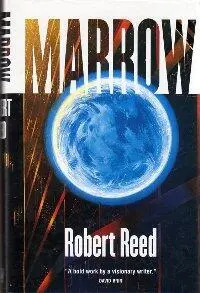
- Название:Marrow
- Автор:
- Издательство:Tor Books
- Жанр:
- Год:2000
- ISBN:0-312-86801-4
- Рейтинг книги:5 / 5. Голосов: 1
-
Избранное:Добавить в избранное
- Отзывы:
-
Ваша оценка:
Marrow: краткое содержание, описание и аннотация
Предлагаем к чтению аннотацию, описание, краткое содержание или предисловие (зависит от того, что написал сам автор книги «Marrow»). Если вы не нашли необходимую информацию о книге — напишите в комментариях, мы постараемся отыскать её.
Marrow — читать онлайн бесплатно полную книгу (весь текст) целиком
Ниже представлен текст книги, разбитый по страницам. Система сохранения места последней прочитанной страницы, позволяет с удобством читать онлайн бесплатно книгу «Marrow», без необходимости каждый раз заново искать на чём Вы остановились. Поставьте закладку, и сможете в любой момент перейти на страницу, на которой закончили чтение.
Интервал:
Закладка:
A sound followed after the motion. There was a low, low roar that came sweeping from above, racing down the avenue and passing deeper into the ship.
Washen feigned surprise.
Pamir did it better. He straightened his back and looked at the woman officer, and with a voice edging into terror, he asked, “What the fuck was that?”
She didn’t know.
For a long moment, the five Waywards were as lost as anyone. Then Washen offered the obvious explanation. “It was an impact.” She looked at her companions, telling them, “It was a comet. We’re closing on that next star and black hole… it must have been one of their comets hitting us…”
Word spread through the cafe, merging with the same explanation as it was generated up and down the long avenue.
The Wayward was trying to believe Washen. But then she heard a general announcement coming through an implanted nexus, explaining enough that she winced as if in pain, and she growled under her breath, then turned to her companions and announced, “One of the engines… has failed…”
Then she seemed to realize that she shouldn’t have spoken so freely. A conjured smile framed her next words. “But everything is very much under control,” she told everyone, her expression and tone saying the precise opposite.
Human faces looked wounded, or they laughed with a giddy nervousness. Aliens digested the news with everything from calmness to a pheromonal scream, the cafe’s air suddenly thick with odd stinks and piercing, indigestible sounds.
Another message was delivered on a secure channel. The woman tilted her head, paying rapt attention. Then to her team, she shouted, “With me. Now!”
The five Waywards ran, pushing into a full sprint.
If anything, that made the panic worse. Patrons began searching through official news services as well as the rumor oceans, holo projections covering tabletops and slick granite floor and dancing in the air. One of the ship’s two firing engines had fallen into a premature sleep. Nothing else was certain. A thousand self-labeled experts promised that no combination of mistakes could cause a malfunction, certainly nothing this catastrophic. Again and again, voices mentioned the pointed word, “Sabotage.”
Within three minutes, sixty-five individuals and ghostly organizations had claimed responsibility for this tragedy.
Washen gave Pamir a brief look.
He did nothing. Then after a few moments, he announced, “We need to be leaving,” as he rose to his feet. Looking up the avenue, he seemed to be deciding on their route to the next hiding place. Then he said, “This way,” and took the harum-scarum under its spiked elbow, coaxing it along.
Perpendicular to the avenue was a narrow, half-lit tunnel.
Pamir and the false alien were walking side by side, passing through a demon door into a thicker, warmer atmosphere. Where the tunnel bent to the right, a figure appeared, small and running hard, the black of the uniform making it blend into the gloom.
There wasn’t space for three bodies.
The collision was abrupt and violent, and utterly one-sided. The security officer found himself on his back, gazing up at an unreadable alien face.
Pamir started to kneel, started to say, “My apologies.”
He was offering the officer a big hand.
The Wayward gave a low, wild scream. And that’s when the rest of his squad appeared, rounding the turn to find one of their own apparently being assaulted. Weapons were deployed. Curt warnings were shouted. The loudest Wayward told everyone, “Stand back!”
The harum-scarum kept true to its nature.
“I stand here,” he rumbled. “You stand there.”
A kinetic round entered the neck, obliterating flesh and ceramic bones, nothing vital damaged and the automation barely wavering, long hands thrust up against the ceiling while the translation box cried out:
“No no no no!”
In a wild panic, every Wayward fired on the monster.
The head dropped backward, riding a hinge of leather, and the legs were dissolved with lasers, the great body dropping hard onto its stumplike knees. Then an explosive round cut into the body itself, exposing a human tied into a secret bundle, wrapped inside a transparent silicone envelope.
Locke stared out at the armed officers. His expression was simple. A pure withering terror had taken hold of him, the surprise total and dismantling.
Standing nearby, Washen saw his enormous eyes and little else.
Every weapon was pointed at him. There was a slippery instant when everything was possible, and maybe they would set down their lasers and free him. Maybe. But then Washen threw herself toward her son, screaming, “No-!”
They fired.
What Locke would see last was his mother trying to cover him with her inadequate body, and then a purple brilliance stretching on forever.
Forty-two
A chain of tiny, almost delicate explosions had smashed valves and pumping stations. No target was vital. The Great Ship was nothing but redundancies built on sturdy redundancies. But the cumulative effects were catastrophic: a lake of pressurized hydrogen gathered in the worst possible place, and a final sabotage caused a magnetic bottle to fail, a mirroring mass of metallic anti-hydrogen dropping into the sudden lake, the resulting blast excavating a plasma-filled wound better than twelve kilometers across.
The vast rocket coughed, then stopped firing.
Within seconds, security forces were on full alert, gathering at predetermined disaster-management stations.
Within minutes, using lasers and hyperfiber teeth, a scuttlebug worked its way through the thinnest part of the slag, a spare head shoved out into the open, its mouth blistered by the residual plasmas and the eyes seeing a rainbow of hard radiations.
Miocene saw nothing but the rainbow. Then she closed that set of eyes and opened her own, seeing her son’s hard gaze. And with a calmly low voice, she said, “It’s nothing.”
She told Till, and herself, “It’s just an inconvenience.”
Then before he could respond, she assured both of them, “Our burn resumes in seven minutes. Using backup pumps, and at full strength. I’ll extend the burn to allow for the delay, and the ship will be back on course.”
He had assumed as much. With a heavy shake of the head, he asked, “Who?”
What she knew, she told.
He repeated the critical word. “Remoras,” he said, a painful disappointment wrapped around it. Then, “Which ones? Can we tell?”
Miocene fed him compressed gouts of data, including coded transmissions and visual images culled from distant security eyes. The presumption of guilt was just that. Nothing was perfectly incriminating. But the innocent break-down of the skimmer was too perfect to be believed. She admitted as much, then concluded with the cold, perfectly honest comment, “I’ve never particularly trusted Remoras.”
Between them, Till showed less emotion.
“Our enemies,” he said calmly. “Where are they now?”
A replacement skimmer had rendezvoused with the Remora crew, then continued out onto the ship’s leading face. “I’ve ordered its capture,” Miocene mentioned. “But my sense is that they won’t be on board.”
Her son agreed, seeing the best alternative. “The disabled skimmer—”
“Was towed back to the city.”
Till was silent for a long moment.
Through a security nexus, Miocene felt a ripple, a tremor, and her breathing quit abruptly. “Did you—” she began.
“Wouldn’t you?” was his response.
Before Miocene could offer her opinion, he assured her, “We’ll use a minimum of five-person teams. And they’ll only search for that one crew. Isn’t that the reasonable course?”
“Reasonable or rash,” she answered, “it’s the Master’s responsibility. Which means that it’s my decision to make.” Till sighed heavily, then forced a wide smile. “Make it,” he coaxed.
Читать дальшеИнтервал:
Закладка:
Похожие книги на «Marrow»
Представляем Вашему вниманию похожие книги на «Marrow» списком для выбора. Мы отобрали схожую по названию и смыслу литературу в надежде предоставить читателям больше вариантов отыскать новые, интересные, ещё непрочитанные произведения.








Обсуждение, отзывы о книге «Marrow» и просто собственные мнения читателей. Оставьте ваши комментарии, напишите, что Вы думаете о произведении, его смысле или главных героях. Укажите что конкретно понравилось, а что нет, и почему Вы так считаете.